Productivity System: Build Leverage, Not a To-Do List
A list tells you what is open. A productivity system tells you what matters today, and gets more of the work done without you.
Most people who search for a productivity system already have one. It is called a to-do list. It lives in three apps and a notebook, and it grows faster than it shrinks.
That is not a failure of discipline. It is a design problem. A list collects everything that asks for your attention, and it has no opinion about which item moves your year forward. So the loudest item wins. You clear twelve small things, and the one thing that mattered waits for next week.
I build Gaapp in about an hour a day. With that little time, a list does not just slow you down. It eats the hour. The hour needs a structure that answers one question before it starts: what is the one step that moves the goal today?
This article lays out that structure. Five layers, from one yearly goal down to today's step, plus the two layers most systems skip: leverage and review. You can set it up in one evening and run it in about ten minutes a day.
Key takeaways
- A productivity system is not a better list. It is a chain from one goal down to today's step, plus a review that keeps the chain honest.
- Specific, difficult goals beat "do your best" (Locke and Latham, 2002). If-then plans had a medium to large effect on reaching goals across 94 tests (Gollwitzer and Sheeran, 2006).
- The layer most systems miss is leverage: write down what repeats, let software run it, and keep a human check where mistakes are expensive.
What a productivity system actually is
A productivity system is a set of rules that decides, ahead of time, what you work on, when, and how you know it worked. The tools are secondary. A notebook can run a good system. An expensive app can run a bad one.
Every working personal productivity system has three parts:
- A direction. Something that says what matters this year, so you can say no to the rest.
- A rule for today. A way to turn the direction into one concrete action you can start in the next five minutes.
- A feedback loop. A fixed moment where you look at what happened and adjust.
A to-do list only has the second part, and only half of it. It holds actions, but it does not rank them against anything. That is why lists keep busy people busy. They reward clearing items, not moving goals.
What is a productivity system? A productivity system is a repeatable way to decide what to work on and to check whether it worked. A good one connects a long-term goal to a daily action and includes a regular review. Methods like GTD, Pomodoro or time blocking are parts you plug into a system, not the system itself.
Why most productivity systems fail
Most productivity systems do not fail because people are lazy. They fail in one of four predictable places.
No goal at the top. If the system starts with tasks, every task looks equally valid. Goal research has been clear on this for decades. In their review of 35 years of studies, Edwin Locke and Gary Latham found that specific, difficult goals led to higher performance than telling people to do their best. A vague goal lets you define success after the fact. "Get fit" is not a goal. "Run 10 kilometers in under 55 minutes by June 30" is.
No path from the goal to today. A big goal with no breakdown is a wish with a deadline. The gap between "this year" and "this morning" is too wide to cross by willpower. You need rungs in between, or the goal stays on a vision board while the list runs your day.
Capture without decisions. Many systems are excellent at collecting. Every idea, link and request lands in an inbox. But collecting is not deciding. An inbox with 400 items feels productive to build and terrible to open. The Zeigarnik effect article shows why a plan for an open task, not the task itself, is what quiets the mind.
No review. Without a fixed moment to look back, the system drifts. Old projects stay on the list, new ones get added, and after six weeks nobody trusts it. Then you start over with a new app, which feels like progress and is not.
The common root: the system is built around tasks instead of around a goal. Fix that, and most of the rest gets easier.
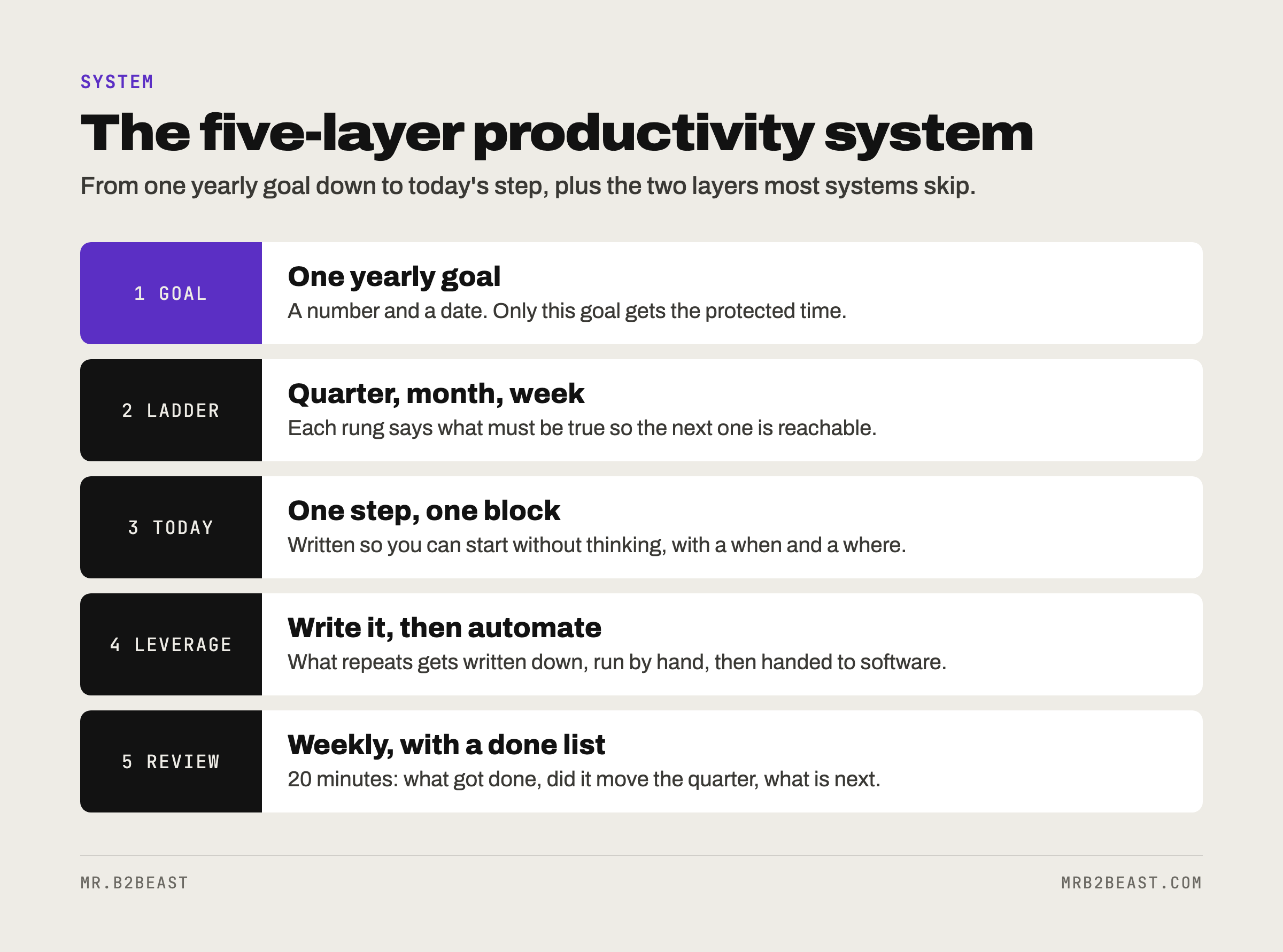
The five-layer productivity system
Here is the structure. It works on paper, in a notes app or in a dedicated tool. The point is the order, not the software.
Layer 1: One yearly goal
Pick one goal for the year. One, not five. You can have other things going on, but only one gets the protected time.
Make it specific enough that a stranger could check whether you hit it: a number and a date. If you cannot measure it, you cannot break it down, and the next layer will not work.
This is the hardest layer, because choosing one goal means not choosing the others. That is the point. The guide to yearly planning goes deeper into how to pick it.
Layer 2: The ladder from year to today
Now break the goal down: quarter, month, week, today. Each rung answers one question. What has to be true by the end of this period so the next rung is reachable?
The quarter does most of the work. A year is too far away to feel urgent. A week is too short to show real progress. Twelve weeks is close enough to create pressure and long enough to finish something. The article on quarterly goals covers the evidence: in a classic experiment, a far goal produced about the same result as no goal at all, while a near goal did not.
This ladder is the idea Gaapp is built on: one yearly goal, broken down to quarter, month, week and the step for today, because to-do lists keep busy people busy. You do not need an app for it. Five lines in a notebook work:
- Year: the goal, with a number and a date.
- Quarter: the milestone that makes the year likely.
- Month: the piece of that milestone you finish this month.
- Week: two or three outcomes for this week.
- Today: one step.
Layer 3: Today's step in one protected block
Every morning, the ladder gives you one step. Not a list of eight. One step that moves this week's outcome, written so specifically that you can start without thinking. "Work on the newsletter" is a topic. "Write the subject line and the first three paragraphs of Tuesday's issue" is a step.
Then give that step a time and a place. This is one of the best-supported moves in goal research. Peter Gollwitzer and Paschal Sheeran pooled 94 independent tests of if-then plans, where people decide in advance "when situation X happens, I will do Y". The plans had a medium to large effect on reaching goals (d = 0.65). The plan does not add motivation. It removes the moment where you decide whether to start.
A simple version: "When I sit down at the desk, I open only the file for today's step." One block, one context. The context switching article shows the real cost of jumping between tasks: part of your attention stays behind on the last one.
The other tasks still exist. Email, admin, small requests. They get their own time after the block, not instead of it. Deciding which of them goes first is a separate skill, covered in how to prioritize tasks.
Layer 4: Leverage
This is the layer most productivity systems skip, and it is the one that compounds.
Leverage means the work keeps happening when you are not there. Every layer above still depends on you doing the step. Leverage asks a different question: which of my weekly tasks repeat in the same way, and could they run without me?
The order matters. First write the process down. Then run it by hand until it is clean. Only then hand it to software. The article on AI workflow automation shows why: a written checklist only helped where people actually used it, and automation copies whatever process you give it, good or broken.
Here is what that looks like in my setup today:
- Since 2026-10-19, an agent (Claude Code, running headless on a schedule on my own Hetzner server) writes my X posts 10 to 14 days ahead. A second agent checks them. I approve nothing in advance and only stop what I do not like, via Telegram.
- Since 2026-10-08, every new article on this site goes out as an X post automatically.
- Since 2026-10-20, an agent writes the newsletter on Mondays and schedules it for Tuesday at 15:00 Berlin time. The welcome mail goes out automatically after someone confirms.
None of that replaced the goal or the daily step. It freed time for them.
Leverage has an honest cost: it fails quietly. Three weekly recap posts from 2026-10-16 to 2026-10-18 had unfilled placeholders instead of numbers and post references. They stayed as drafts and never went out. In the first batch of 24 posts on 2026-10-19, the checking agent rejected nothing. That is why I keep a veto, and why some things I never automate: replies under other people's posts, follows other than follow-backs, reposts, and emails to individual people.
The rule: automate what is frequent, written down and cheap to get wrong. Keep a human where a mistake costs trust. The piece on the AI operating system shows the whole setup as an org chart: who writes, who checks, who stops.
Layer 5: A weekly review with a done list
Once a week, 20 minutes. Same day, same time. Three questions:
- What got done this week? Write it as a list, not as a feeling.
- Did the week move the quarter? If not, what got in the way?
- What is the one outcome for next week?
The first question matters more than it looks. In the diary research covered in the progress principle article, progress on meaningful work was the strongest driver of a good workday, and setbacks hit two to three times harder than progress. A to-do list shows you only what is still open. A done list shows what moved. Same week, different story, different energy on Monday.
The review is also where you prune. Anything that has sat on the list for three weeks gets a decision: do it this week, schedule it, or delete it. GTD calls this step "reflect". It is the moment the system earns your trust again.
How a productivity system fits into one hour a day
Gaapp gets about an hour a day. When time is that short, the layers have to behave differently. The daily levers for a short hour, like picking tomorrow's step before you stop, are in how to be more productive. Here is what changes in the system itself.

Overflow stays inside the goal. If the step is done early, pull in the next step from the same week. Not something from another project, and not the inbox. Otherwise the hour quietly turns into admin time.
Repetition moves to layer 4. Anything you do the same way every week is a candidate to leave the hour: posting, scheduling, drafts, reports. The hour stays for the work only a person can do: deciding what to build next and building it.
The review covers the automation too. The expensive mistake is not a bad plan. It is assuming automated work checks itself. The placeholders above are the proof. If software runs part of your system, the weekly review looks at its output as well.
What this does not prove: that the system makes anyone faster than a person with a good list and a free calendar. If you have eight open hours a day and one project, a list might be enough. A system earns its keep when time is scarce and projects compete for it.
Popular productivity systems and where they fit
You do not have to throw away the methods you know. Most of them are good parts for one layer. They fail when one part is treated as the whole system.
| Method | What it is | Layer it fits | What it lacks alone |
|---|---|---|---|
| Getting Things Done (GTD) | David Allen's five steps: capture, clarify, organize, reflect, engage | Capture and review | A goal at the top. GTD manages everything that has your attention. It does not choose what matters |
| Pomodoro Technique | Francesco Cirillo's timer method from the 1980s, typically 25 minutes of work and a short break | Layer 3, the protected block | Any opinion on what to work on |
| Eisenhower matrix | Sort tasks by urgent and important, named after a 1954 remark Eisenhower credited to a former college president | Triage of everything outside the block | A link to a yearly goal |
| Time blocking | Give each task a fixed slot in the calendar | Layer 3 | Protection against filling the blocks with busywork |
| OKRs and the 12 week year | Measurable goals on a quarterly rhythm | Layers 1 and 2 | A rule for today |
| Kanban | Cards moving across columns, with a limit on work in progress | Week and day | Direction, unless the board is filtered by the goal |
The pattern is the same every time. Each method fixes one part. Stack them in the right order and you get a system. Use one alone and you get a well-organized list.
How to set up your personal productivity system this week
You can build the whole thing in one evening and refine it over two weeks.
- Evening one, 45 minutes. Write your one yearly goal with a number and a date. Fill the ladder: quarter, month, this week. Put tomorrow's single step at the bottom.
- Every morning, 5 minutes. Read the step. Write the if-then plan: when and where you start. Do the block before email.
- Every evening, 5 minutes. Write down what got done. Pick tomorrow's step from this week's outcomes.
- End of week one, 20 minutes. Run the review. Prune the list. Note which task you did three times the same way.
- End of week two. Write that repeating task down as a checklist. Run it by hand twice. If it stays the same, look for a way to automate it. That is your first piece of leverage.
Start small on purpose. A system you run for 12 weeks beats a perfect one you abandon after 10 days.
When a productivity system will not help
Honest limits, because structure is not a cure:
- If the goal is wrong, the system makes you faster in the wrong direction. The review only catches this if you ask whether the goal still makes sense, not just whether you hit the week.
- If your calendar is not yours, the protected block will lose. Then the first job is winning back one block a day, before any method.
- If you are exhausted, structure does not create energy. The companion piece on how to be more productive is about doing less on purpose, which is often the better first move.
FAQ
What is the best productivity system? The best productivity system is the one that links your yearly goal to today's step and that you still use after 12 weeks. GTD, Pomodoro and OKRs are strong parts, but none covers goal, daily action, leverage and review on its own. Combine them in that order.
What is a personal productivity system? A personal productivity system is your own set of rules for deciding what to work on, when, and how you check it. It usually includes one goal, a breakdown to the week, a daily step, a protected time block and a weekly review. It can live on paper or in any app.
What are three examples of productivity software? Most setups use three kinds: a calendar for time blocks, a task manager for the ladder and the daily step, and a notes app for capture and the review. The category matters more than the brand. One tool that holds the ladder beats five tools nobody reviews.
What are the top productivity strategies? The strategies with the strongest support are specific, difficult goals instead of "do your best", if-then plans for when and where you start, one task at a time instead of switching, short deadlines, and tracking progress with a regular review. Most popular methods are versions of these five.
How is a productivity system different from productivity tips? Tips are single moves, like a timer or a shorter list. A system decides which moves you use and connects them to a goal. If you want the daily levers rather than the structure, read how to be more productive without doing more.
About the author
Tristan Eilenburg. One person. AI systems. Global reach. I write about building systems that work, with evidence instead of hype.
- X: @MrB2Beast
- LinkedIn: Tristan Eilenburg
- Instagram: @mrb2beast
The newsletter goes out once a week. If this one taught you something, the newsletter is where the next one lands first.
Sources
- Locke, E. A., and Latham, G. P. (2002). Building a practically useful theory of goal setting and task motivation: A 35-year odyssey. American Psychologist, 57(9), 705-717. https://doi.org/10.1037/0003-066X.57.9.705
- Gollwitzer, P. M., and Sheeran, P. (2006). Implementation intentions and goal achievement: A meta-analysis of effects and processes. Advances in Experimental Social Psychology, 38, 69-119. https://doi.org/10.1016/S0065-2601(06)38002-1
- David Allen Company. What is GTD? The five steps. https://gettingthingsdone.com/fivesteps/
- Cirillo, F. (2018). The Pomodoro Technique. Currency, Penguin Random House. https://www.penguinrandomhouse.com/books/555557/the-pomodoro-technique-by-francesco-cirillo/
- Quote Investigator (2014). What is important is seldom urgent and what is urgent is seldom important. https://quoteinvestigator.com/2014/05/09/urgent/