How to Prioritize Tasks When Everything Feels Urgent
Ten prioritization methods all need the same missing piece. Here is the one question that supplies it.

Most advice on how to prioritize tasks hands you a menu. The Eisenhower Matrix. ABCDE. The 1-3-5 rule. MoSCoW. Eat the frog. Pick one, sort your list, feel organized.
Then Monday arrives, everything is marked urgent, and the matrix has four full boxes.
The methods are not wrong. They all ask you to judge what is "important." None of them tells you important for what. That is the part you have to bring, and most people skip it because the list is already on fire.
I give my own product, Gaapp, about one hour a day. One hour does not fit ten priorities. It fits one step. That constraint is the whole argument of this article: before any method, ask one question.
This article covers why urgent work wins even when it should not, what the popular frameworks actually do, and a five-step filter you can run on today's list.
Key takeaways
- In five experiments, people picked tasks with worse payoffs just because those tasks looked urgent (Zhu, Yang and Hsee, 2018).
- Every prioritization framework needs a definition of "important." Without one goal behind it, the sorting is guesswork.
- Ask one question of every task: does this move my goal forward this week? Then cut, defer or hand off the rest.
Why urgent tasks win even when they should not
If everything feels urgent, you are not imagining a personal flaw. Urgency pulls on everyone.
In 2018, Meng Zhu, Yang Yang and Christopher Hsee published "The Mere Urgency Effect" in the Journal of Consumer Research. Across five experiments, people more often chose tasks with lower payoffs over tasks with better payoffs when the worse tasks merely seemed urgent, for example because of a short completion window. The authors describe it as people behaving as if an urgent task has its own appeal, separate from what it actually delivers.
That is the trap in one sentence. A short deadline feels like a reason. It is not one.
The idea is older than the research. In 1954, Dwight D. Eisenhower gave a speech at Northwestern University and quoted a former college president who split problems into urgent and important ones. The line, as recorded: "The urgent are not important, and the important are never urgent." Eisenhower did not claim it as his own, but the matrix named after him is built on the idea.
So the problem is not that you lack a method. The problem is that urgency is loud and importance is quiet, and a method cannot hear the quiet one unless you tell it what to listen for.
Prioritization techniques, explained in one paragraph each
Here are the prioritization frameworks you will meet most often. Each one is useful. Each one has the same gap.
The Eisenhower Matrix
Sort every task into four boxes: urgent and important (do now), important but not urgent (schedule), urgent but not important (hand off), neither (drop). It is the most popular of all prioritization techniques because it is fast. Its weak spot is the word "important." When everything feels important, you get four crowded boxes.
The ABCDE method (the five priority levels)
Brian Tracy describes this in "Eat That Frog!" You give each task a letter. A means serious consequences if skipped. B means mild consequences. C is nice to do. D gets delegated. E gets eliminated. You never touch a B while an A is open. This is the most common answer to "what are the five priority levels for tasks." It works well, as long as you can tell what "serious consequences" means for you.
The 1-3-5 rule
Alex Cavoulacos of The Muse popularized this daily limit: one big thing, three medium things, five small things. Nine items, no more. It is a good cap on ambition. It does not tell you which item deserves to be the big one.
The four (or five) D's
Do, defer, delegate, delete. Some versions add a fifth D, often "diminish," meaning you shrink the task before you do it. Sources do not agree on the fifth, which tells you something: the useful part is the first four, and they map straight onto the Eisenhower boxes.
In short: every method sorts. None of them decides what the sorting is for.
How to prioritize when everything is important: the missing anchor
Importance only exists relative to a goal. "Write the proposal" is important if the proposal serves the outcome you care about this year. If it does not, it is just a task with a deadline.
That is why the classic advice to "define your big rocks first" holds up. Most guides still hand you a matrix right after, and the matrix is where people get lost again.
The alternative: one yearly goal, broken down to the quarter, the month, the week and the step for today. That chain is the idea Gaapp is built on. Once the chain exists, prioritization stops being a ranking exercise. It becomes a yes or no question.
If you do not have that chain yet, build it first. Picking the goal is covered in yearly planning, the quarter in quarterly goals, and the full setup around it in the productivity system article.
The One-Question Filter: how to prioritize tasks in five steps
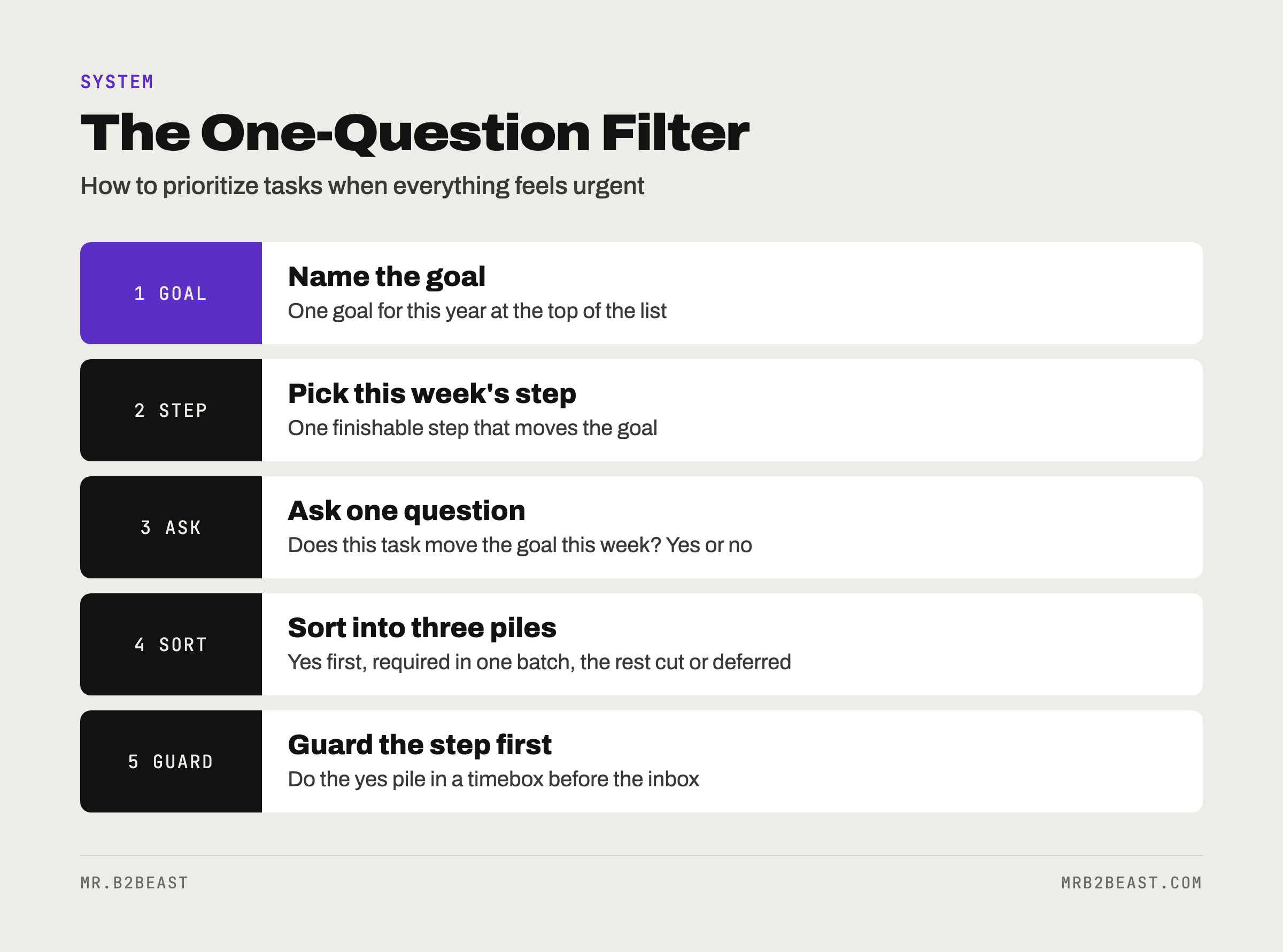
Step 1: Name the goal. Write your one goal for this year at the top of the list. One, not three. If you cannot pick, use the goal for this quarter instead.
Step 2: Pick this week's step. What is the single step that moves the goal forward this week? Make it finishable. "Ship the signup page" is a step. "Work on growth" is not.
Step 3: Ask one question of every task. Go down the list and ask: does this move my goal forward this week? Answer yes or no. No "kind of." This takes about as long as reading the list.
Step 4: Sort into three piles.
- Yes: these go first, inside a fixed block of time.
- No, but required: taxes, admin, the reply your landlord needs. Batch them into one slot so they stop leaking into the day.
- No: delete it, defer it to a dated review, or hand it off. This is where the four D's finally earn their place.
Step 5: Guard the step first. Do the yes pile before the inbox. A timebox helps here. The research on Parkinson's law shows that tight limits speed work up, and longer limits make tasks look bigger than they are.
That is the whole filter. It is deliberately boring. The value is that it takes the decision away from whatever is loudest.
An example
A freelance designer has one goal for the year: three retainer clients. Her Monday list has 14 items. Six are client revisions due this week, four are admin, two are "update portfolio," one is a podcast invite, one is a pitch to a past client.
Run the question. The pitch moves the goal. So does the portfolio update, because the pitch links to it. The revisions are required, so they get batched into two afternoon slots. The podcast invite does not move the goal this week, so it gets a polite "next quarter." Admin goes into one Friday hour.
Her list did not get shorter. Her first two hours did.
Three mistakes that keep everything urgent
Mistake 1: Ranking instead of choosing
Ranking 14 tasks from 1 to 14 feels rigorous. It also hides the real question, because number 4 and number 5 get the same attention as number 1. Choosing one step and protecting it beats a perfect ranking.
Mistake 2: Trusting the time estimate
You will think the important task takes two hours. It will take five. The planning fallacy research shows that even people's worst-case estimates run late. Plan from how long similar tasks took last time, then block that much.
Mistake 3: Switching all day
Prioritizing in the morning does not help if you answer every ping by 10:00. Each switch leaves part of your attention on the last task. The article on context switching covers what that really costs. Batch the required pile so the yes pile gets clean time.
When this filter does not work
Honest limits.
If your job is reactive by design, like support or on-call work, urgent requests are the job. The filter applies only to the part of the week you control. Find that part and protect it.
If you have no goal at all, the question has nothing to point at. Do not fake one. Pick a goal for the next 90 days and test it.
If your team sets the priorities, the filter becomes a conversation. Bring your goal and ask which step your manager would cut first. That beats silently ranking their list.
And the filter tells you what to do next. It does not show you what actually happened this week. For that, keep a done list next to it. One looks forward, the other looks back.
FAQ
What are the 5 priority levels for tasks? The most common version is Brian Tracy's ABCDE method. A tasks have serious consequences if skipped, B tasks mild ones, C tasks none. D tasks get delegated and E tasks get eliminated. You finish every A before you start a B.
What is the 1-3-5 rule for prioritizing tasks? The 1-3-5 rule, popularized by Alex Cavoulacos of The Muse, limits your day to one big task, three medium tasks and five small ones. It caps the list at nine items so you plan for what fits. It works best when the one big task is the step that moves your main goal.
Is prioritization an ADHD issue? The US National Institute of Mental Health lists trouble staying organized as a sign of inattention in adults with ADHD, and poor time management and planning as common problems. But struggling to prioritize is common and does not mean you have ADHD. If it affects your work or life badly, talk to a doctor. A filter like this one is a tool, not a treatment.
What are the five D's of prioritization? The core four are do, defer, delegate and delete. Sources disagree on the fifth; a common one is diminish, which means shrinking a task before you start it. The four D's map closely onto the four boxes of the Eisenhower Matrix.
What is the best way to prioritize tasks? Start from one goal, not from the list. Pick the one step that moves that goal this week, ask of every task whether it moves the goal, and do the yes tasks first in a fixed block. Batch required admin and cut or defer the rest.
About the author
Tristan Eilenburg. One person. AI systems. Global reach. I write about building systems that work, with evidence instead of hype.
- X: @MrB2Beast
- LinkedIn: Tristan Eilenburg
- Instagram: @mrb2beast
The newsletter goes out once a week. If this one taught you something, the newsletter is where the next one lands first.
Sources
- Zhu, M., Yang, Y., and Hsee, C. K. (2018). The mere urgency effect. Journal of Consumer Research, 45(3), 673-690. https://academic.oup.com/jcr/article/45/3/673/4932125
- Quote Investigator (2014, May 9). What is important is seldom urgent and what is urgent is seldom important. https://quoteinvestigator.com/2014/05/09/urgent/
- Tracy, B. (2001). Eat That Frog! 21 Great Ways to Stop Procrastinating and Get More Done in Less Time. Berrett-Koehler. Summary of the ABCDE method: https://www.shortform.com/blog/?p=28281
- Cavoulacos, A. A better to-do list: the 1-3-5 rule. The Muse. https://www.themuse.com/advice/a-better-todo-list-the-135-rule
- Duluth News Tribune. On leadership: how to master productivity with the 5 D's framework. https://www.duluthnewstribune.com/business/on-leadership-how-to-master-productivity-with-the-5-ds-framework
- National Institute of Mental Health. ADHD in adults: 4 things to know. https://www.nimh.nih.gov/health/publications/adhd-what-you-need-to-know