Managers Rank It Last. The Progress Principle Says It Matters Most
Why recognition is not the strongest lever for motivation at work, and why setbacks matter even more than wins.

Harvard researchers Teresa Amabile and Steven Kramer asked 669 managers what motivates people at work. They offered five options. Only 35 managers, 5 percent, picked "support for making progress" as the top motivator. Most ranked it dead last.
Then Amabile and Kramer read nearly 12,000 daily diary entries from 238 knowledge workers. On the best days, the most common event was making progress in meaningful work. Steps forward occurred on 76 percent of the best-mood days.
They called it the progress principle. The managers had picked recognition instead.
The managers were not stupid. Recognition matters, and it shows up in the data too. It is just not the event that most often decides whether a workday feels good or bad.
I want to show you what the diary study actually found, including the number most summaries skip. I want to show you why that skipped number changes how you should track your work. And I want to give you a 2-minute daily system that turns small wins into progress on a yearly goal.
Key takeaways
- In a survey of 669 managers, only 5 percent ranked progress as the top motivator. Diaries from 238 workers put it first.
- The number most posts skip: setbacks hit two to three times harder than progress. They appeared on 67 percent of the worst days.
- Small wins count. 28 percent of incidents with a minor impact on the project had a major impact on how people felt.
What the research actually shows
The common belief about what motivates people is simple. Pay them well, praise good work, set clear goals. Managers in the survey agreed. They ranked "recognition for good work" first.
The diary study tested a different question. Not what people say motivates them, but what actually happened on their good and bad days.
The diary study, read closely
Amabile and Kramer recruited 26 project teams from seven companies in three industries: high tech, chemicals and consumer products. Every workday, each of the 238 participants got an email with the same short questionnaire.
They rated their emotions, their motivation and their view of the team, the boss and the work. Then they described one event from the day that stood out.
The archived dataset at Harvard gives the precise count. The response rate was 75 percent, which yielded 11,637 daily entries. The form took most people 5 to 10 minutes, filled in shortly before the end of the workday.
That detail matters later. The participants were, without planning it, running a daily progress log.
What is inner work life? Inner work life is the mix of emotions, motivations and perceptions people experience during a workday. It covers how happy people feel and how motivated they are by the work itself. It also covers how they view their team, their boss, their work and themselves. It is mostly invisible to managers.
What the best and worst days had in common
The researchers coded every reported event. Then they compared the days with the best mood against the days with the worst.
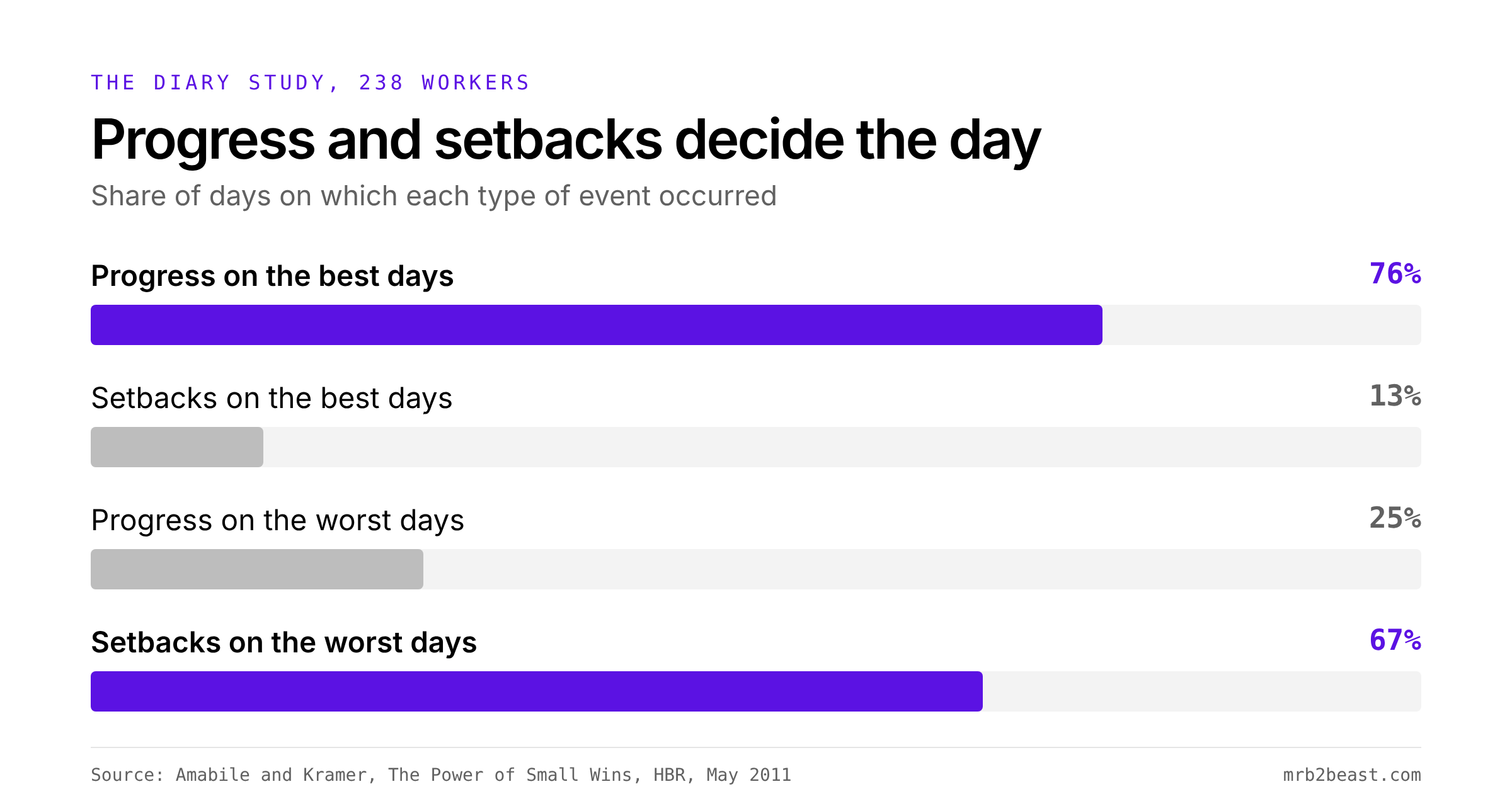
Steps forward occurred on 76 percent of the best-mood days. Setbacks occurred on only 13 percent of them. On the worst-mood days, the picture flipped. Setbacks occurred on 67 percent of those days, progress on only 25 percent.
The number nobody quotes
Most summaries stop at "progress motivates." The more useful finding sits next to it.
Setbacks were stronger than progress. In an interview with HBS Working Knowledge, Amabile put it plainly: the effect of setbacks was two to three times stronger than the effect of progress. Summaries of the book give the split: on happiness, a setback had about twice the effect of a progress event. On frustration, it was over three times as strong.
Psychologists know this pattern well. In 2001, Roy Baumeister and colleagues reviewed the evidence. Their paper is titled "Bad Is Stronger Than Good." Negative events tend to have larger and longer effects than positive events of the same size.
The managers also missed this. They ranked support for progress last as a motivator and third as an influence on emotion.
What is the progress principle? The progress principle states that of all the events that can lift inner work life, the single most important is making progress in meaningful work. Amabile and Kramer named it in 2011, based on their diary study. It applies to small steps, not only big milestones, and only when the work matters to the person doing it.
Small wins are not small
The progress does not need to be large. In the diaries, 28 percent of incidents that had only a minor impact on the project had a major impact on how people felt.
One programmer wrote that he had figured out why something was not working. He felt relieved and happy, he wrote, because it was a minor milestone for him.
The term "small wins" is older than the diary study. The organizational psychologist Karl Weick used it in 1984 for concrete, completed outcomes of moderate importance. His argument: large problems feel overwhelming, while a series of small wins makes progress visible and keeps people moving.
A fair caveat. The diary data are correlational. Good days and progress could feed each other in both directions. Amabile and Kramer argue the link runs both ways: inner work life drives performance, and progress lifts inner work life. They call it the progress loop.
In short: the best days were mostly progress days, the worst days were mostly setback days, and setbacks weighed more.
The three mistakes that kill motivation at work
Once you know the numbers, the common mistakes are easy to spot. They apply to managers, and they apply just as much when you manage yourself.
Mistake 1: Only counting big milestones
Big milestones are rare. A launch, a closed deal, a finished book. If those are the only things you count as progress, most of your days will feel like nothing happened.
The diary data say small events carry real weight. A day with one solved problem can feel like a good day. But only if you notice it.
Mistake 2: Celebrating wins and ignoring setbacks
Most motivation advice is about adding positives. Celebrate wins, give praise, add rewards.
The research suggests the bigger lever sits on the other side. If setbacks hit two to three times harder, then removing one recurring blocker can be worth more than adding two small celebrations. A tool that never works, a waiting time that kills every Tuesday, an approval that always comes late.
Here is an example. A solo founder plans to publish two articles a week. Every week, she loses a full morning to fixing the same broken export in her publishing tool.
She logs her wins, but never the blocker. So it stays invisible, and every week starts with the same setback. Fixing it once would protect more of her motivation than any reward she could add.
Mistake 3: Making progress on work that does not matter
The progress principle has a condition. In the words of Amabile and Kramer, "the work must be meaningful to the person doing it."
Meaningful does not mean world-changing. It means you can see how the task connects to something you care about. Clearing 40 emails is activity. Moving a project that serves your yearly goal is progress.
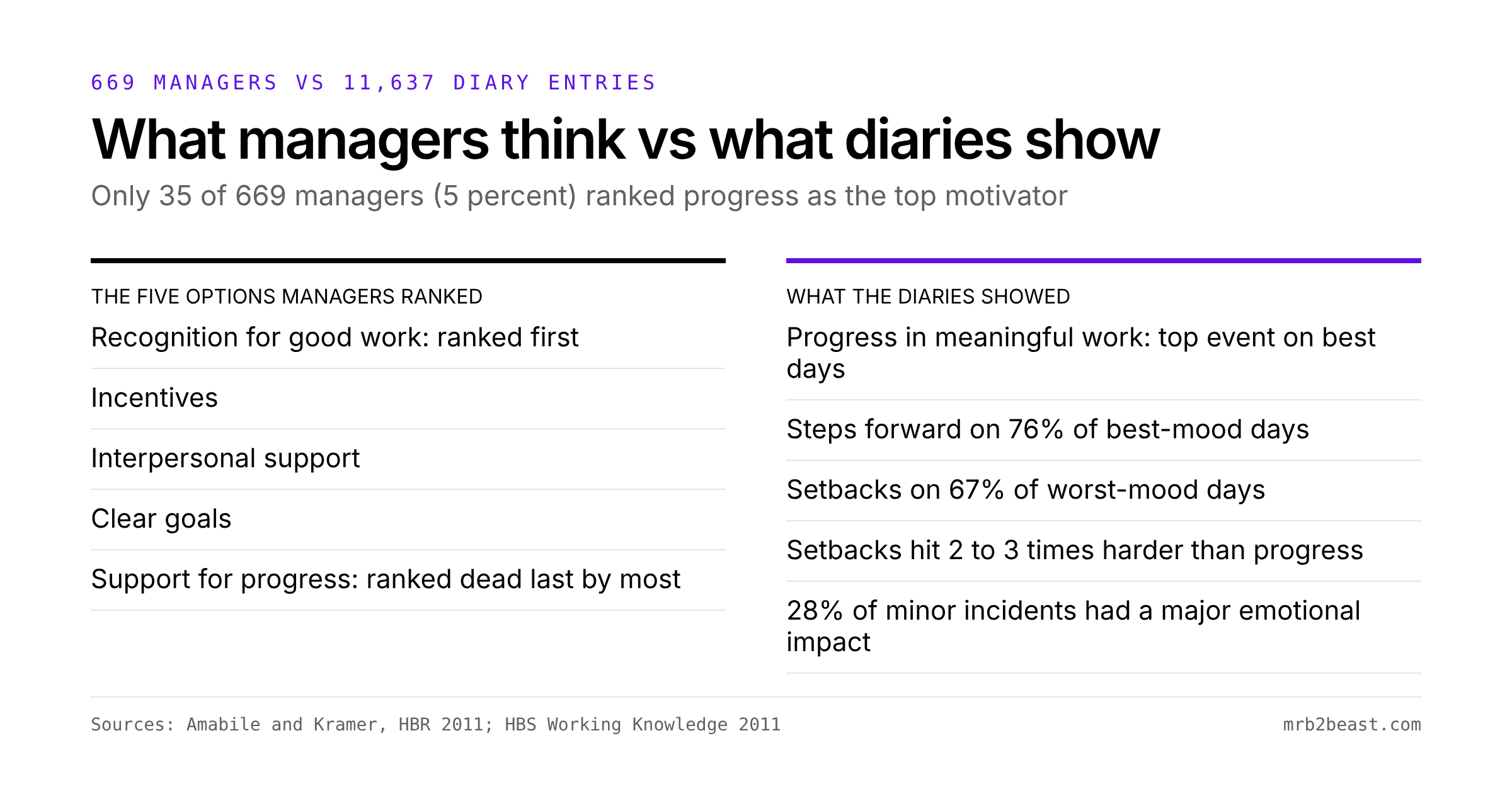
The chart says it in one view. Managers bet on the lever they can see. The diaries point to the lever that shows up in the workday itself.
How to use the progress principle: the Small Wins Ledger
You do not need a research team to apply this. You need a place where small wins and setbacks are visible, and a link from each day to something bigger.
Amabile has recommended keeping a work diary of 5 to 10 minutes a day. The version below is smaller on purpose: 2 minutes, three lines. It is easier to keep for months, and that is what counts.
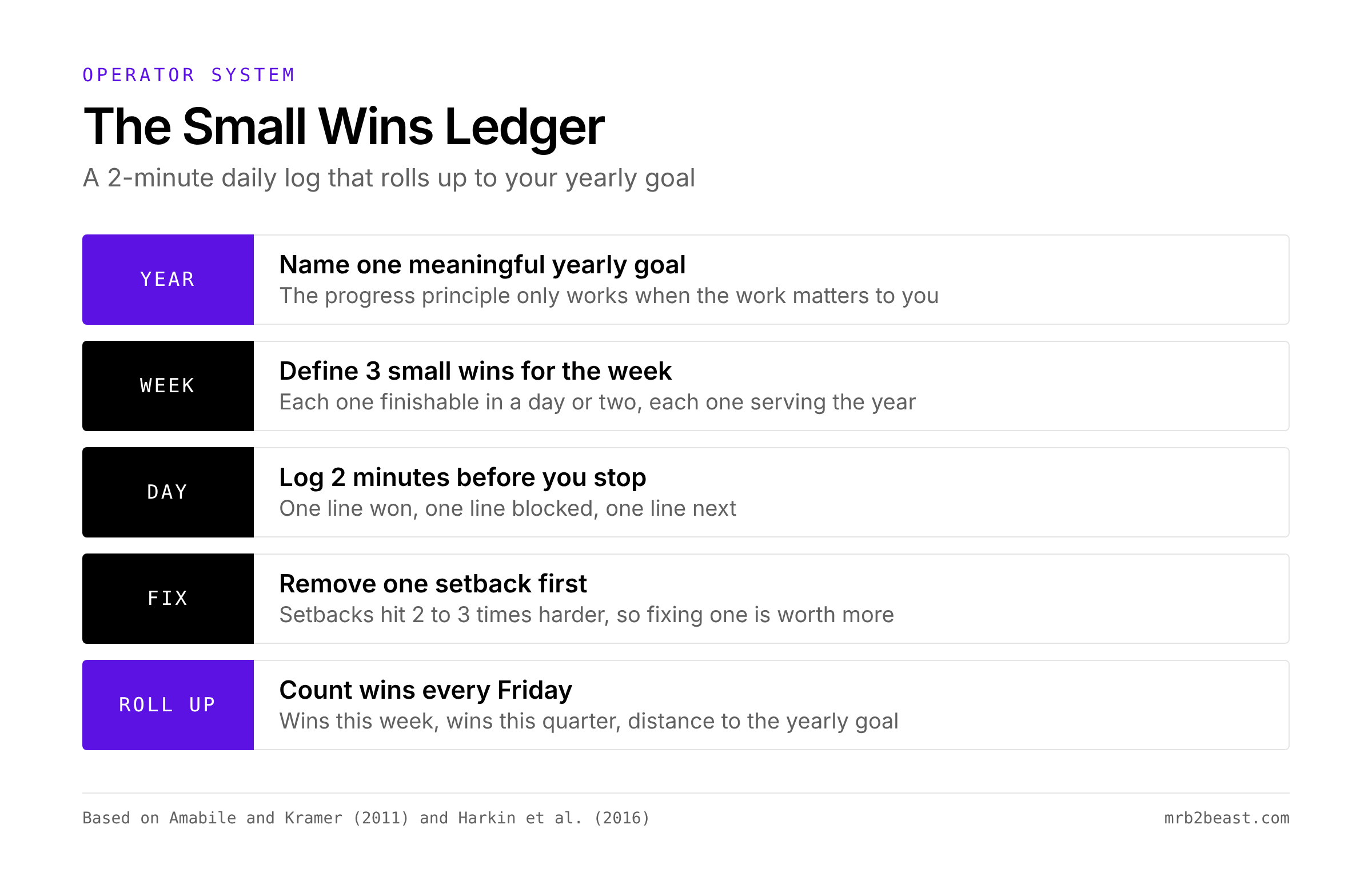
Step 1: Name one meaningful yearly goal. One outcome you actually care about. This is what makes daily progress count as meaningful. If you need help building it, the guide on how to achieve goals shows the full chain from year to day.
Step 2: Define 3 small wins for the week. Each one should be finishable in a day or two, and each one should serve the yearly goal. "Draft the pricing page" is a small win. "Work on marketing" is not.
Step 3: Log 2 minutes before you stop. At the end of each workday, write three lines. Won: what moved forward today. Blocked: what set you back. Next: the first step for tomorrow. That is the same timing the diary participants used.
Step 4: Remove one setback first. Every Friday, read your "blocked" lines. If the same blocker shows up twice, fixing it is your first task next week. Setbacks weigh more, so this step protects motivation more than any reward.
Step 5: Count wins every Friday. How many of your 3 weekly wins did you finish? How many this quarter? How far are you from the yearly goal? A 2016 meta-analysis by Benjamin Harkin and colleagues found that monitoring progress improves goal attainment, especially when progress is physically recorded.
This rollup from daily step to yearly goal is the idea behind Gaapp.io, a tool to track daily progress that shows what is due today and which yearly goal it serves. Disclosure: I am building it. A paper notebook works too. The log matters more than the tool.
The daily log is also a habit, and habits take longer than a few weeks to stick. The article on how long it takes to form a habit covers what that runway actually looks like.
Ask yourself this week:
- What did I move forward today, and which yearly goal does it serve?
- Which setback has shown up more than once this month?
- If I only counted big milestones, how many good days would I have had this week?
Conclusion: make progress visible, and make setbacks rare
Most managers bet on recognition. The diaries pointed to progress, and to setbacks even more.
The progress principle is not a motivational slogan. It is a pattern found in 11,637 daily entries from people doing real work. Good days were mostly progress days. Bad days were mostly setback days. And the bad days weighed more.
That gives you two levers. Make small wins visible every day. And treat every repeated setback as the most important thing to fix next week.
What you learned today
- Only 35 of 669 managers ranked progress as the top motivator. In 238 diaries, progress in meaningful work topped the best days.
- Setbacks occurred on 67 percent of the worst days, and their effect was two to three times stronger than progress.
- A 2-minute daily log with one win, one blocker and one next step is a small version of what the study participants did every day.
FAQ
What is the progress principle? The progress principle says that of all the events that can lift people at work, the most important is making progress in meaningful work. Teresa Amabile and Steven Kramer described it in 2011, based on nearly 12,000 diary entries from 238 knowledge workers in seven companies. Even small steps forward count.
What motivates people at work the most? In the diary study by Amabile and Kramer, making progress in meaningful work was the most common event on the best days, occurring on 76 percent of them. Recognition, support and clear goals also matter. But only 5 percent of 669 managers surveyed ranked progress as the top motivator.
What are small wins? Small wins are concrete, completed steps of moderate size, such as solving one problem or finishing one draft. Karl Weick introduced the term in 1984. In the progress principle research, 28 percent of incidents with a minor impact on a project had a major impact on how people felt.
What is inner work life? Inner work life is the mix of emotions, motivations and perceptions people experience during a workday. It includes how happy they feel, how interested they are in the work and how they view their team and boss. Amabile and Kramer found it is shaped most by progress and setbacks.
How do you apply the progress principle to yourself? Set one meaningful yearly goal and define three small wins per week that serve it. At the end of each day, spend 2 minutes logging one win, one setback and the next step. Every Friday, fix one repeated setback first, then count your wins against the yearly goal.
About the author
Tristan Eilenburg. One person. AI systems. Global reach. I write about building systems that work, with evidence instead of hype.
- X: @MrB2Beast
- LinkedIn: Tristan Eilenburg
- Instagram: @mrb2beast
- Building Gaapp.io (Instagram: @gaapp.io)
I write one of these every week. If this one taught you something, the newsletter is where the next one lands first.
Sources
- Amabile, T. M., and Kramer, S. J. (2011). The power of small wins. Harvard Business Review, 89(5), 70-80. https://hbr.org/2011/05/the-power-of-small-wins
- Amabile, T. M., and Kramer, S. J. (2011). The Progress Principle: Using Small Wins to Ignite Joy, Engagement, and Creativity at Work. Boston, MA: Harvard Business Review Press.
- Amabile, T. (2017). Diary Study Database (The T.E.A.M. Study or The Progress Principle Study). Harvard Dataverse. https://doi.org/10.7910/DVN/25463
- Nobel, C. (2011, September 6). How Small Wins Unleash Creativity. HBS Working Knowledge. https://www.library.hbs.edu/working-knowledge/how-small-wins-unleash-creativity
- Baumeister, R. F., Bratslavsky, E., Finkenauer, C., and Vohs, K. D. (2001). Bad is stronger than good. Review of General Psychology, 5(4), 323-370. https://doi.org/10.1037/1089-2680.5.4.323
- Weick, K. E. (1984). Small wins: Redefining the scale of social problems. American Psychologist, 39(1), 40-49. https://doi.org/10.1037/0003-066X.39.1.40
- Harkin, B., Webb, T. L., Chang, B. P. I., Prestwich, A., Conner, M., Kellar, I., Benn, Y., and Sheeran, P. (2016). Does monitoring goal progress promote goal attainment? A meta-analysis of the experimental evidence. Psychological Bulletin, 142(2), 198-229. https://eprints.whiterose.ac.uk/91437/
- Cieplak-Mayr von Baldegg, K. (2012, September 24). How keeping a diary makes you happier and better at your job. The Atlantic, republished by Government Executive. https://www.govexec.com/management/2012/09/how-keeping-diary-makes-you-happier-and-better-your-job/58283/