Weekly Review: The Ritual That Keeps One Goal Alive
Most weekly reviews clean up your lists. This one asks a single question: did the week move the goal?

A weekly review is a fixed moment, once a week, where you look at what happened and decide what happens next. Almost every productivity method has one. Almost nobody keeps doing it.
The reason is rarely laziness. Most weekly review templates try to make every list current at once: inboxes, projects, calendars, someday lists. That takes an hour or two, so it gets skipped the first busy week, and then it is gone.
I build Gaapp in about an hour a day. A two-hour review would eat two days of building. So the review has to be short, and it has to be about the one thing that matters this year.
This article gives you that version. Four steps, 30 minutes, built around one yearly goal instead of every open loop.
Key takeaways
- A weekly review earns its time when it checks progress against one goal, not when it makes every list tidy.
- Monitoring progress improved goal attainment across 138 experiments, and the effect was larger when progress was written down (Harkin et al., 2016).
- Run it in four steps: count what got done, compare it with the plan, cut what is stale, commit to next week's outcomes.
What a weekly review is, and what it is for
A weekly review has one job: close the gap between what you planned and what happened, before the gap grows into a lost month.
Days are too short to show whether you are on track. A bad Tuesday says nothing. A quarter is too long, because by the time you notice drift, eight weeks are gone. The week is the smallest unit where progress is visible and the cheapest unit to correct.
That makes the weekly review the hinge of any goal system. The guide to yearly planning breaks one goal into quarters, months and weeks. The quarter sets the pace: close enough to feel urgent, long enough to finish something. The weekly review is where you check, every seven days, whether the plan still matches reality.
Why weekly reviews work: the evidence
The strongest evidence is not about reviews by name. It is about monitoring progress, which is what a review does.
Benjamin Harkin and colleagues pooled 138 experiments with 19,951 participants in which people were randomly assigned to monitor their goal progress more often, or not. Monitoring improved goal attainment with an average effect of d = 0.40. Two details matter for a weekly review. The effect was larger when progress was physically recorded, and larger when it was reported to someone else.
So a review in your head is the weak version. Write it down. Even better, tell one person what you said you would do.
This fits older goal research. In their review of 35 years of studies, Edwin Locke and Gary Latham found that goals work best when people get feedback that shows their progress against them. A goal without feedback is a hope. The weekly review is the feedback.
There is also a reason to write down what went right, not only what is late. In the diary studies behind the progress principle (Amabile and Kramer, 2011), progress on meaningful work was the strongest driver of a good workday. A review that only lists open items reads like a failure report every week, and people stop reading failure reports.
GTD weekly review vs a one-goal review
The best-known version comes from David Allen's Getting Things Done. The official GTD Weekly Review has 11 steps in three phases: get clear, get current, get creative. You empty every inbox, review every action list, past and upcoming calendar, the waiting-for list, projects and someday ideas. Allen calls it the critical success factor of GTD and recommends doing it every 7 to 10 days. A thorough one takes one to two hours.
That is a good design for its purpose. GTD wants a complete, trusted inventory of everything that has your attention. If you manage a lot of incoming work, it delivers.
It has two weak spots for someone chasing one goal with little time.
- It is long. One to two hours is the first thing to go in a hard week. A review you skip has an effect size of zero.
- It is neutral. GTD keeps every project current. It does not ask which project moved your year. You can finish a perfect GTD review and still have spent the week on everything except the goal.
A one-goal review flips the order. Start with the goal, check the week against it, and only then touch the lists. The lists get cleaned as a side effect, not as the point.
| GTD Weekly Review | One-goal weekly review | |
|---|---|---|
| Question | Is everything current? | Did the week move the goal? |
| Steps | 11, in three phases | 4 |
| Time | One to two hours | About 30 minutes |
| Output | Clean lists you trust | Two or three outcomes for next week |
| Best for | Lots of incoming work | One goal, little time |
You can combine them. Run the short review every week and a full GTD sweep once a month.
How to do a weekly review in 30 minutes: count, compare, cut, commit
Same day, same time, every week. Friday afternoon works if you want a clean weekend. Sunday evening works if you want Monday decided. The day matters less than never moving it.
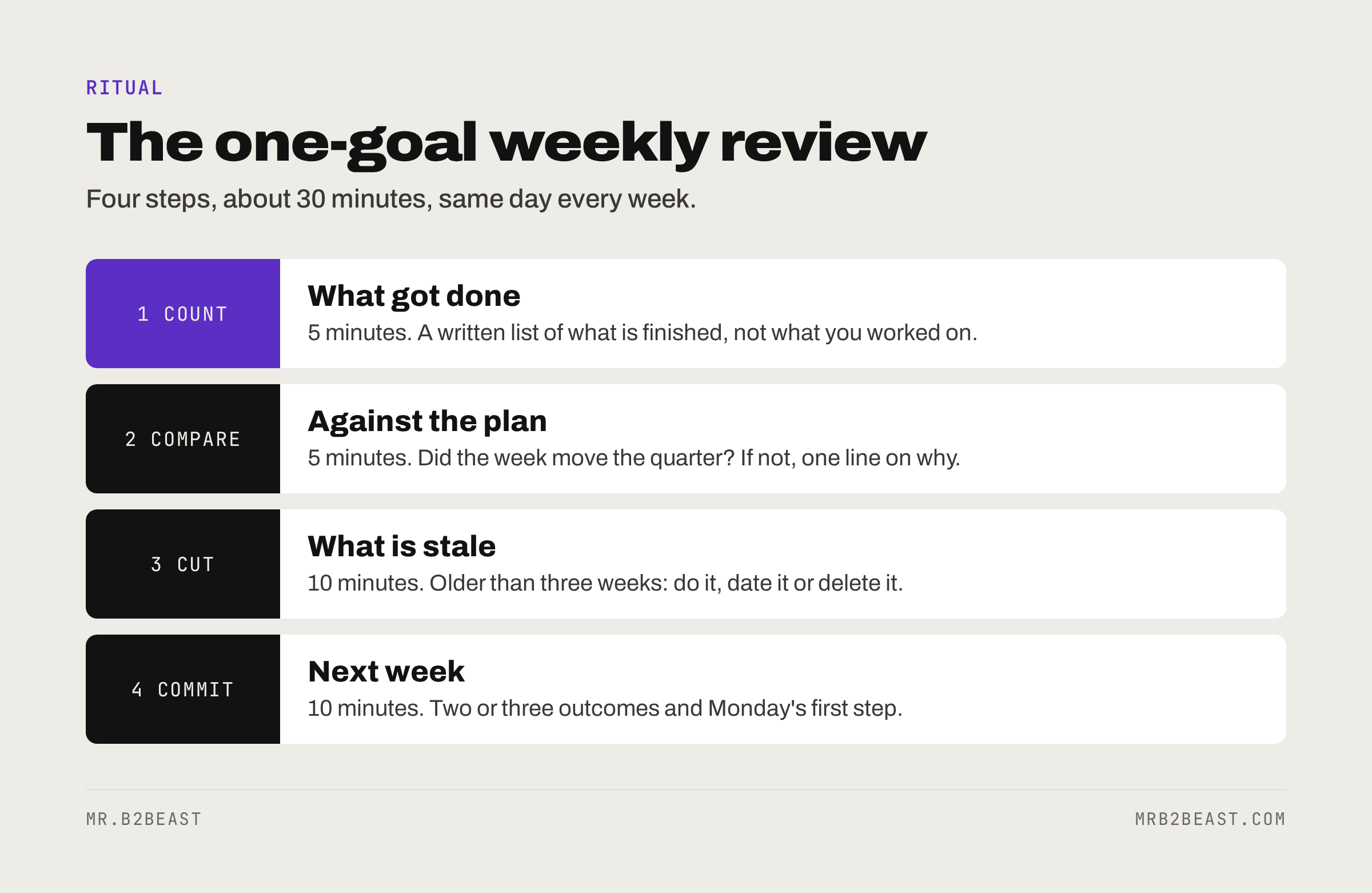
Step 1: Count what got done (5 minutes)
Open a blank page and list what got finished this week. Not what you worked on. What is done. Calendar, sent mail and commits help you remember.
This is a done list for the week. It comes first on purpose. You judge the week better after you see what moved, and the list is the written record that made monitoring work in the research above.
Step 2: Compare with the plan (5 minutes)
Put last week's two or three outcomes next to the done list. Mark each one: done, partly done, or not started. Then ask the only question that counts: did this week move the quarter's milestone?
If not, write one line on why. Usually it is one of three things. The outcome was too big. Something urgent took the time, which is a prioritizing problem, not a planning one. Or you worked on the goal, but on the wrong part of it.
If the outcome was too big three weeks in a row, that is the planning fallacy at work: people underestimate how long their own tasks take, even when they know past tasks ran late. The fix is not more effort. Make next week's outcome smaller.
Step 3: Cut what is stale (10 minutes)
Now the lists. Go through open tasks and give anything older than three weeks a decision: do it next week, put it on a date, or delete it.
Delete more than feels comfortable. An item that survived three reviews without being done is telling you something. Either it does not matter, or it is too vague to start. Rewrite the vague ones as a first step you could do in 20 minutes. Delete the rest.
If you use GTD, this is where you empty the inbox. If you do not, this is where you stop the list from growing faster than it shrinks.
Step 4: Commit to next week (10 minutes)
Pick two or three outcomes for next week that move the quarter. Outcomes, not activities. "Draft and send the onboarding email" is an outcome. "Work on onboarding" is a topic.
Then write Monday's first step with a time and a place: "Monday 8:00, at the desk, before email, I write the subject line." If-then plans like this had a medium to large effect on reaching goals across 94 tests (Gollwitzer and Sheeran, 2006). The plan removes the moment where you decide whether to start.
That is the review. Close the page.
Weekly review questions that keep one goal in view
If you prefer a template, these seven questions cover the four steps. Answer them in writing, in one or two lines each.
- What got done this week?
- Which of last week's outcomes did I hit, partly hit, or miss?
- Did the week move this quarter's milestone?
- What took the time I planned for the goal?
- Which open item is older than three weeks, and what do I do with it?
- What are the two or three outcomes for next week?
- When and where do I start on Monday?
Add one question once a month: does the yearly goal still make sense? A review that only checks the week can keep you efficient in the wrong direction.
How to plan your week from the review
The review and the plan are one session, not two. Step 4 is the plan.
Keep it light. Two or three outcomes, one first step, done. Do not schedule every hour of the coming week in the review. A detailed week plan written on Sunday rarely survives Tuesday, and then it feels like another failure on the list.
What helps more is protecting one block for the goal on each workday, before anything else gets the time. The productivity system article describes that block and the ladder from yearly goal to today's step. The weekly review is the layer that keeps that ladder honest.
If a week goes completely off the rails, do not wait for the next review. Monday is a natural fresh start, and research on the fresh start effect shows people are more likely to start on goals after such dates. But a new week only helps if you use it, so the review should end with Monday's first step already written.
Review the automation, not only yourself
If parts of your work run on software, the weekly review has to look at their output too. Automated work fails quietly.
A scheduled report can go out with empty fields. A sync can stop without an error. A checking step can approve everything it sees. None of that shows up on a done list, because from the outside the work looks finished. A weekly report with no numbers in it is the same failure as a weekly review done in your head. It looks like a review and checks nothing. So step 2 includes one extra line for anything automated: did it produce what it should, and did anyone look?
When a weekly review will not help
Honest limits:
- If there is no goal, there is nothing to compare. The review then turns into list cleanup, which is GTD with fewer steps. Start with one goal.
- If the outcomes are vague, every week looks fine. "Make progress on the course" is always partly done. Use outcomes a stranger could check.
- If the review becomes the work, it is too long. Thirty minutes is a ceiling, not a target. Fifteen honest minutes beat an hour you skip.
FAQ
What does a week in review mean? A week in review is a short look back at the past seven days: what got done, what did not, and what you learned. In personal productivity it usually also includes deciding the next week's priorities. The written version is more useful than the mental one, because recorded progress has a larger effect on reaching goals.
How long should a weekly review take? The GTD Weekly Review is designed for one to two hours. A review built around one goal takes about 30 minutes: five to count, five to compare, ten to cut, ten to commit. Shorter and done every week beats longer and skipped.
What is the 3-3-3 rule at work? The 3-3-3 method is a daily structure attributed to author Oliver Burkeman: three hours on your most important project, three shorter urgent tasks, and three maintenance tasks like email or exercise. It is a daily rule, not a weekly one. It pairs well with a weekly review, which decides what the three hours go to.
What is the best day for a weekly review? The day you can keep every week. Friday afternoon closes the week while you still remember it. Sunday evening sets up Monday. Pick one and keep it fixed, because a review that moves around tends to disappear.
How do you run a weekly review meeting with a team? Use the same four steps, shared. Each person names what got done and whether it moved the team goal, the group cuts stale work, and the meeting ends with two or three outcomes and an owner for each. Keep it under 30 minutes and write the outcomes down where everyone sees them.
About the author
Tristan Eilenburg. One person. AI systems. Global reach. I write about building systems that work, with evidence instead of hype.
- X: @MrB2Beast
- LinkedIn: Tristan Eilenburg
- Instagram: @mrb2beast
The newsletter goes out once a week. If this one taught you something, the newsletter is where the next one lands first.
Sources
- Harkin, B., Webb, T. L., Chang, B. P. I., Prestwich, A., Conner, M., Kellar, I., Benn, Y., and Sheeran, P. (2016). Does monitoring goal progress promote goal attainment? A meta-analysis of the experimental evidence. Psychological Bulletin, 142(2), 198-229. https://doi.org/10.1037/bul0000025
- Locke, E. A., and Latham, G. P. (2002). Building a practically useful theory of goal setting and task motivation: A 35-year odyssey. American Psychologist, 57(9), 705-717. https://doi.org/10.1037/0003-066X.57.9.705
- Gollwitzer, P. M., and Sheeran, P. (2006). Implementation intentions and goal achievement: A meta-analysis of effects and processes. Advances in Experimental Social Psychology, 38, 69-119. https://doi.org/10.1016/S0065-2601(06)38002-1
- David Allen Company (2011). GTD Best Practices: Review (part 4 of 5). https://gettingthingsdone.com/2011/11/gtd-best-practices-review-part-4-of-5/
- David Allen Company. GTD Weekly Review checklist. https://gettingthingsdone.com/wp-content/uploads/2014/10/Weekly_Review_Checklist.pdf
- Buehler, R., Griffin, D., and Ross, M. (1994). Exploring the "planning fallacy": Why people underestimate their task completion times. Journal of Personality and Social Psychology, 67(3), 366-381. https://doi.org/10.1037/0022-3514.67.3.366
- Dai, H., Milkman, K. L., and Riis, J. (2014). The fresh start effect: Temporal landmarks motivate aspirational behavior. Management Science, 60(10), 2563-2582. https://doi.org/10.1287/mnsc.2014.1901
- Amabile, T., and Kramer, S. (2011). The Progress Principle: Using Small Wins to Ignite Joy, Engagement, and Creativity at Work. Harvard Business Review Press.
- Bartter, A. (2024). What is the 3-3-3 productivity method? Stylist. https://www.stylist.co.uk/life/3-3-3-method-productivity-time-management/939462