Context Switching Does Not Cost You 23 Minutes. Here Is What It Really Costs
The most quoted interruption statistic measured something else. The real cost is quieter, and you can cut it.

You have probably read it: after an interruption, it takes 23 minutes to get your focus back. It is the most quoted number on context switching. It comes from Gloria Mark, a professor of informatics at UC Irvine.
But that is not what she measured. In her 2005 study, 25 minutes and 26 seconds was the average time before people returned to an interrupted project at all. In between, they worked on about two other projects. The famous "23 minutes and 15 seconds" comes from a 2006 interview with Gallup, not from a paper.
It gets stranger. In a 2008 lab study by the same researcher, interrupted people finished their work faster than people who were left alone. They paid in a different currency: stress.
The idea behind the 23 minutes is not wrong. Switching does cost you. It just costs you in a different place than the number suggests.
I want to show you what the famous number really measured. I want to show you where the actual cost of context switching sits, according to the research. And I want to give you a simple system to cut that cost, one you can start tomorrow morning.
Key takeaways
- The "23 minutes" is the average time until people went back to an interrupted project, with about two other tasks in between. It is not the time needed to refocus.
- Interrupted people can work faster with no loss in quality, but report more stress, frustration, time pressure and effort.
- The hidden cost is attention residue: part of your mind stays on the unfinished task. A short "ready-to-resume" note reduces it.
What the research actually shows
Most people believe a simple rule. Every interruption burns 23 minutes of focus, so five interruptions cost you two hours.
That rule is easy to remember. It is also not what the data says.
What the 23 minutes really measured
In 2005, Gloria Mark, Victor Gonzalez and Justin Harris published a paper called "No Task Left Behind?" at CHI, the main conference for human-computer interaction research. They shadowed 24 information workers: 7 managers, 9 analysts and 8 developers. In total, they logged more than 700 hours of observation.
They grouped work into "working spheres," meaning projects or units of work with a shared goal. On average, people spent 11 minutes and 4 seconds in one sphere before moving on. And 57.1 percent of all sphere segments were interrupted.
Here is the key part. 77.2 percent of interrupted work was resumed on the same day. When it was, it took an average of 25 minutes and 26 seconds. In between, people worked in an average of 2.26 other spheres.
What is context switching? Context switching means moving your attention from one task or project to another before the first one is done. The switch can be forced, like a call, or self-chosen, like checking email. The cost is not only the time of the switch. It is also the part of your attention that stays behind on the task you left.
So where does 23 minutes and 15 seconds come from? In June 2006, Mark gave an interview to the Gallup Business Journal about a study with 36 managers, analysts, developers, engineers and project leaders. There she said that 81.9 percent of interrupted work was resumed the same day, on average after 23 minutes and 15 seconds. She added that this was "not so long."
That is the number the internet kept. Notice what it describes. It is the time until you come back to a project, after doing about two other things. It is not the time your brain needs to refocus after a ping.
In short: the 23 minutes is a gap in your work pattern, not a reboot time for your brain.
Interrupted people worked faster
In 2008, Mark, Daniela Gudith and Ulrich Klocke ran an experiment with 48 participants. Each person played an HR manager and answered a set of emails "as quickly, correctly and politely as possible." Some were interrupted. Some were not.
The result surprised the researchers. People with no interruptions needed 22.77 minutes. Interrupted people needed 20.31 minutes when the interruptions matched the task, and 20.60 minutes when they did not. There was no significant difference in errors or politeness.
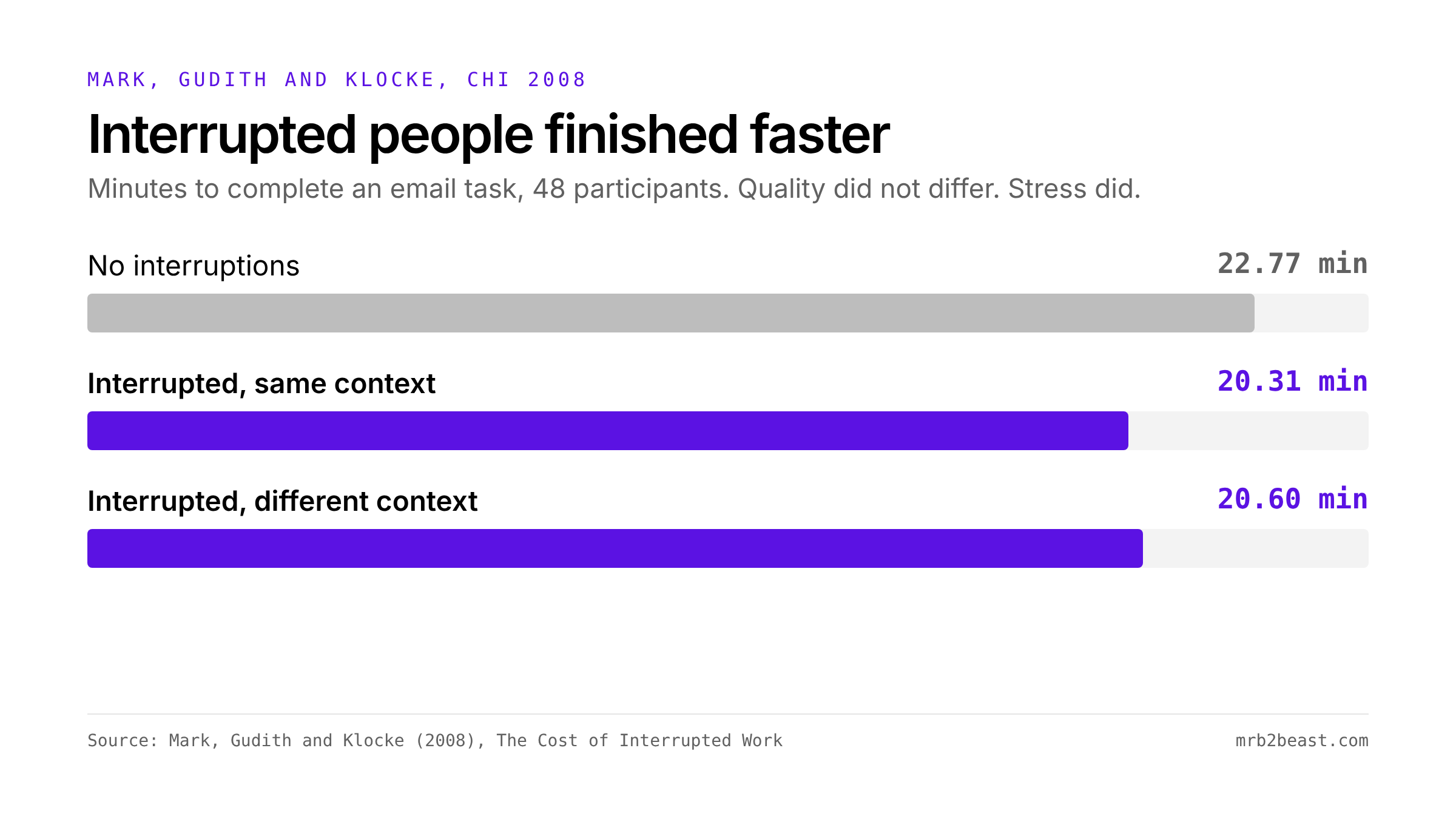
The price showed up elsewhere. Interrupted people reported significantly more stress, frustration, time pressure and effort. They compensated by working faster, and that speed was paid for with strain.
That changes the question. The cost of context switching is not always lost minutes. Often it is a day that feels like a sprint and ends with nothing big finished.
The part of you that stays behind
In 2009, the organizational researcher Sophie Leroy gave the hidden cost a name: attention residue. In two experiments, people who switched away from an unfinished task performed worse on the next one.
What is attention residue? Attention residue is the part of your mind that keeps thinking about a previous task after you switch to a new one. Sophie Leroy described it in 2009. It is strongest when the first task is unfinished. The result is lower performance on the task you are actually doing.
Leroy found a second detail that few posts mention. Finishing the first task was not enough. People also needed some time pressure while finishing it. That pressure helped them close the task in their head and move on.
In 2018, Leroy and Theresa Glomb tested a fix in four studies. When people are interrupted and expect to return under time pressure, attention residue rises and performance on the interrupting task drops. A short "ready-to-resume" plan reduced that effect. In it, people noted where they stopped, what was left and what to do next. The University of Washington summary put the effort at about a minute.
Attention on a screen: 47 seconds
There is a newer number from Mark that deserves more attention than the 23 minutes. Using computer logging, her team measured how long people stay on one screen before switching.
In 2004, the average was about two and a half minutes. By 2012, it was 75 seconds. In recent years, it was 47 seconds, with a median of 40 seconds. Mark reported these numbers in 2023, in interviews about her book "Attention Span."
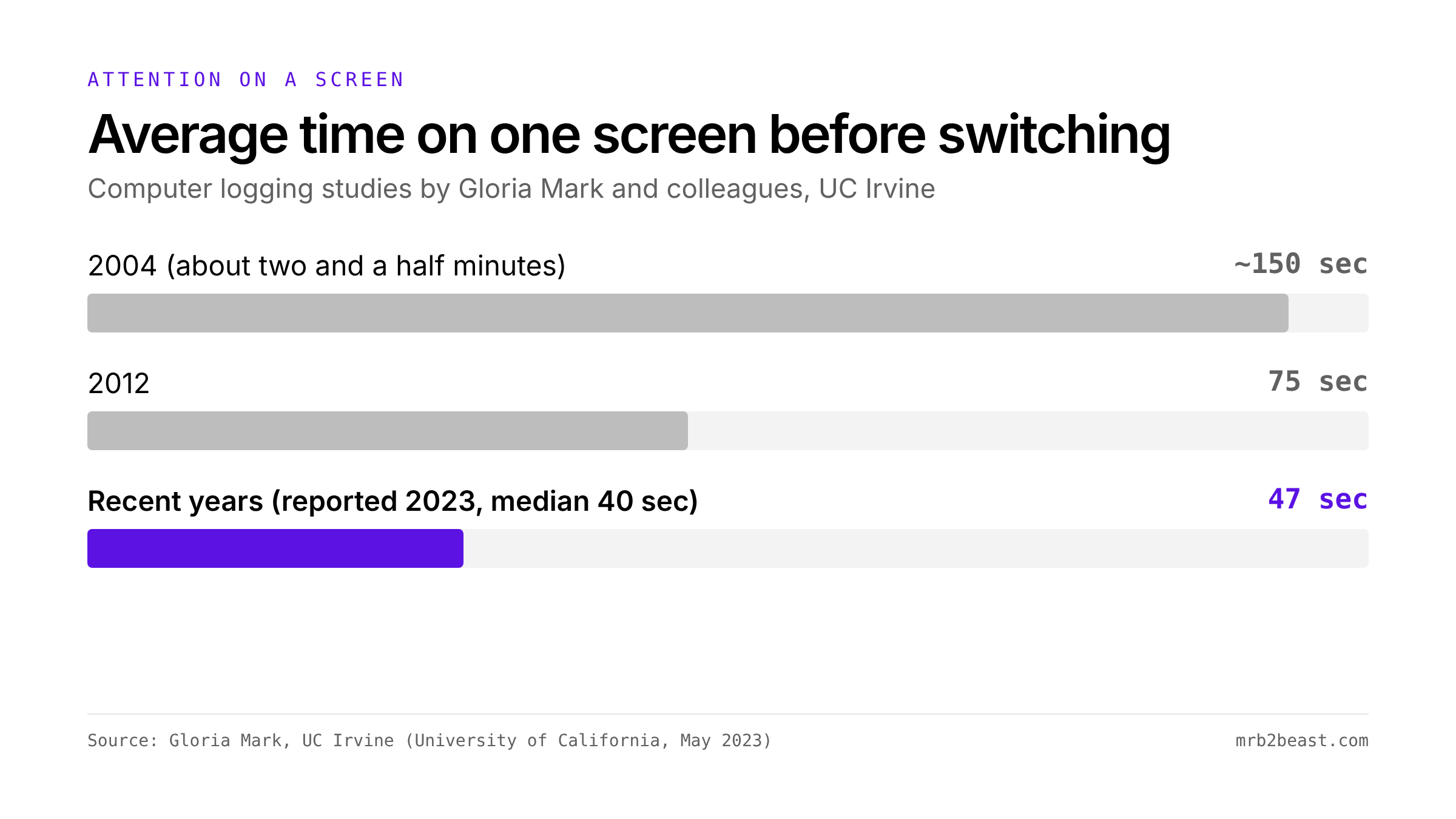
Many of those switches are not interruptions from others. They are self-interruptions. Nobody pinged you. You just went.
In short: the main cost of context switching is not a fixed 23-minute penalty. It is attention left behind on unfinished work, plus the stress of working faster to make up for it.
The three mistakes almost everyone makes with context switching
Once you see the research, the typical mistakes are easy to spot.
Mistake 1: Leaving tasks open without a note
Here is an example. A solo founder is drafting a sales proposal. A client message arrives. She switches, answers it and jumps into a support ticket. The proposal sits half-written, and part of her mind stays with it all afternoon.
That is attention residue at work. The proposal is not lost. But it keeps pulling on her attention, and the support ticket gets less of her than it should. Leroy and Glomb found the effect is worse when you expect time pressure on the way back.
Mistake 2: Spreading small tasks across the whole day
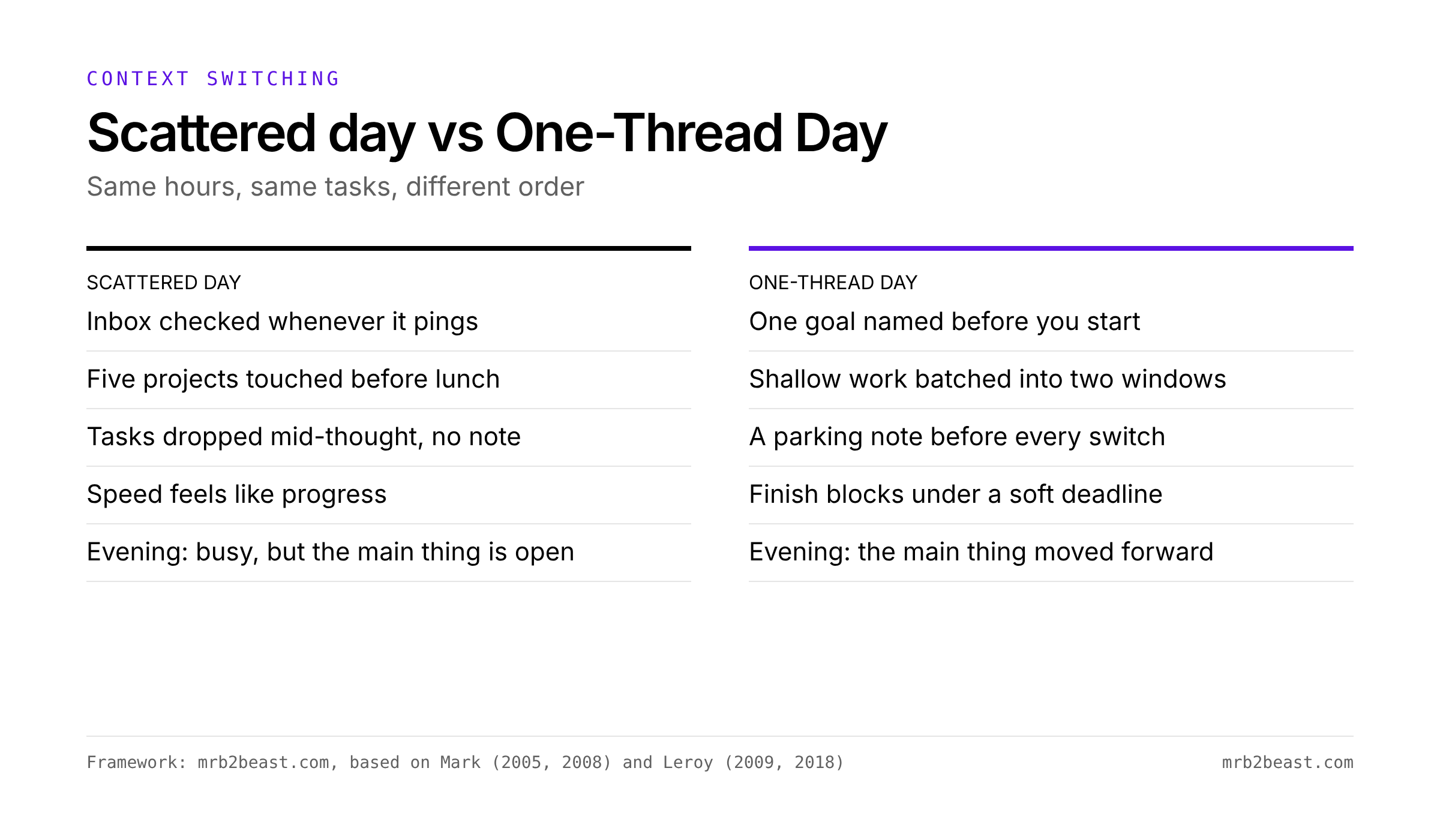
Email, chat, admin and quick requests are not the problem. Scattering them is. Every small task dropped into the middle of deep work creates one more switch and one more open loop.
In the 2005 data, people juggled an average of 11.7 different working spheres. Each sphere you touch is a context you may have to rebuild later.
Mistake 3: Measuring the day by speed
The 2008 experiment shows why busy days feel productive. Interrupted people really did move faster. Quality did not drop in that short task. Stress did.
Speed is not the score. If you are fast all day and the one important task is still open at six, the switching won.
How to reduce context switching: the One-Thread Day
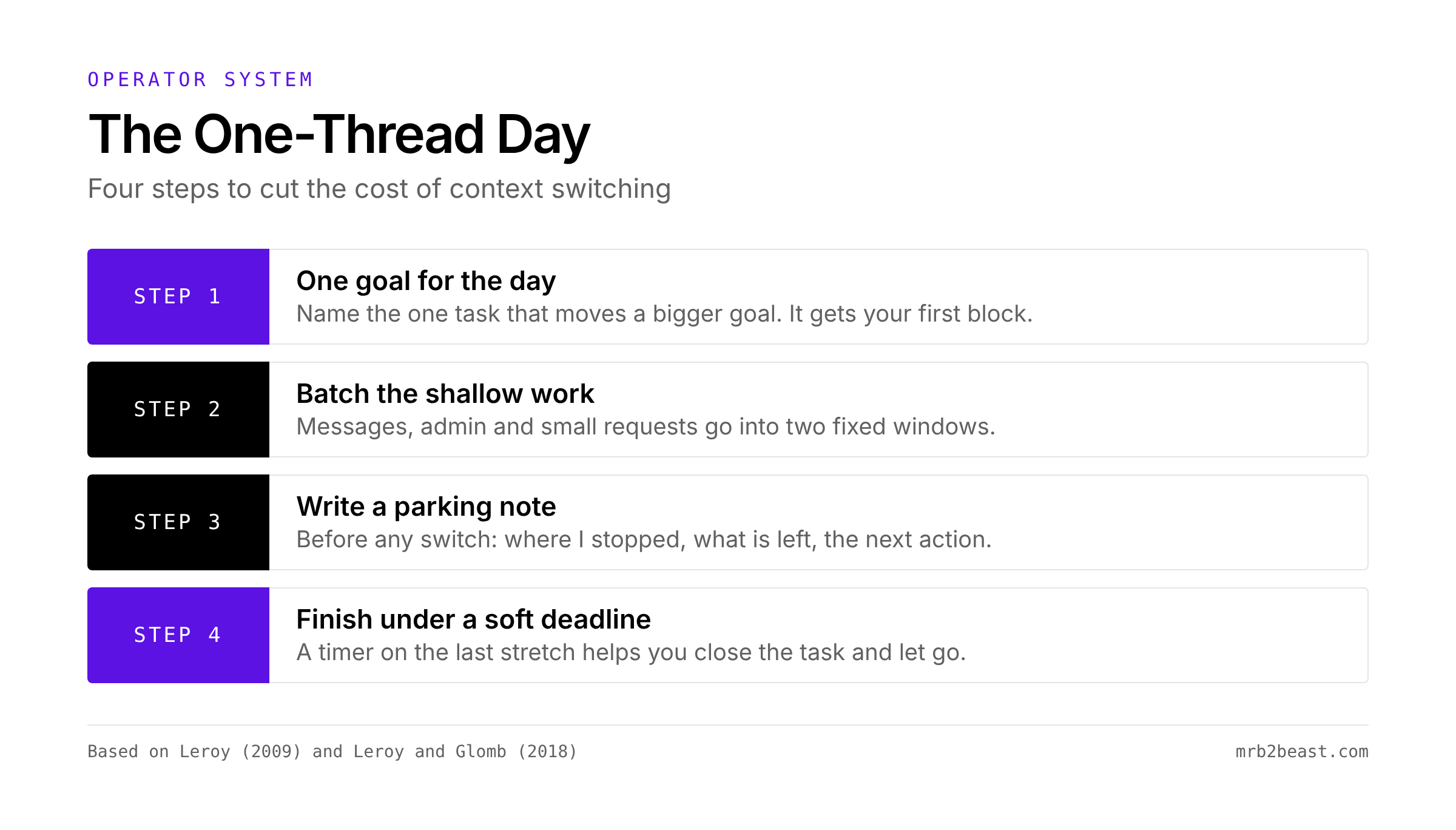
I am not saying you can work without interruptions. Most jobs do not allow that. I am saying you can control how much attention each switch takes from you. Here is a four-step system built on the research above.
Step 1: Pick one goal for the day. Before you open your inbox, name the one task that moves a bigger goal forward. It gets your first block of the day. Everything else is secondary. If you use yearly goals, this is the daily end of the chain from the goal system in this article.
Step 2: Batch the shallow work. Messages, admin and small requests go into fixed windows. For example: one window before lunch and one in the late afternoon. Outside those windows, notifications stay off. This cuts the number of open loops instead of the number of tasks.
Step 3: Write a parking note before every switch. When you must leave a task, take about a minute. Write three lines: where I stopped, what is left, the next concrete action. This is the "ready-to-resume" plan from Leroy and Glomb. It tells your brain the task is safe, so it can let go.
Step 4: Finish blocks under a soft deadline. Leroy found that some time pressure while finishing helped people disengage from a task. Set a timer for the last stretch of your focus block. When it rings, finish the sentence, write the parking note and close the file.
This is the idea behind Gaapp.io, a daily focus planner that shows what is due today and which bigger goal it serves. Disclosure: I am building it. A paper notebook works too. The system matters more than the tool.
Ask yourself this week:
- What was the one task that mattered today, and did it get my first block?
- How many tasks did I leave without a note on where to restart?
- Was I fast today, or did I finish something that counts?
Conclusion: switching is not the enemy, open loops are
The 23 minutes was never a reboot time. The real cost is the attention you leave behind.
Gloria Mark measured something real. Work is fragmented, and people often take a long detour before they return to what they started. But the popular version turned a work pattern into a brain rule.
The research points to a more useful target. Reduce open loops, not just interruptions. Pick one goal, batch the small stuff, write a parking note, and finish with a deadline. None of that needs new software or a quiet office.
What you learned today
- The famous 23 minutes and 15 seconds came from a 2006 interview. It describes the time until people went back to an interrupted project, not the time needed to refocus.
- In a 2008 experiment, interrupted people finished an email task faster (20.31 vs 22.77 minutes) with no loss in quality, but with more stress and frustration.
- Attention residue is the real cost of context switching. A one-minute "ready-to-resume" note reduces it.
FAQ
What is context switching? Context switching is moving your attention from one task or project to another before the first is finished. It can be triggered by others, like a message, or by yourself, like checking email. Research shows the main cost is attention residue: part of your mind stays on the unfinished task and your performance on the new task drops.
Does it really take 23 minutes to refocus after an interruption? Not according to the source. Gloria Mark found that interrupted work was resumed after about 23 to 25 minutes on average, with roughly two other tasks in between. The 25 minutes and 26 seconds figure is from her 2005 paper. The 23 minutes and 15 seconds figure is from a 2006 Gallup interview. Neither measured refocusing time.
What is attention residue? Attention residue is the part of your attention that stays on a previous task after you switch. Sophie Leroy described it in a 2009 paper based on two experiments. It is strongest when the earlier task is unfinished. A later study with Theresa Glomb found that a short plan for resuming the task reduces it.
What is the cost of context switching? The cost is less about lost minutes and more about lower performance and higher strain. In one experiment, interrupted people worked faster but reported more stress, frustration, time pressure and effort. Other studies show lower performance on the next task when the previous one is left open in your head.
How do you reduce context switching? Pick one goal for the day and give it your first block. Batch messages and admin into fixed windows. Before you switch away from a task, write a short note: where you stopped, what is left and the next action. Finish focus blocks with a timer so you can close the task and move on.
About the author
Tristan Eilenburg. One person. AI systems. Global reach. I write about building systems that work, with evidence instead of hype.
- X: @MrB2Beast
- LinkedIn: Tristan Eilenburg
- Instagram: @mrb2beast
- Building Gaapp.io (Instagram: @gaapp.io)
I write one of these every week. If this one taught you something, the newsletter is where the next one lands first.
Sources
- Mark, G., Gonzalez, V. M., and Harris, J. (2005). No Task Left Behind? Examining the Nature of Fragmented Work. Proceedings of the SIGCHI Conference on Human Factors in Computing Systems (CHI 2005), 321-330. https://www.interruptions.net/literature/Mark-CHI05-p321-mark.pdf
- Robison, J. (2006, June 8). Too Many Interruptions at Work? Interview with Gloria Mark. Gallup Business Journal. https://news.gallup.com/businessjournal/23146/too-many-interruptions-work.aspx
- Mark, G., Gudith, D., and Klocke, U. (2008). The Cost of Interrupted Work: More Speed and Stress. Proceedings of CHI 2008, 107-110. https://www.interruptions.net/literature/Mark-CHI08.pdf
- Leroy, S. (2009). Why is it so hard to do my work? The challenge of attention residue when switching between work tasks. Organizational Behavior and Human Decision Processes, 109(2), 168-181. https://ideas.repec.org/a/eee/jobhdp/v109y2009i2p168-181.html
- Leroy, S., and Glomb, T. M. (2018). Tasks Interrupted: How Anticipating Time Pressure on Resumption of an Interrupted Task Causes Attention Residue and Low Performance on Interrupting Tasks and How a "Ready-to-Resume" Plan Mitigates the Effects. Organization Science, 29(3), 380-397. https://doi.org/10.1287/orsc.2017.1184
- University of Washington News (2018, January 16). Task interrupted: A plan for returning helps you move on. https://www.washington.edu/news/2018/01/16/task-interrupted-a-plan-for-returning-helps-you-move-on/
- Capuano, C. (2023, May 11). Can't pay attention? You're not alone. University of California / UC Irvine, interview with Gloria Mark. https://www.universityofcalifornia.edu/news/cant-pay-attention-youre-not-alone
- Mark, G. (2023). Attention Span: A Groundbreaking Way to Restore Balance, Happiness and Productivity. Hanover Square Press.