Yearly Planning: One Goal, Four Quarters, One Next Step
A year is too far away to steer a Tuesday. Here is how to plan one anyway, without a list of eleven goals.

Most yearly planning happens in the first week of January and is over by March. A fresh notebook, a list of eleven goals, a good feeling. Then the calendar fills up and the list goes quiet.
The problem is rarely motivation. It is structure. A year is too far away to pull on what you do this Tuesday. And eleven goals give you eleven reasons to be busy with none of them.
Most guides you find describe the company version: targets, budgets, stakeholders, resource allocation. This one is for a person with a full calendar. One goal for the year. Four quarters as the pacemaker. One next step you can do today.
Key takeaways
- In a 1981 experiment, a far goal did about as much as no goal: 55 versus 53 percent of the material done. A near goal reached 74 percent.
- People overrun their own worst case. In one study, students expected a thesis to take 33.9 days, named 48.6 days as the worst case, and needed 55.5.
- Plan one goal, give each quarter one milestone, plan only the next quarter in detail, and name the step for today.
What annual planning means for one person
Annual planning is deciding once what the next twelve months are for, and then turning that decision into steps small enough to fit a normal week. The annual plan is the written result.
A company plan needs budgets and owners. A personal annual plan needs five lines:
- One goal for the year, phrased as something you will do or build.
- One sentence on why it matters to you.
- Four quarterly milestones.
- The next quarter broken into weeks.
- The step for today.
If your plan has more than that, it is probably a wish list. Wish lists feel productive because writing them is easy. They fail because nothing on them tells you what to do on a Tuesday at 7:00.
Why most year plans are dead by March
A year is too far away to pull
In 1981, Albert Bandura and Dale Schunk gave 40 children who struggled with subtraction the same 42 pages of self-study material. One group aimed for six pages per session. One aimed for all 42 pages by the last session. One got no goal at all.
The near-goal group finished 74 percent of the material. The far-goal group finished 55 percent, the no-goal group 53 percent. The far goal was almost worthless. I went through the details in the article on quarterly goals.
A yearly goal is a far goal by design. That does not make it useless. It means it needs closer finish lines underneath it, or it pulls about as hard as nothing.
Too many goals compete for the same hour
Every goal needs calendar time. Ten goals split the same free hours ten ways. I build Gaapp in about an hour a day. One hour holds one serious goal. It does not hold five.
We plan for the best case
Roger Buehler, Dale Griffin and Michael Ross asked students how long their thesis would take. The average guess was 33.9 days, the average worst case 48.6 days. The theses took 55.5 days. That is the planning fallacy: even our pessimism is too optimistic.
For a year plan, this means your quarterly milestones are probably too big. Size them from how similar projects actually went, not from how this one should go.
Resolutions are not the enemy
Resolutions get mocked, but the data is less grim than the memes. In a 2002 study, 46 percent of people who made a New Year resolution were still succeeding after six months. In a Swedish experiment with 1,066 people, approach goals ("start doing X") beat avoidance goals ("stop doing Y"), 58.9 versus 47.1 percent. More in the New Year resolution statistics.
So the goal itself is not the weak point. The missing structure between January and December is.
How to plan your year in five steps
Here is the method. I call it One goal, four quarters, one next step. It takes about two hours the first time.
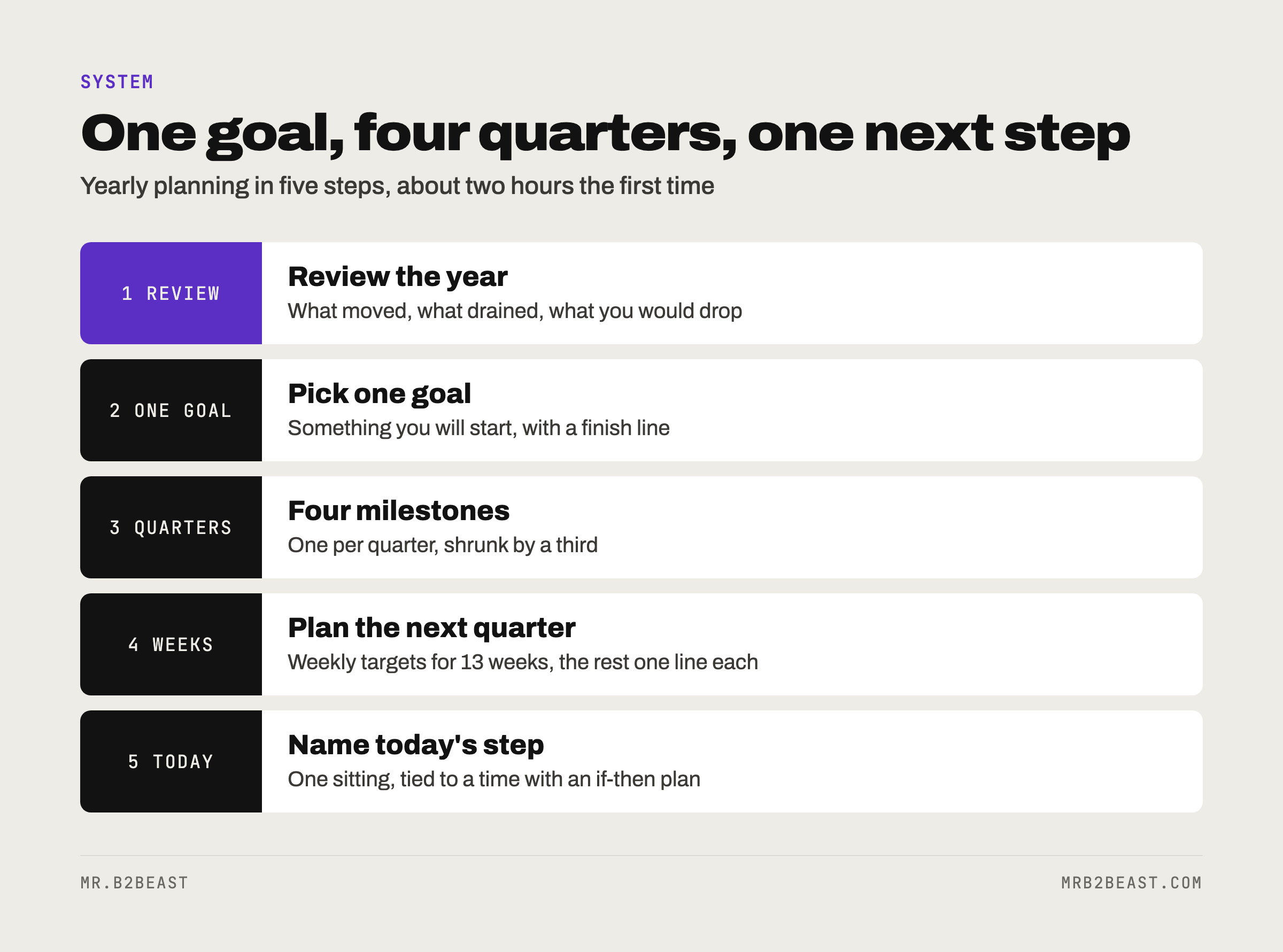
Step 1: Review the year you are leaving. Thirty minutes, three questions. What actually moved? What drained energy for little result? What would you drop if you had to? Start with subtraction. Most plans fail because they only add.
Step 2: Pick one goal. Phrase it as something you will do, not something you will stop. Test it with one question: if only this happens next year, would the year count? If the answer is no, you have the wrong goal. If you have three candidates, the other two become "not this year", written down so they stop nagging you.
Step 3: Split it into four quarters. Give each quarter one milestone you can see from the start of that quarter. Thirteen weeks is close enough to pull. Then shrink each milestone by a third, because of the planning fallacy above.
Step 4: Plan only the next quarter in detail. Break the next milestone into weekly targets. Leave the other three quarters as one line each. You will know much more in April than you know today, so detailed plans for October are fiction.
Step 5: Name today's step and an if-then plan. The step should take one sitting. Then attach it to a moment: "If it is Tuesday at 7:00, then I open the draft." Peter Gollwitzer and Paschal Sheeran pooled 94 independent tests of such if-then plans and found a medium to large effect on goal achievement (d = 0.65). The WOOP method adds the obstacle to that plan, and how to achieve goals covers the rest of the evidence.
Then run one short weekly review: did this week move the quarter? Track the milestone plus two or three inputs you control, as described in the goal tracker article.
Can you provide an example of an annual plan?
Here is one for a common goal: publishing a weekly newsletter for a full year. It is an example, not my own numbers.
| Milestone | What "done" looks like | |
|---|---|---|
| Q1 | Start the habit | Fixed send day, signup page live, 12 issues sent |
| Q2 | Make it easier | One template, a list of 20 topic ideas, 13 issues sent |
| Q3 | Get it found | Every issue reused as one post or article, 13 issues sent |
| Q4 | Keep or change | 13 issues sent, a review of what readers clicked and answered |
Next week: write issue one. Today: pick the send day and write three subject lines. If that is your goal, here is how to write a newsletter people actually open.
A second, shorter example. Goal: hold a 20-minute conversation in Spanish by December. Q1: 15 minutes of practice a day and the 500 most common words. Q2: one tutor session a week. Q3: a 10-minute conversation without switching to English. Q4: the 20 minutes. Today: book the first session.
Notice what both plans have in common. Every quarter ends in something you can check with a yes or a no.
What are some good yearly goals?
A good yearly goal is not about ambition. It is about whether you can steer it. Four tests:
- You control it. "Publish 50 issues" is yours. "Get 10,000 readers" depends on others.
- It starts something. Approach goals did better than avoidance goals in the Swedish study.
- It has a finish line. You can say on December 31 whether it happened.
- It fits one sentence. If you need a paragraph, it is two goals.
| Vague | Plannable |
|---|---|
| Get healthy | Run a 10k in under an hour by October |
| Read more | Read one book a month, twelve in total |
| Grow my audience | Publish one article every week |
| Build something | Ship a small product and get its first ten users |
Year planning with a full calendar: let the quarter set the pace
The quarter does the heavy lifting in this system. Four times a year, take one hour and do three things. Score the milestone with a yes or a no. Write the next quarter in weeks. Decide whether the yearly goal still deserves the year.
Changing the goal at a quarterly review is not failure. It is the review doing its job. Changing it every Monday is the problem.
You also do not need to wait for January. Hengchen Dai, Katherine Milkman and Jason Riis found that commitment contracts on one goal-setting site rose 145.3 percent at the start of a year, and also rose at the start of a week. Landmarks help, but any Monday is one. The fresh start effect article shows why waiting for the date can even cost you effort.
This is the structure I am building Gaapp around: one yearly goal, broken down to quarter, month, week and the step for today. A paper notebook works just as well. What matters is that the step for today exists and points at the goal.
The honest limits of yearly planning
The evidence here comes from children doing subtraction, students writing theses and people reporting on their own resolutions. Each study is a signal, not a law, and none of them tested this exact method.
A plan also cannot create time. If your week has no free hour, no annual plan will fix that. Start by finding the hour.
And some years should not have one big goal. If you are in a phase of recovery or a big life change, a quarter at a time is enough. The method still works, you just stop at Step 4.
FAQ
How do you do yearly planning? Review the past year, pick one goal you would be proud of on its own, and split it into four quarterly milestones. Plan only the next quarter in weekly detail. Then name one step you can do today and tie it to a fixed time with an if-then plan.
What does annual planning mean? Annual planning means deciding what the next twelve months are for and turning that into milestones and steps. Companies add budgets and resources. For one person, an annual plan can fit on one page: one goal, four milestones, the next quarter in weeks and today's step.
When should I start planning my year? Any time. A new year gives a motivational boost, but so does the start of a week or a month. Starting in November or December gives you a calm review before January and lets the first quarter begin on any Monday you choose.
How many goals should I set for a year? One main goal is enough for most people with a full calendar. Every extra goal takes time from the same free hours. Write the other candidates on a "not this year" list so they stop competing for attention.
Is quarterly planning better than yearly planning? They do different jobs. The yearly goal sets the direction, the quarter sets the pace. Research on goal distance suggests near goals pull much harder than far ones, so a year plan without quarterly milestones loses most of its force.
About the author
Tristan Eilenburg. One person. AI systems. Global reach. I write about building systems that work, with evidence instead of hype.
- X: @MrB2Beast
- LinkedIn: Tristan Eilenburg
- Instagram: @mrb2beast
The newsletter goes out once a week. If this one taught you something, the newsletter is where the next one lands first.
Sources
- Bandura, A., and Schunk, D. H. (1981). Cultivating competence, self-efficacy, and intrinsic interest through proximal self-motivation. Journal of Personality and Social Psychology, 41(3), 586-598. https://doi.org/10.1037/0022-3514.41.3.586
- Buehler, R., Griffin, D., and Ross, M. (1994). Exploring the "planning fallacy": Why people underestimate their task completion times. Journal of Personality and Social Psychology, 67(3), 366-381. https://doi.org/10.1037/0022-3514.67.3.366
- Norcross, J. C., Mrykalo, M. S., and Blagys, M. D. (2002). Auld lang syne: Success predictors, change processes, and self-reported outcomes of New Year's resolvers and nonresolvers. Journal of Clinical Psychology, 58(4), 397-405. https://doi.org/10.1002/jclp.1151
- Oscarsson, M., Carlbring, P., Andersson, G., and Rozental, A. (2020). A large-scale experiment on New Year's resolutions: Approach-oriented goals are more successful than avoidance-oriented goals. PLOS ONE, 15(12), e0234097. https://doi.org/10.1371/journal.pone.0234097
- Gollwitzer, P. M., and Sheeran, P. (2006). Implementation intentions and goal achievement: A meta-analysis of effects and processes. Advances in Experimental Social Psychology, 38, 69-119. https://doi.org/10.1016/S0065-2601(06)38002-1
- Dai, H., Milkman, K. L., and Riis, J. (2014). The fresh start effect: Temporal landmarks motivate aspirational behavior. Management Science, 60(10), 2563-2582. https://doi.org/10.1287/mnsc.2014.1901