Practice Does Not Make You Better at Multitasking. Here Is What the Research Shows
The people who multitask the most were worse at it in the lab. And they were the most sure they were good.
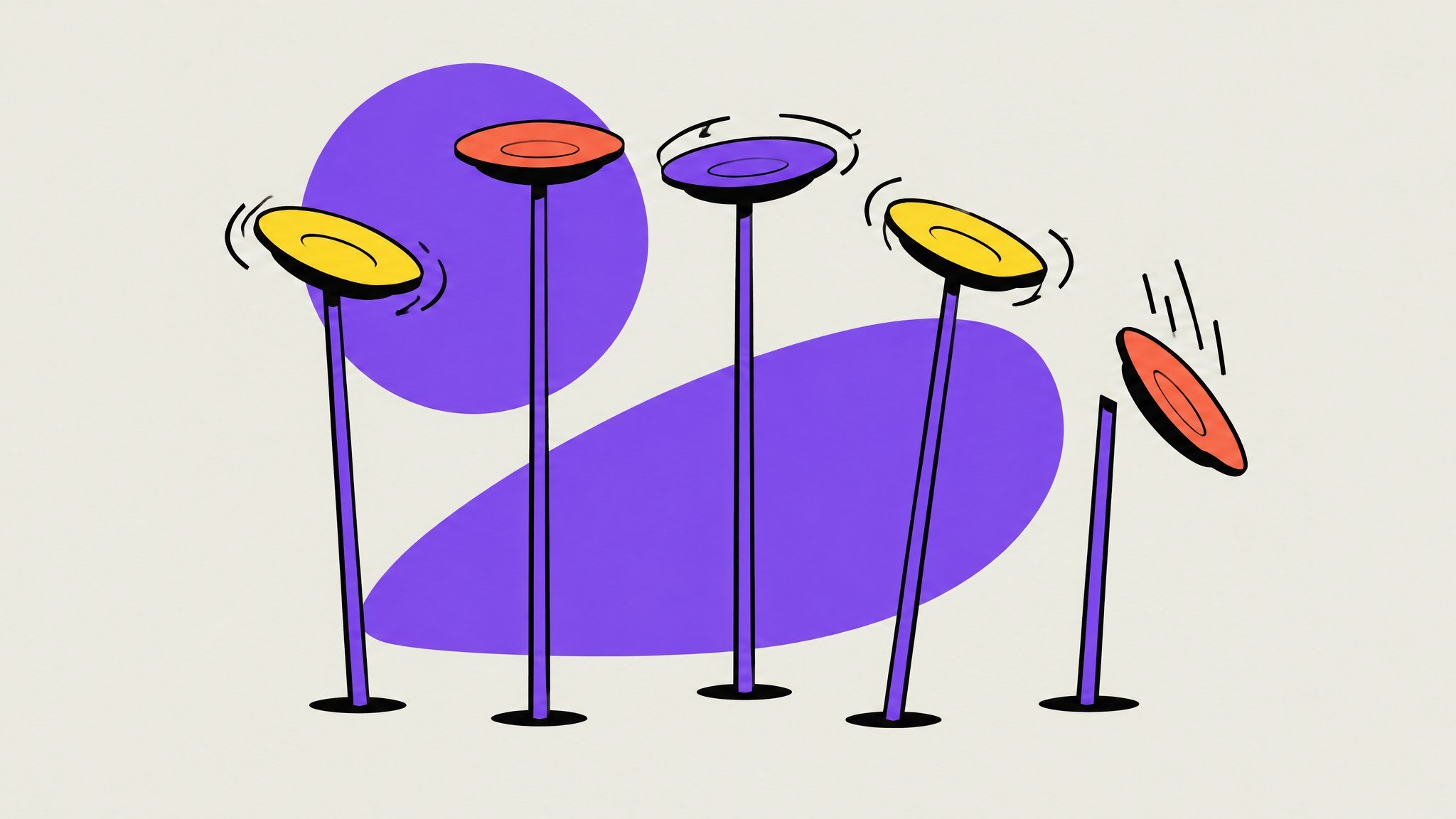
You would expect people who multitask all day to get good at it. Practice usually works that way.
In 2009, three Stanford researchers tested exactly that. Eyal Ophir, Clifford Nass and Anthony Wagner compared heavy and light media multitaskers in PNAS. The heavy multitaskers were not better at switching between tasks. They were worse. They were also worse at ignoring distractions.
In the Stanford press release, lead author Ophir said the team kept looking for something heavy multitaskers were better at. They did not find it.
The idea that multitasking is a skill is not stupid. Some people really can do two things at once. It is just a much smaller group than most of us think, and most of us are not in it.
I want to show you what the multitasking studies actually found, including the replications that make the story less clean. I want to show you why the people who multitask most are the worst judges of their own ability. And I want to give you a simple single-tasking system you can set up this week.
Key takeaways
- In the 2009 Stanford study, heavy media multitaskers were worse at task switching and at filtering distractions than light multitaskers.
- Later replications are mixed. About half of the studies find heavy multitaskers do worse on memory and attention. The other half find no difference. No published paper shows them with better working memory.
- Only 5 of 200 people (2.5 percent) showed no cost when driving and doing a memory task at once. In another study, 69.7 percent rated themselves above average at multitasking.
What the research actually shows
Most people believe multitasking is a trainable skill. If you juggle email, chat and a call every day, you should get faster at it over time.
That belief is reasonable. It is also the opposite of what the first big study found.
The Stanford study: worse, not better
Ophir, Nass and Wagner started with an online questionnaire. 262 Stanford students reported how often they used 12 media forms at the same time, such as video, music, chat and text. From this, the team built a Media Multitasking Index.
Students more than one standard deviation above the mean counted as heavy media multitaskers. Students more than one standard deviation below counted as light ones. Small groups from both ends then came to the lab. In the first filtering test, that was 19 heavy and 22 light multitaskers.
What is a heavy media multitasker? A heavy media multitasker is someone who often uses several media streams at the same time, for example a video, a chat and a document. In research, the label comes from a questionnaire score, usually the top end of the group. It describes a habit, not a measured skill.
The results went one way. Heavy multitaskers were more distracted by irrelevant items on screen. They had more trouble with irrelevant items in memory. And in a task switching test, they were slower to switch, which is the one thing practice should have improved. The authors linked this to weaker filtering of the task they had just left.
In short: the group with the most practice at switching was the group that switched worst.
The replications: mixed, but never better
A single study with groups of 15 to 22 people is not the last word. So the field kept testing.
In 2017, Wisnu Wiradhany and Mark Nieuwenstein ran two replications and a meta-analysis. Across their two experiments, they ran 14 tests. Only five showed the expected effect, and only two held up in a stricter Bayesian analysis. Their meta-analysis of 39 effect sizes found a weak link between media multitasking and distractibility. It became non-significant after a correction for small-study bias.
In 2018, Melina Uncapher and Anthony Wagner, one of the original authors, reviewed a decade of work in PNAS. Wagner summarized it for Stanford: in about half of the studies, heavy multitaskers did significantly worse on working memory and sustained attention. The other half found no significant difference.
The detail that matters for you: Wagner added that not a single published paper shows a significant positive link between media multitasking and working memory capacity. And Wagner was clear that the data do not prove multitasking causes the gap. People with weaker attention may simply multitask more.
The 2.5 percent who can
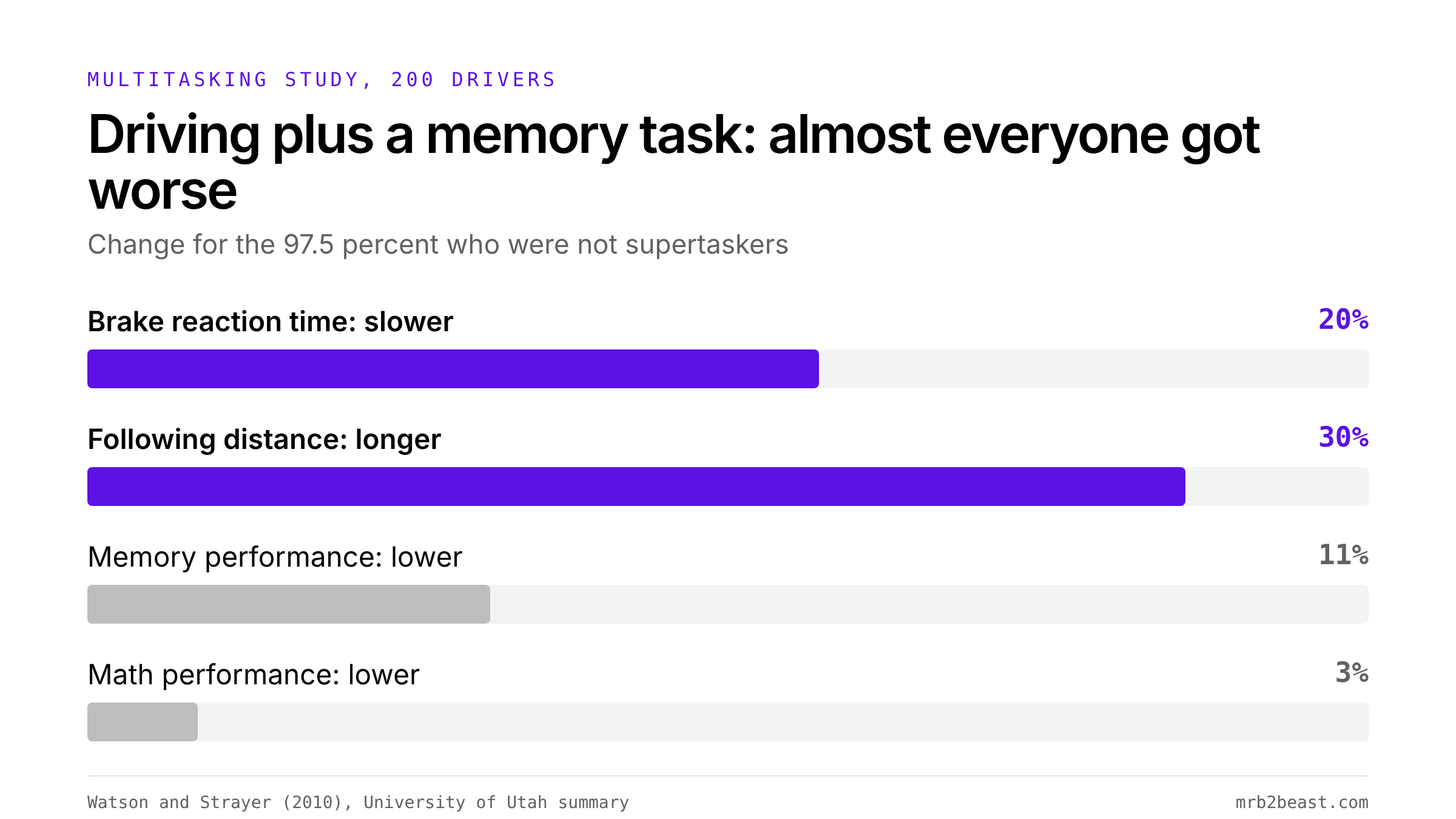
There is one group that really can multitask. In 2010, Jason Watson and David Strayer at the University of Utah put 200 people in a driving simulator. While driving, they did a demanding memory task: remember words in order while solving math problems.
For most people, everything got worse. According to the university summary, they took 20 percent longer to brake and left 30 percent more distance to the car ahead. Memory dropped 11 percent and math 3 percent.
Five people showed no cost at all. That is 2.5 percent of the sample. The researchers called them supertaskers.
What is a supertasker? A supertasker is a person who can do two demanding tasks at once with no drop in performance on either. Watson and Strayer found 5 among 200 participants. Note that this is a sample of students, so 2.5 percent is an estimate, not a census.
In short: multitasking without a cost exists. It is rare, it is not the result of practice, and the odds say it is not you.
The three mistakes almost everyone makes with multitasking
Once you see the research, the common mistakes are easy to spot.
Mistake 1: Trusting your own sense of how good you are
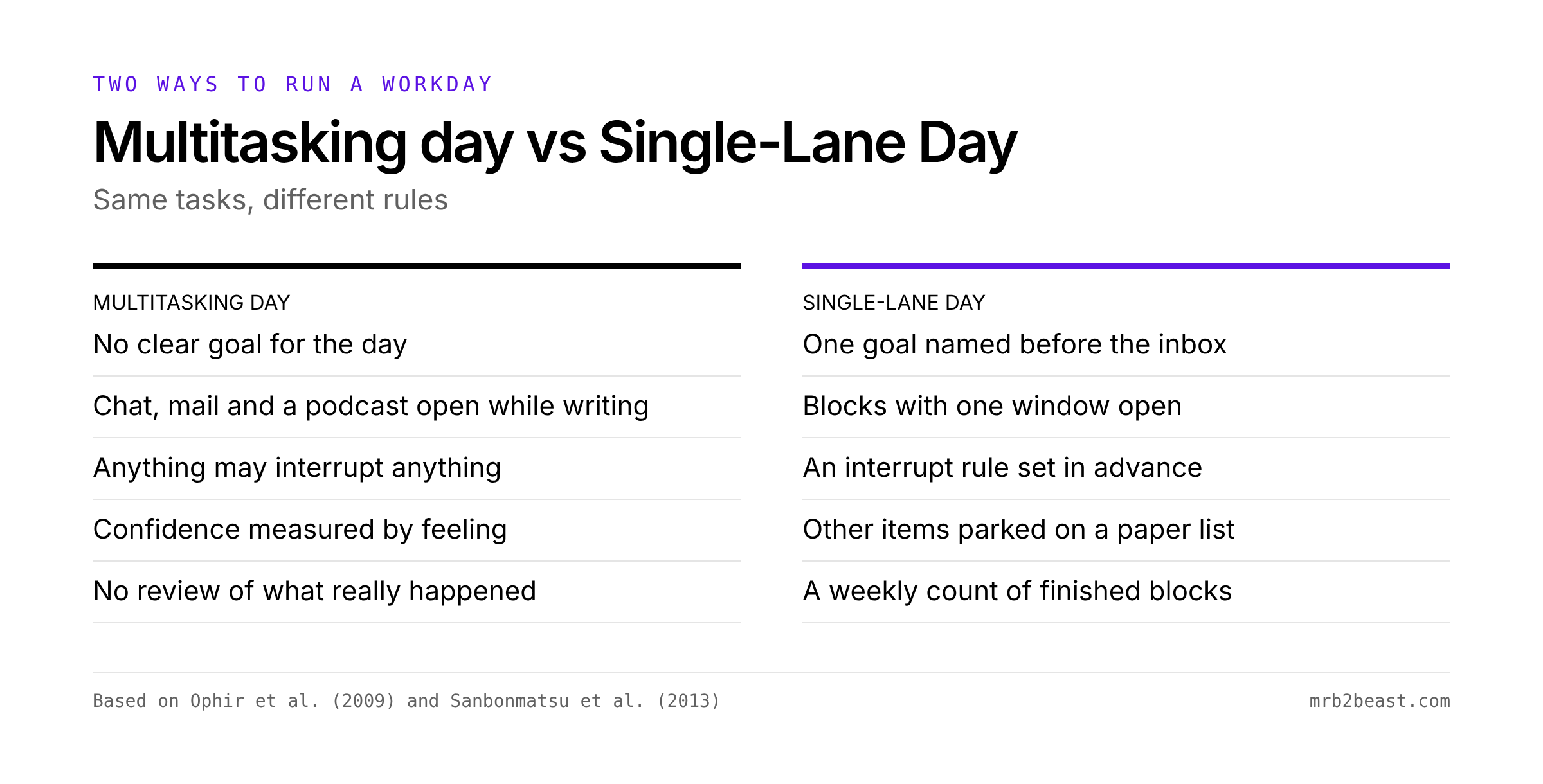
In 2013, David Sanbonmatsu, Strayer and colleagues tested 310 students in PLOS ONE. They measured real multitasking ability with a memory and math task. They also asked people how often they multitask and how good they think they are.
Of the 277 people with valid data, 193 rated themselves above average. That is 69.7 percent. By definition, at most half can be above the median.
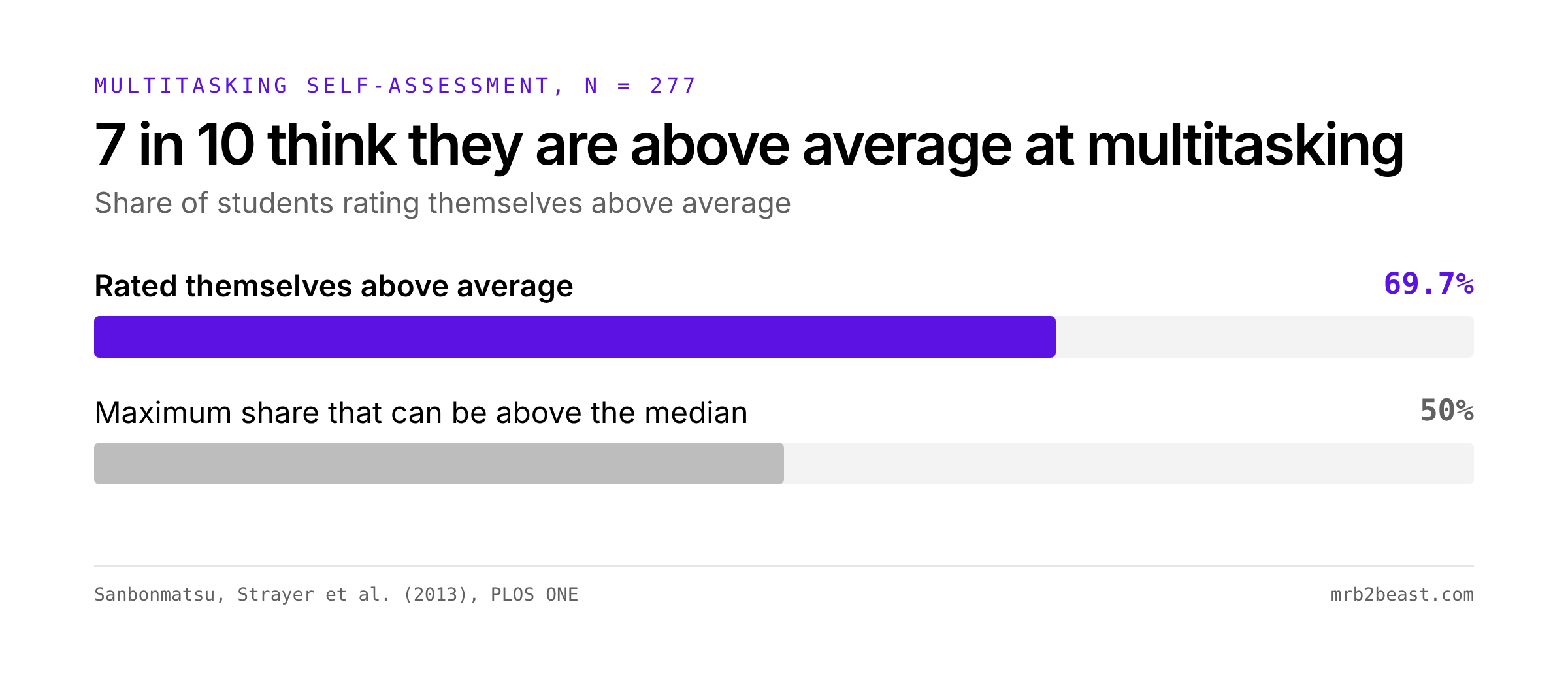
It gets worse. The people who multitasked most, including on the phone while driving, rated their ability higher. Their measured ability was lower. And perceived ability had no significant link to actual ability.
That means: the feeling of being good at multitasking is not evidence. In this study, it pointed in the wrong direction.
Mistake 2: Running every channel during deep work
Here is an example. A solo founder writes a sales proposal with chat, email and a podcast running. Nothing dramatic happens. She answers a few messages and the proposal gets done.
But the Stanford data suggest the cost is in filtering. Each open channel is one more thing your brain has to ignore. If you are like most heavy multitaskers in those studies, ignoring is exactly the part that is weaker.
The proposal does not fail. It just gets the attention left over after every other channel took its share.
Mistake 3: Letting anything interrupt anything
Most people have no rule for what may break a focus block. So everything can. A client mail, a colleague question and a phone notification all get the same priority as the task in front of you.
The result is not one big multitasking session. It is a day of small switches, each one cheap on its own. If you want the detail on what each switch costs, the article on context switching covers it.
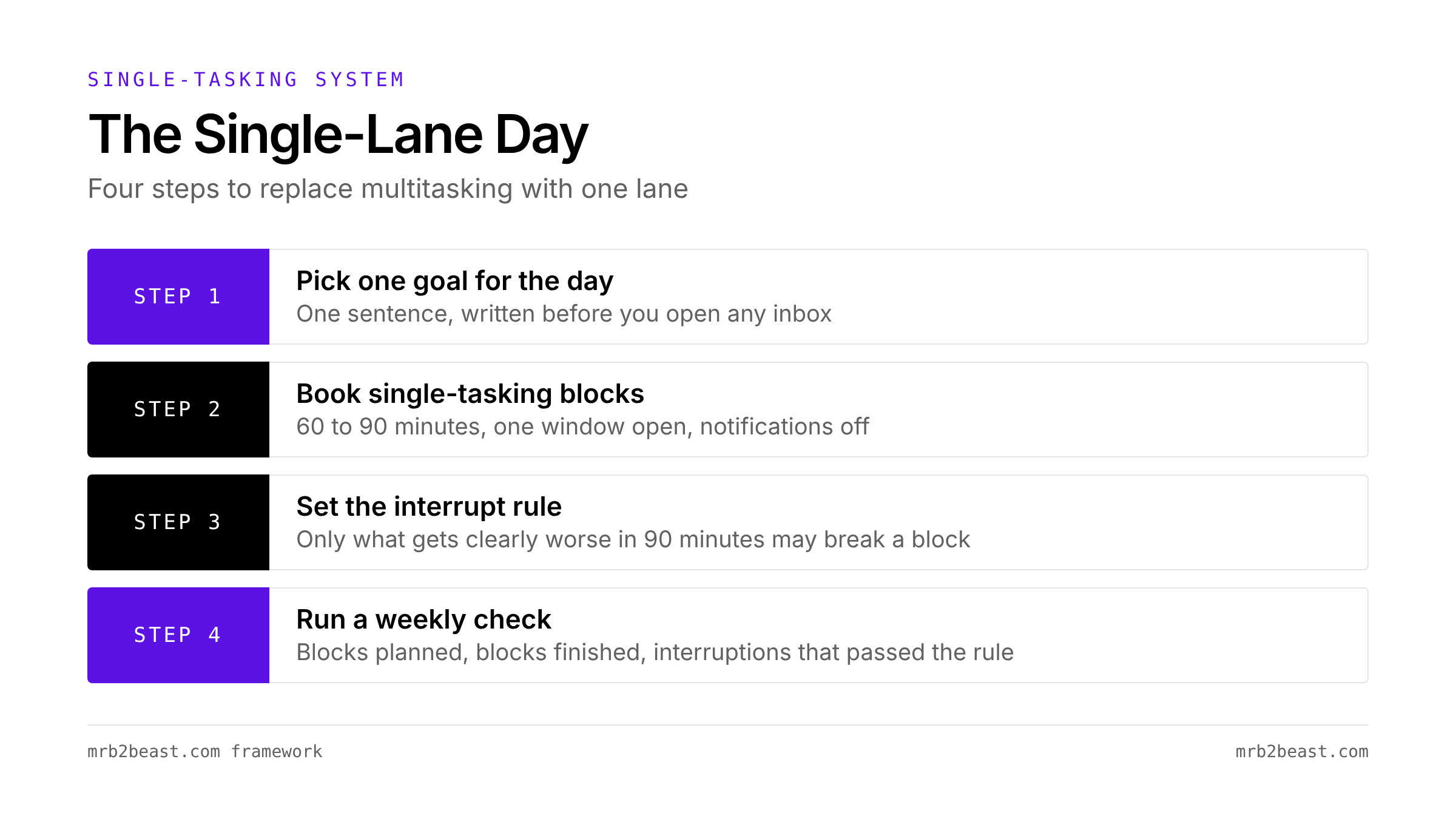
The Single-Lane Day: a single-tasking system
I am not saying you must never do two things at once. Folding laundry during a podcast is fine. I am saying that demanding work deserves one lane. Here is a four-step system built on the research above.
Step 1: Pick one goal for the day. Before you open any inbox, name the one task that moves a bigger goal forward. Write it down in one sentence. This is the task your single-tasking blocks will serve. If you work with yearly goals, it is the daily end of the chain from the goal system in this article.
Step 2: Book single-tasking blocks for that goal. Put one or two blocks of 60 to 90 minutes in your calendar. During a block, only one window is open. Chat, mail and phone notifications are off. No music with lyrics, no second screen with a feed. You are removing things your brain would otherwise have to filter.
Step 3: Set your interrupt rule before the block starts. Decide in advance what may break a block. A simple version: only something that will be clearly worse in 90 minutes than it is now. A customer with a down system qualifies. A question that can wait until lunch does not. Everything else goes on a paper list next to you and gets handled after the block.
Step 4: Run a weekly check. Once a week, count three things. How many blocks you planned. How many you finished without a break. And how many interruptions passed your rule. If the last number is high, your rule is too loose or your channels are not really closed.
This is the idea behind Gaapp.io, a tool to plan one goal per day that shows what is due today and which bigger goal it serves. Disclosure: I am building it. A paper notebook works too. The system matters more than the tool.
Ask yourself this week:
- What is the one goal for today, and does it have a block in my calendar?
- What exactly is allowed to interrupt that block, and did I decide it before or during?
- Do I believe I am good at multitasking, and what evidence do I have besides the feeling?
Conclusion: practice builds the habit, not the skill
The people who multitask the most are not the best at it. They are the most convinced.
The Stanford result was a surprise because it broke a simple rule: practice makes you better. Later studies made the picture less dramatic. Many found no difference at all. But none found that heavy multitaskers had better working memory.
The rest is simple. A few people can do two demanding things at once. Most cannot, and most of those believe they can. A day goal, a single lane, an interrupt rule and a weekly check do not need talent. They just need to be set up before the day starts.
What you learned today
- In the 2009 Stanford study, heavy media multitaskers were worse at task switching and filtering distractions, not better. Later studies are mixed, but none show better working memory.
- Only 5 of 200 people (2.5 percent) could drive and do a memory task with no cost. For the rest, brake time rose 20 percent.
- 69.7 percent of students rated themselves above average at multitasking, and those who multitasked most had lower measured ability.
FAQ
Is multitasking bad for you? For demanding tasks, the research points to a cost. In a driving study, 97.5 percent of people got worse at both tasks when doing them together. Studies of heavy media multitaskers find worse memory and attention in about half of the cases and no difference in the rest. Simple tasks combined with automatic ones, like walking and talking, are a different case.
Is multitasking a myth? Mostly, for demanding work. The brain usually switches between tasks rather than running them in parallel. A small group, called supertaskers, showed no cost in one study: 5 of 200 people, or 2.5 percent. For everyone else, doing two demanding things at once means doing both a little worse.
What are heavy media multitaskers? Heavy media multitaskers are people who often use several media streams at once, such as video, chat and text. The term comes from a 2009 Stanford study that used a questionnaire score to sort people. In that study, heavy multitaskers were worse at filtering distractions and at task switching than light multitaskers.
What is a supertasker? A supertasker is someone who can do two demanding tasks at once without a drop in performance. Watson and Strayer found 5 among 200 participants who drove in a simulator while doing a memory and math task. The supertaskers even scored slightly better on memory. The rest of the group got worse on driving and memory.
How do I stop multitasking and focus on one task? Pick one goal for the day before opening any inbox. Book a 60 to 90 minute block for it with only one window open and notifications off. Decide in advance what may interrupt, and write everything else on a list. Once a week, count how many blocks you finished without a break.
About the author
Tristan Eilenburg. One person. AI systems. Global reach. I write about building systems that work, with evidence instead of hype.
- X: @MrB2Beast
- LinkedIn: Tristan Eilenburg
- Instagram: @mrb2beast
- Building Gaapp.io (Instagram: @gaapp.io)
I write one of these every week. If this one taught you something, the newsletter is where the next one lands first.
Sources
- Ophir, E., Nass, C., and Wagner, A. D. (2009). Cognitive control in media multitaskers. Proceedings of the National Academy of Sciences, 106(37), 15583-15587. https://doi.org/10.1073/pnas.0903620106
- Gorlick, A. (2009, August 24). Media multitaskers pay mental price, Stanford study shows. Stanford News. https://news.stanford.edu/stories/2009/08/multitask-research-study-082409
- Wiradhany, W., and Nieuwenstein, M. R. (2017). Cognitive control in media multitaskers: Two replication studies and a meta-analysis. Attention, Perception, and Psychophysics, 79(8), 2620-2641. https://doi.org/10.3758/s13414-017-1408-4
- Uncapher, M. R., and Wagner, A. D. (2018). Minds and brains of media multitaskers: Current findings and future directions. Proceedings of the National Academy of Sciences, 115(40), 9889-9896. https://doi.org/10.1073/pnas.1611612115
- Stanford News (2018, October 25). Decade of data reveals that heavy multitaskers have reduced memory, Stanford psychologist says. https://news.stanford.edu/stories/2018/10/decade-data-reveals-heavy-multitaskers-reduced-memory-psychologist-says
- Watson, J. M., and Strayer, D. L. (2010). Supertaskers: Profiles in extraordinary multitasking ability. Psychonomic Bulletin and Review, 17(4), 479-485. https://doi.org/10.3758/PBR.17.4.479
- University of Utah (2010, March 29). Few drive well while yakking on cell phones; yet 1 in 40 are "supertaskers" who can do both. Via ScienceDaily. https://www.sciencedaily.com/releases/2010/03/100329075911.htm
- Sanbonmatsu, D. M., Strayer, D. L., Medeiros-Ward, N., and Watson, J. M. (2013). Who multi-tasks and why? Multi-tasking ability, perceived multi-tasking ability, impulsivity, and sensation seeking. PLOS ONE, 8(1), e54402. https://doi.org/10.1371/journal.pone.0054402
- University of Utah (2013, January 23). Frequent multitaskers are bad at it: Can't talk and drive well. Via ScienceDaily. https://www.sciencedaily.com/releases/2013/01/130123195101.htm