How to Be More Productive Without Doing More
Longer days stop paying off sooner than you think. The bigger lever is what you take away.
Most advice on how to be more productive adds something. Another app, an earlier alarm, a longer morning routine. More inputs, same day.
I build Gaapp in about an hour a day. An hour does not leave room for more. It forces the opposite question: what can I remove so the hour goes to the one thing that matters?
This piece is about that question. Five subtractions, each backed by research or by what a short daily hour teaches you fast.
Key takeaways
- In a study of munitions workers, output rose in step with hours only up to about 49 hours a week. Output at 70 hours differed little from output at 56 (Pencavel, 2015).
- The strongest productivity tips remove things: projects, decisions, switches, slack time and the habit of counting only what is still open.
- Run the five subtractions for two weeks before you add any new tool.
Why doing more stops working
The intuitive fix for falling behind is to work longer. The data says that fix runs out.
The economist John Pencavel went back to records from British munitions workers in the First World War. Below 49 hours a week, output moved in proportion to hours. Above that, each extra hour added less. Output peaked at about 63 hours, and output at 70 hours differed little from output at 56. Rest mattered too: 48 hours over six days produced slightly more than 70 hours over seven.
Factory work is not knowledge work, and a century is a long time. But the shape is familiar to anyone who has pushed through a late night and rewritten the work the next morning. After a point, hours stop turning into output. So the useful question is not how to do more. It is how to waste less of what you already put in.
5 ways to be more productive by subtracting
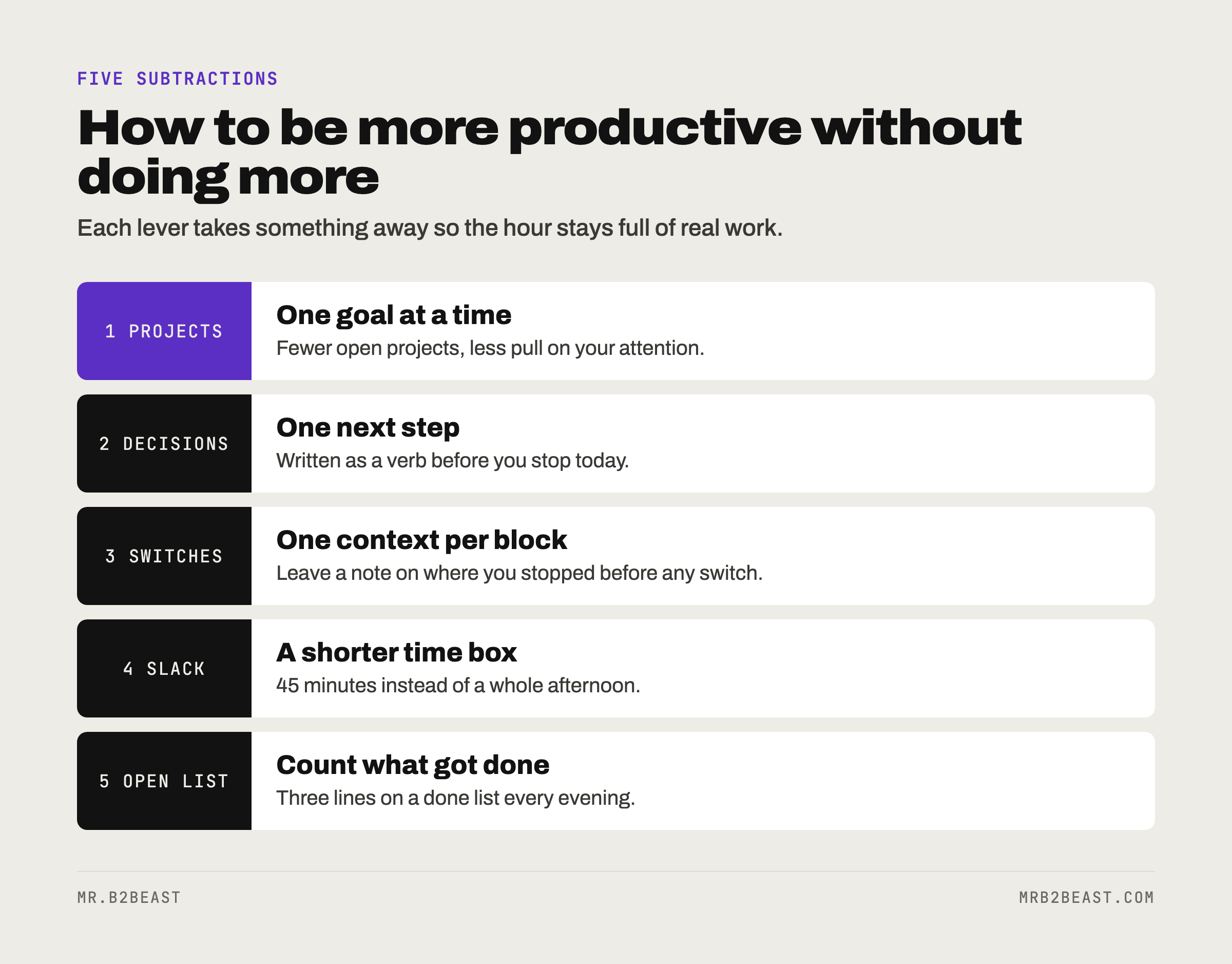
1. Subtract projects: one goal at a time
Every active project takes a slice of attention, even when you are not working on it. Five open projects means five things pulling at you every time you sit down.
Pick one goal that gets your best hours. The rest waits, or gets done in whatever time is left. If you want the full structure behind that, from the yearly goal down to today, the productivity system article lays it out layer by layer. Here, the point is smaller: fewer projects, less pull.
2. Subtract decisions: one next step, written as a verb
Half of a slow start is deciding what to do. "Newsletter" is not something you can start. "Write three subject lines for Tuesday" is.
Write tomorrow's next step before you stop today, starting with a verb. When you sit down, there is nothing to decide, only something to begin. With one hour a day, this alone protects the first 15 minutes.
3. Subtract switches: one context per block
Switching between tasks feels efficient. It is not free. The context switching article explains the hidden cost, attention residue: part of your mind stays on the unfinished task. The fix it describes is cheap. Before you switch, write a short note on where you stopped and what comes next.
And no, practice does not make you good at doing two things at once. The multitasking research shows heavy multitaskers doing worse at switching, not better. One block, one task, notifications off.
4. Subtract slack: a shorter time box
Give a task a whole afternoon and it tends to need one. The Parkinson's law article shows that tight time limits do speed up work in studies, and that longer limits make people believe a task is bigger than it is.
So shrink the box on purpose. Give the draft 45 minutes instead of "today". You will not finish everything. You will finish the part that matters, because the box forces you to choose it first.
5. Subtract the open list: count what got done
A to-do list only shows what is still open. At the end of a good day, it still looks unfinished. That feeling quietly drains the next day.
Write a done list instead, three lines each evening. The progress principle research found that progress on meaningful work was the top driver of a good workday, and that small wins count. You did make progress. Now you can see it.
What one hour a day teaches about how to be productive
An hour a day is a good teacher, because it punishes every bad habit immediately.
Start the hour with email, and it is gone. Keep three side projects open, and none of them moves. Spend ten minutes picking a task, and you lose a sixth of your time before you start.
The lesson is not "work harder in the hour". It is that the hour only works when everything else has already been removed: the project choice, the decision about the step, the open tabs, the vague deadline. That is why these five tips are subtractions. Each one takes something out so the hour can stay full of the work itself.
If you have more than an hour, the same rule holds. You just notice the waste later.
What is the 3-3-3 rule for productivity?
The 3-3-3 rule, usually credited to the author Oliver Burkeman, splits a day into three parts: three hours on your most important project, three shorter urgent tasks, and three maintenance tasks, the routine upkeep like cleaning or exercise.
It works for the same reason the subtractions work. It caps the list at nine items and gives the most important project the first and biggest slot. If three hours is not realistic, keep the shape and shrink the numbers. One focused hour, one or two short tasks, a little upkeep.
Productivity tips that cost more than they return
Some popular ways to be more productive add work instead of removing it:
- A new app every few weeks. Moving your tasks is not progress. Pick one tool and keep it for a quarter.
- Very early alarms by default. An earlier start only helps if the extra time goes to the one goal. Lost sleep is a bad trade for an hour spent on email.
- Longer lists. Writing down more does not get more done. It makes the list harder to trust.
FAQ
How can I be more productive every day? Pick one goal, write tomorrow's next step before you stop today, and protect one block for it before email. Keep one task per block and count what got done in the evening. These steps remove friction instead of adding hours.
What are the best ways to be more productive at work? Cut the number of active projects, give each task a tight time box, and batch small requests outside your focus block. Leave a short note on where you stopped before every switch, so you can come back faster.
Is working longer hours more productive? Only up to a point. In Pencavel's study of munitions workers, output stopped rising in proportion to hours above about 49 hours a week, and 70 hours produced little more than 56. Fewer, better hours usually beat longer ones.
What is the difference between being productive and being busy? Busy means many tasks done. Productive means the right task moved forward. A day with one finished step on your main goal can be more productive than a day with twenty small items checked off.
About the author
Tristan Eilenburg. One person. AI systems. Global reach. I write about building systems that work, with evidence instead of hype.
- X: @MrB2Beast
- LinkedIn: Tristan Eilenburg
- Instagram: @mrb2beast
The newsletter goes out once a week. If this one taught you something, the newsletter is where the next one lands first.
Sources
- Pencavel, J. (2015). The productivity of working hours. The Economic Journal, 125(589), 2052-2076. https://doi.org/10.1111/ecoj.12166
- Government Executive (2014, December). You really can work longer hours without killing your productivity. https://www.govexec.com/management/2014/12/you-really-can-work-longer-hours-without-killing-your-productivity/101394
- Bartter, A. (2024, November 17). Too much to do and not sure where to start? Try the 3-3-3 method to cultivate calm and boost productivity. Stylist. https://www.stylist.co.uk/life/3-3-3-method-productivity-time-management/939462