Done List: Why It Beats Your To-Do List
A to-do list shows what is still open. A done list shows that the week actually moved.
A done list is the reverse of a to-do list. It starts empty every morning, and you add a line each time you finish something.
That sounds trivial. It changes what you look at. A to-do list measures the gap between you and everything you could do. That gap never closes, so every day starts in debt. A done list starts at zero, and every line counts up.
The writer Oliver Burkeman makes this case well: the to-do list will never be empty, and accepting that frees you to focus on what matters. I want to add the part most posts skip: why seeing progress works, what to write down, and how to turn a daily list into a yearly record.
Key takeaways
- A to-do list counts what is open. A done list counts what moved, including the unplanned work that ate your day.
- In a diary study of 238 knowledge workers, making progress was by far the most prominent event on their best days, and small wins counted.
- A meta-analysis of 138 studies found that monitoring progress improves goal attainment, more so when progress is physically recorded.
What is a done list?
A done list is a running record of what you completed, written as you go. No plan, no ranking, no due dates. Just finished work, in the order it happened.
The difference between a done list and a to-do list is direction. A to-do list looks forward and asks what is left. A done list looks back and asks what happened. You need both questions. Most people only ever ask the first one.
Done list vs to-do list: what each one hides
A to-do list hides your progress. Finished items get crossed out and disappear, while new ones keep arriving. On a busy day you can finish eight things, add nine, and end with a longer list than you started with.
A done list hides nothing that happened. It also catches the work no list predicted: the client call that ran long, the bug you fixed, the decision you finally made. That unplanned work is often most of the day. On a to-do list it is invisible. On a done list it is the evidence of where your time went.
That is why a done list is the best to-do list alternative for people who feel busy but stuck. It does not replace planning. It shows whether the plan and the day had anything in common.
Why small wins on paper work
Teresa Amabile and Steven Kramer collected nearly 12,000 daily diary entries from 238 knowledge workers at seven companies. Of all the events on the best workdays, Amabile said, "by far the most prominent was making progress." Small wins mattered too: 28 percent of incidents with only a minor impact on the project had a major impact on how people felt. Setbacks hit roughly two to three times harder than progress. The full numbers are in the article on the progress principle.
The participants were, in effect, writing a daily record of their work. A done list is a lighter version of the same habit.
The second piece of evidence is about recording. In 2016, Benjamin Harkin and colleagues pooled 138 randomized studies with 19,951 participants. Interventions that got people to monitor their progress improved goal attainment, and the effect was larger when the progress was physically recorded. Most of those studies were about health goals, so treat this as a direction, not a guarantee for your workday.
The third piece is about what stays open. Unfinished tasks are said to nag at you, though the classic Zeigarnik effect mostly fails to replicate. What does hold up: in experiments by E. J. Masicampo and Roy Baumeister, writing a specific plan for an unfinished goal reduced intrusive thoughts about it, even though the goal stayed unfinished. That is why the routine below ends with one next step.
How to keep a done list in two minutes a day
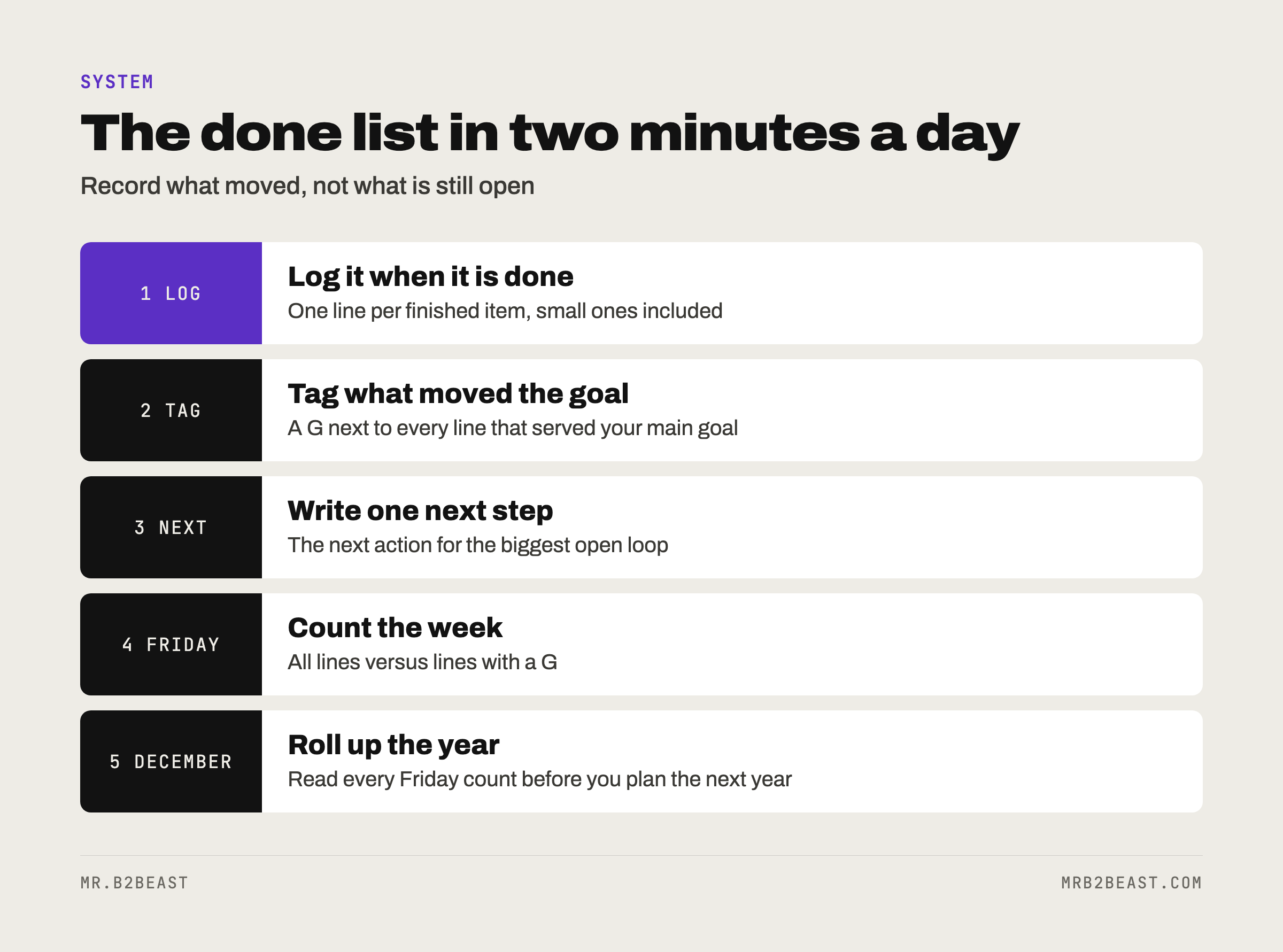
Step 1: Log it when it is done. One line per finished item, written right away. Use whatever is open all day: a note app, a text file, paper. Small items count.
Step 2: Tag what moved the goal. Put a G next to any line that moved your main goal forward. Everything else stays untagged. This turns the list from a diary into a signal.
Step 3: Write one next step. Before you stop, add one line for the most important open loop: the next action, when, and where. That is the plan that quiets the unfinished task.
Step 4: Count on Friday. How many lines this week? How many with a G? If the G count is near zero, you were busy, not productive. That is the moment to read how to prioritize tasks and fix next week before it starts.
Step 5: Roll up in December. Read the year's Friday counts in one sitting. You will find more than you remember.
What a done list looks like in practice
Here is my October so far, written as a done list:
- Moved mrb2beast.com off Lovable to my own server. New site live since 2026-10-07.
- Lighthouse mobile score on the homepage from 77 to 99, in one night, with Claude Code. Measured locally; the official PageSpeed Insights re-test is still pending.
- Started publishing 20 articles that test famous productivity studies, one per morning since 2026-10-06.
- Put the X tips cheat sheet live on 2026-10-19: 148 tips from 9 creator videos, as of that day.
- Since 2026-10-19, one agent writes my X posts 10 to 14 days ahead and a second agent checks them.
- Followers on @MrB2Beast: about 100 in early October, 531 on 2026-10-21 according to the X API.
And the lines that did not go well. Three weekly recap posts from 2026-10-16 to 2026-10-18 still had unfilled placeholders instead of numbers and post references, so they stayed drafts and never went out. A connect post on 2026-10-19 failed to publish. A done list with only wins is a highlight reel. The misses are what you fix on Friday.
Count what got done this year
The end of the year is when most people make a list of what they will do next year. Try the opposite first. Open your done list, or your calendar and sent mail if you have no list yet, and write down what actually got finished this year.
Two things happen. You see progress you forgot, which is the progress principle at work. And you see where the year really went, which is the best input there is for next year's plan. People start new goals more often after landmarks like a new year, as the fresh start effect research shows. January is that landmark. Arrive with evidence, not a wish list.
When a done list is not enough
A done list tells you what happened. It does not tell you what to do next. Keep a short plan alongside it, built around one goal, as described in the productivity system article.
It can also turn into busywork. If you start doing small tasks just to log them, look at your G count. Ten lines without a G is a full day that did not move anything.
FAQ
What is the difference between a done list and a to-do list? A to-do list records what you still need to do and never empties. A done list records what you finished, starting from zero each day. The to-do list plans the day. The done list shows what actually happened, including unplanned work.
What can I say instead of to-do list? Common alternatives are task list, action list, or plan for the day. If you mean a record of finished work, "done list" or "got done list" is the usual term.
Do people with ADHD make to-do lists? Some do and some do not; there is no single pattern. None of the studies in this article tested done lists for ADHD, and a done list is not a treatment. If focus problems affect your work or life, talk to a doctor.
Should I keep a done list and a to-do list? Yes, for most people. Keep a short plan for what comes next and a done list for what happened. Compare them on Friday to see whether your days match your goal.
About the author
Tristan Eilenburg. One person. AI systems. Global reach. I write about building systems that work, with evidence instead of hype.
- X: @MrB2Beast
- LinkedIn: Tristan Eilenburg
- Instagram: @mrb2beast
The newsletter goes out once a week. If this one taught you something, the newsletter is where the next one lands first.
Sources
- Burkeman, O. What if you're already on top of things? https://www.oliverburkeman.com/donelist
- Nobel, C. (2011, September 6). How small wins unleash creativity. HBS Working Knowledge. https://www.library.hbs.edu/working-knowledge/how-small-wins-unleash-creativity
- Harkin, B., et al. (2016). Does monitoring goal progress promote goal attainment? A meta-analysis of the experimental evidence. Psychological Bulletin, 142(2), 198-229. https://eprints.whiterose.ac.uk/91437/
- American Psychological Association (2015, October). Frequently monitoring progress toward goals increases chance of success. https://www.apa.org/news/press/releases/2015/10/progress-goals
- Masicampo, E. J., and Baumeister, R. F. (2011). Consider it done! Plan making can eliminate the cognitive effects of unfulfilled goals. Journal of Personality and Social Psychology, 101(4), 667-683. https://doi.org/10.1037/a0024192