The 12 Week Year Is Not Proven. Here Is Why Quarterly Goals Still Work
The evidence is not about the number 12. It is about how far away the finish line feels.

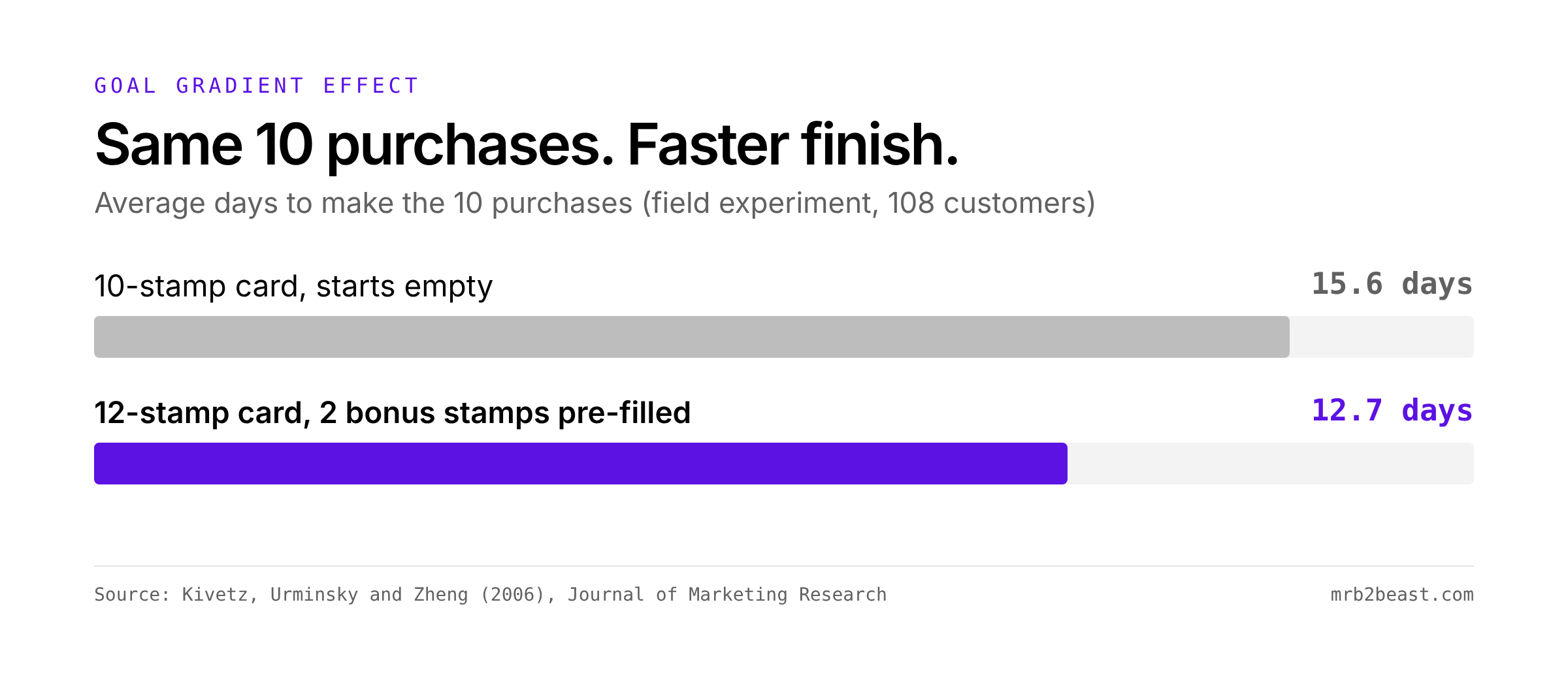
In 2006, researchers at Columbia ran a test at a campus cafe. Some customers got a coffee card with 10 empty stamp slots. Others got a card with 12 slots, two of them already stamped as a bonus.
Both groups needed exactly 10 purchases for a free coffee. The pre-stamped group finished in 12.7 days on average. The empty-card group took 15.6 days.
Nothing about the work changed. Only the feeling of distance did. That study, by Ran Kivetz, Oleg Urminsky and Yuhuang Zheng, says more about quarterly goals than most planning books.
The popular version of this idea is the 12 Week Year, a 2013 book that treats 12 weeks as your new year. The idea is not stupid. It is just sold with more certainty than the evidence gives it.
I want to show you what the research on goal distance actually says. I want to show you what Google really means by "0.7 is a good score," because most posts get it half right. And I want to give you a quarterly system you can set up this week.
Key takeaways
- People speed up as a goal gets closer, even when the closeness is partly an illusion. Shorter horizons create more of those moments.
- In a classic experiment, a far goal produced about the same result as no goal at all. A near goal did not.
- At Google, 0.7 is the target only for aspirational OKRs. Committed OKRs are expected to hit 1.0.
What the research actually shows
The common belief is simple. Set a big goal for the year, keep it in view, and the size of the goal will keep you moving.
The research says distance matters more than size. A goal pulls hardest when it is close.
The goal gradient is real, and it is about perception
The idea is old. In 1932, the behaviorist Clark Hull observed that rats ran faster as they got closer to food. He called it the goal gradient hypothesis. The 2006 paper title says it was "resurrected" for people.
The cafe program first gave the researchers 949 redeemed cards and about 10,000 coffee purchases. In that data, the time between purchases shrank as customers got closer to the free coffee.
Then came the experiment with 108 customers, randomly handed one of the two cards. The pre-stamped group finished nearly three days, or 20 percent, faster.
A second study in the same paper tracked 148 members of an online music-rating program. They had to rate 51 songs to earn a 25 dollar gift card. They visited more often and rated more songs as they got closer to the reward. After each reward, the pace reset and the climb started again.
What is the goal gradient effect? The goal gradient effect is the tendency to increase effort as you get closer to a goal. Kivetz, Urminsky and Zheng showed it in customer reward programs in 2006. The key detail: it responds to perceived distance. Two free stamps on a card changed behavior, even though the real work stayed the same.
A far goal can be worth almost nothing
In 1981, Albert Bandura and Dale Schunk ran an experiment with 40 children who struggled with subtraction. All of them worked through the same 42 pages of self-study material over seven sessions.
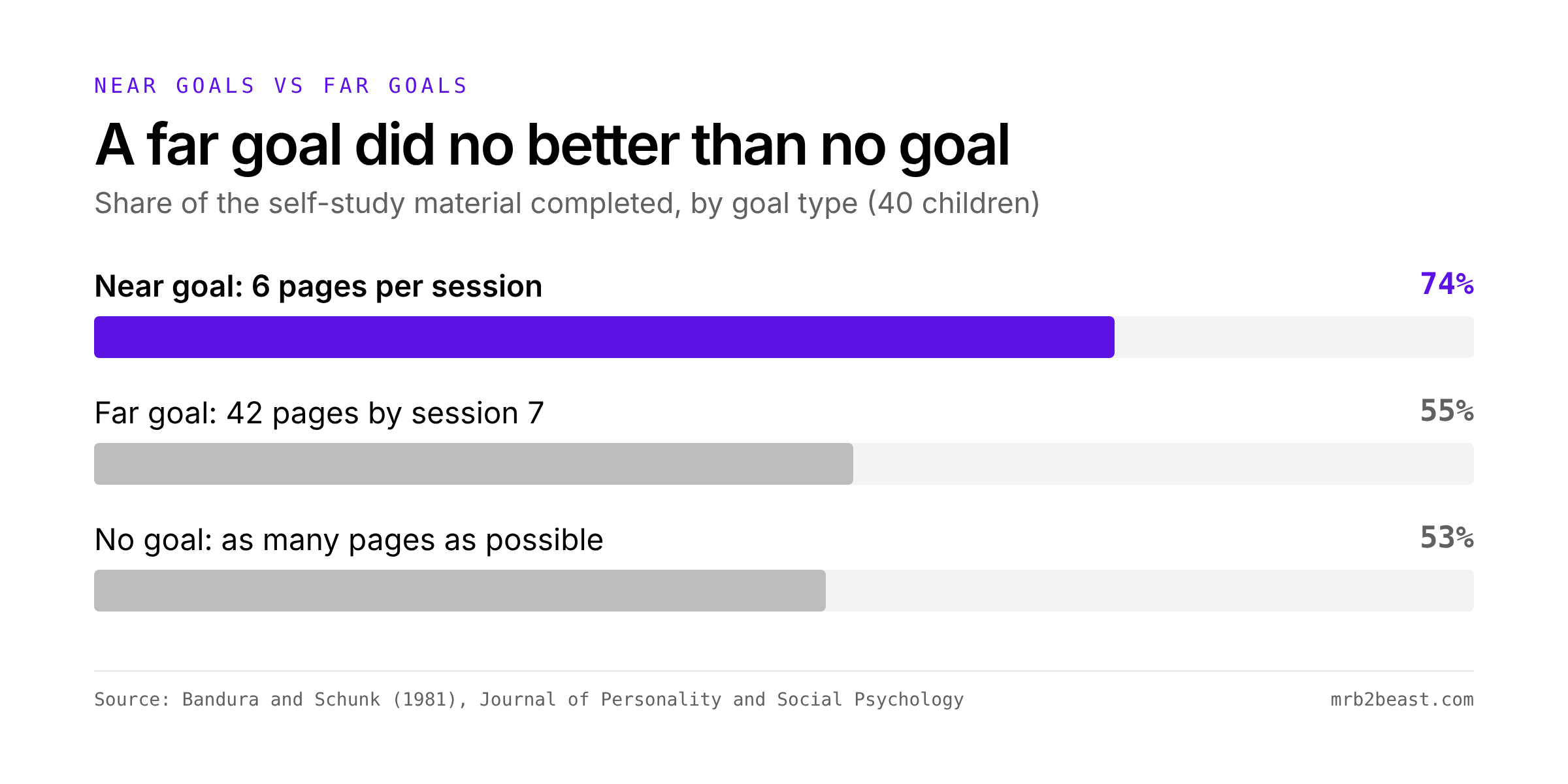
One group was told to aim for at least six pages per session. A second group was told to aim for all 42 pages by the end of session seven. A third group got no goal, just "as many pages as you can."
The near-goal group completed 74 percent of the material. The far-goal group completed 55 percent, and the no-goal group 53 percent. The authors put it bluntly: distal goals had no demonstrable effects.
The near-goal group also learned more and kept going longer on hard problems. Later, given free choice, 90 percent of them chose to solve subtraction problems, against about 40 percent in the other groups. This was a small study with children, so treat it as a strong signal, not a law. But the pattern matches the cafe data.
What to look at changes over time
Minjung Koo and Ayelet Fishbach added a twist in 2012. Their "small-area hypothesis" says motivation rises when you focus on whichever part is smaller: the progress already made, or the progress still left.
In one field study, a sushi restaurant gave customers loyalty cards for a free meal after 10 purchases. Some cards highlighted meals already bought, others the meals left to buy. Early customers responded better to the first framing, and customers close to the reward responded better to the second.
There is also a dip in the middle. Andrea Bonezzi, Miguel Brendl and Matteo De Angelis showed in 2011 that motivation can be higher near the start and near the end, and lower around halfway. A year has one long middle. A quarter has a short one.
In short: goals pull harder when they feel close. A year gives you one finish line. Four quarters give you four.
The three mistakes almost everyone makes with quarterly goals
The research supports shorter horizons. It does not support every way people use them.
Mistake 1: Treating the 12 Week Year as proven science
The 12 Week Year by Brian Moran and Michael Lennington was published by Wiley in 2013. Its subtitle promises to get more done in 12 weeks than others do in 12 months.
The book has useful parts. Summaries of it describe a weekly scorecard, a target of executing 85 percent of planned weekly actions, a weekly accountability meeting and a 13th week for review.
Here is what is not proven. No peer-reviewed trial comparing the 12 Week Year with annual planning appears in the research literature. The 85 percent target is a rule of thumb from the book, not a tested threshold. The research above supports near goals in general. It does not show that 12 weeks beats 10, 13 or 8.
That means: use the structure, but do not expect the number to do the work.
Mistake 2: Copying "0.7 is good" without the other half
Google describes its OKR practice on its re:Work site. Objectives are graded from 0.0 to 1.0, and the "sweet spot" is described as 60 to 70 percent. If someone always hits 1.0, the goals were not ambitious enough.
Here is the number nobody quotes. In the OKR playbook Google published through What Matters, there are two kinds of OKRs. Aspirational OKRs have an expected average score of 0.7. Committed OKRs have an expected score of 1.0, and a miss needs an explanation.
What are OKRs? OKRs, short for Objectives and Key Results, are a goal system that Andy Grove used at Intel and John Doerr brought to Google in 2000. The objective names where you want to go. The key results are measurable steps that show whether you are getting there. Google sets annual and quarterly OKRs and grades them each quarter.
If you score everything at 0.7, your "must ship" goals become optional by design. That is not ambition. It is a built-in excuse.
Mistake 3: Three months of silence between check-ins
Here is an example. A solo founder sets three quarterly goals in January: a new pricing page, 200 trial signups and a first hire. She looks at them again in late March.
By then, the goals are as far away as yearly goals. There was no visible progress in week 3 and no finish line in week 9. The quarter was shorter, but it was still one long middle.
A quarter only creates more "near the finish" moments if you can see them. That takes weekly checkpoints, not a calendar reminder at the end.
How to set quarterly goals: the 0.7 Quarter
I am not saying annual goals are useless. A year is long enough to change something real, as the article on how to achieve goals explains. I am saying a year is too far away to steer a week. Here is a system that uses the parts of the research that hold up.

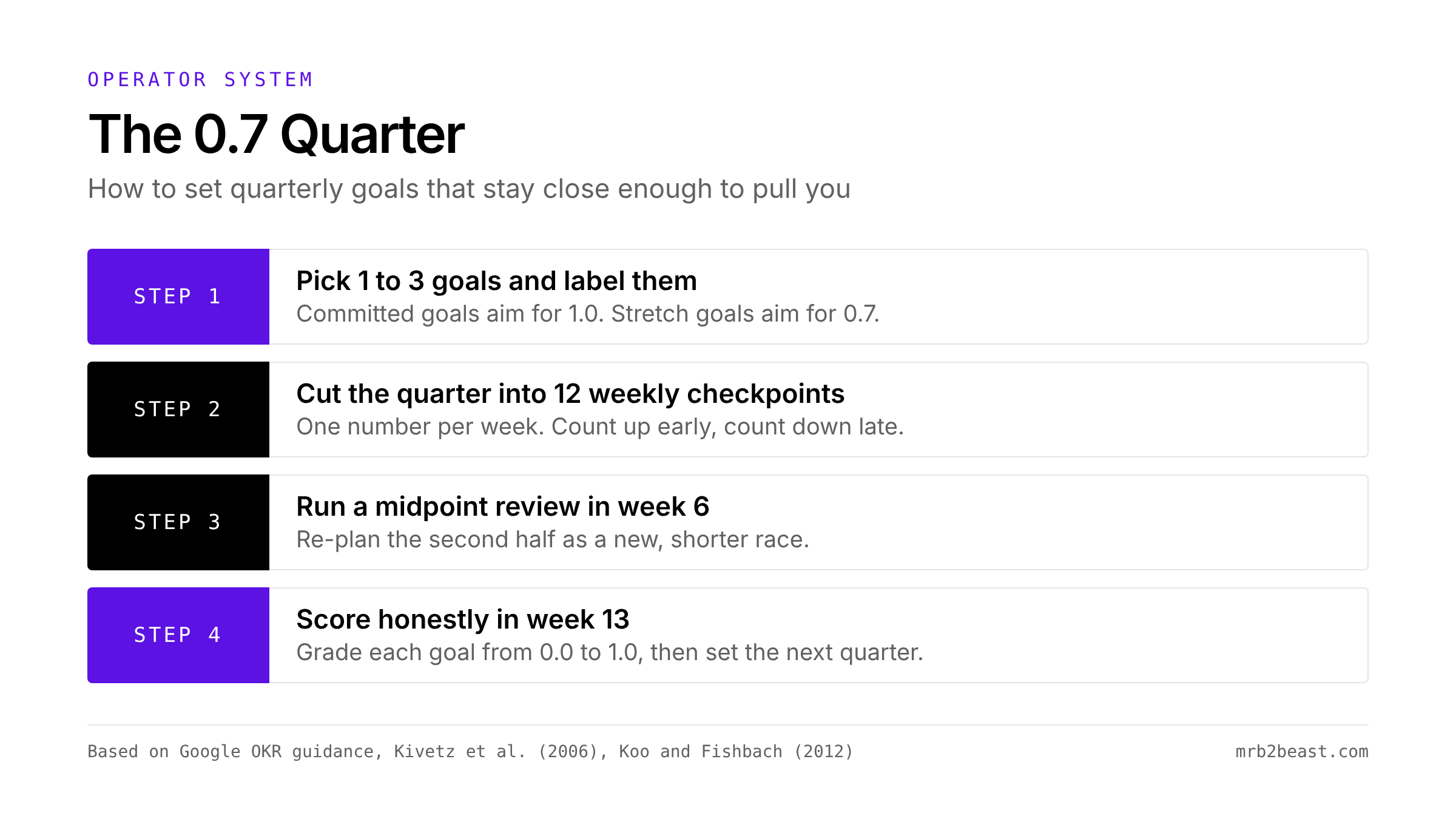
Step 1: Pick 1 to 3 goals and label each one. Google suggests three to five objectives for organizations. One person needs fewer. For each goal, write one sentence and one number. Then mark it committed or stretch. Committed means you will move other work to hit 1.0. Stretch means 0.7 is a good result.
Step 2: Cut the quarter into 12 weekly checkpoints. Write one measurable number for each week. In weeks 1 to 6, track what you have done so far. In weeks 7 to 12, track what is left. That follows the small-area pattern from Koo and Fishbach: look at the smaller number.
Step 3: Run a midpoint review in week 6. Compare the checkpoints with reality. Cut, shrink or swap anything that no longer fits. Then treat weeks 7 to 12 as a new, shorter race with its own finish line. If you tend to underestimate, use your real track record, as described in the article on the planning fallacy.
Step 4: Score honestly in week 13. Grade each goal from 0.0 to 1.0. A committed goal below 1.0 gets a short written reason. A stretch goal around 0.6 to 0.7 is a success. Then carry what matters into the goals for the next quarter, on purpose.
This is the idea behind Gaapp.io, a quarterly goal planner that connects yearly goals to weekly checkpoints and shows what is due today. Disclosure: I am building it. A paper notebook works too. What matters is that the weekly number stays visible.
Ask yourself this week:
- Which of my goals for this quarter are committed, and which are stretch?
- Can I name the number I need to hit by the end of this week?
- When is my week 6 review, and is it in the calendar?
Conclusion: move the finish line, not the goal
A year has one finish line. A quarter, planned well, has twelve small ones.
Quarterly goals work for a reason that has nothing to do with the number 12. Effort rises as a goal gets closer, and a far goal can pull almost nothing. Shorter horizons create more moments near the finish.
The 12 Week Year packages that idea well, but its own numbers are untested. Use the structure, keep committed and stretch goals apart, and look at the weekly number, not the yearly one.
What you learned today
- Coffee cards with 2 pre-filled stamps were completed in 12.7 days instead of 15.6, for the same 10 purchases.
- In a 1981 experiment, a far goal did about as well as no goal: 55 versus 53 percent. A near goal reached 74 percent.
- At Google, 0.7 is the expected score for aspirational OKRs only. Committed OKRs are expected to reach 1.0.
FAQ
What are quarterly goals? Quarterly goals are targets you set for a three-month period instead of a full year. They usually connect to a yearly goal, but they are close enough to steer weekly work. Research on goal distance suggests people put in more effort as a goal gets closer, so shorter horizons create more of those moments.
Does the 12 Week Year actually work? The 12 Week Year by Moran and Lennington (2013) uses ideas with research support, such as near goals and regular progress checks. But no peer-reviewed trial comparing it with annual planning appears in the literature. Its 85 percent execution target is a rule of thumb from the book, not a tested threshold.
What is a good OKR score? At Google, OKRs are graded from 0.0 to 1.0, and the sweet spot is described as 0.6 to 0.7. That applies to aspirational OKRs. Committed OKRs are expected to score 1.0, and a lower score needs an explanation. Scoring every goal at 0.7 turns real commitments into optional goals.
How many quarterly goals should you set? For one person, 1 to 3 is a practical range. Google suggests three to five objectives for organizations, with about three key results each, and warns that more can spread effort too thin. Fewer goals also make the weekly checkpoints easier to see and track.
How do you connect quarterly goals to goal setting for the year? Start with one outcome for the year, then ask what milestone each quarter must prove. Turn that milestone into 12 weekly numbers. Review in week 6 and score in week 13. The yearly goal sets the direction, while the quarter and the week do the steering.
About the author
Tristan Eilenburg. One person. AI systems. Global reach. I write about building systems that work, with evidence instead of hype.
- X: @MrB2Beast
- LinkedIn: Tristan Eilenburg
- Instagram: @mrb2beast
- Building Gaapp.io (Instagram: @gaapp.io)
I write one of these every week. If this one taught you something, the newsletter is where the next one lands first.
Sources
- Kivetz, R., Urminsky, O., and Zheng, Y. (2006). The goal-gradient hypothesis resurrected: Purchase acceleration, illusionary goal progress, and customer retention. Journal of Marketing Research, 43(1), 39-58. https://business.columbia.edu/sites/default/files-efs/pubfiles/1200/goalgradient.pdf
- Bandura, A., and Schunk, D. H. (1981). Cultivating competence, self-efficacy, and intrinsic interest through proximal self-motivation. Journal of Personality and Social Psychology, 41(3), 586-598. https://doi.org/10.1037/0022-3514.41.3.586
- Koo, M., and Fishbach, A. (2012). The small-area hypothesis: Effects of progress monitoring on goal adherence. Journal of Consumer Research, 39(3), 493-509. https://doi.org/10.1086/663827
- Walton, A. G. (2017, June 8). To reach your goal, change tactics in the middle. Chicago Booth Review. https://www.chicagobooth.edu/review/reach-your-goal-change-tactics-middle
- Bonezzi, A., Brendl, C. M., and De Angelis, M. (2011). Stuck in the middle: The psychophysics of goal pursuit. Psychological Science, 22(5), 607-612. https://doi.org/10.1177/0956797611404899
- Google re:Work. Guide: Set goals with OKRs. https://rework.withgoogle.com/en/guides/set-goals-with-okrs
- Google. Google's OKR Playbook. What Matters. https://www.whatmatters.com/resources/google-okr-playbook
- Moran, B. P., and Lennington, M. (2013). The 12 Week Year: Get More Done in 12 Weeks than Others Do in 12 Months. Wiley. https://www.oreilly.com/library/view/the-12-week/9781118616420/ (book summary: https://www.supersummary.com/the-12-week-year/summary/)
- Hull, C. L. (1932). The goal-gradient hypothesis and maze learning. Psychological Review, 39(1), 25-43. https://doi.org/10.1037/h0072640