Your brain does not remember unfinished tasks better. It wants to know when you will get back to them.
You have probably read that your brain remembers unfinished tasks better than finished ones. It is called the Zeigarnik effect. It shows up in productivity posts, UX guides and marketing playbooks.
In 2025, two psychologists at the University of Bern pooled almost a century of research on it. Across 38 publications, the memory advantage was gone. On average, people recalled unfinished and finished tasks equally well.
The idea is not stupid. Something real does happen when you leave work open. It is just a different effect, and it has a much simpler off switch.
I want to show you where the Zeigarnik effect came from and why it fails to replicate. I want to show you the related effect that does hold up, and a 2011 experiment that switched it off without finishing anything. And I want to give you a shutdown routine you can use tonight.
Key takeaways
- A 2025 meta-analysis found no memory advantage for unfinished tasks across 38 publications. The famous 1927 result does not hold up on average.
- The related Ovsiankina effect does hold up: people resume interrupted tasks about 67 percent of the time, against a chance level of 50 percent.
- In experiments, a specific plan for how, when and where to finish a task cut intrusive thoughts about it. The task itself stayed unfinished.
Where the Zeigarnik effect came from
The story starts in a Berlin restaurant in the 1920s, as it is usually told. The psychologist Kurt Lewin noticed that a waiter remembered every open order in detail. Once the bill was paid, the details were gone.
His student Bluma Zeigarnik turned that observation into an experiment. Participants worked through 18 to 20 short tasks of three to five minutes each. About half were interrupted before they were done. Afterwards, people were asked which tasks they remembered.
Her conclusion, published in 1927 in Psychologische Forschung: unfinished tasks were remembered on average nearly twice as well as finished ones. Lewin explained it with tension. An open goal keeps a kind of mental pressure alive until it is done.
That is why the usual Zeigarnik effect examples look the same. A TV cliffhanger. A profile meter stuck at 80 percent. The waiter who forgets the order once it is paid. All of them assume the open loop sticks in memory.
What the research actually shows
Most people treat the Zeigarnik effect as settled. Leave something unfinished, and your brain will hold on to it.
That sounds plausible. It is also mostly not what later studies found.
The memory advantage does not hold up on average
In 2025, Romain Ghibellini and Beat Meier published a meta-analysis in Humanities and Social Sciences Communications. They collected 59 publications. 38 tested the Zeigarnik effect, 20 tested a related effect, and one tested both.
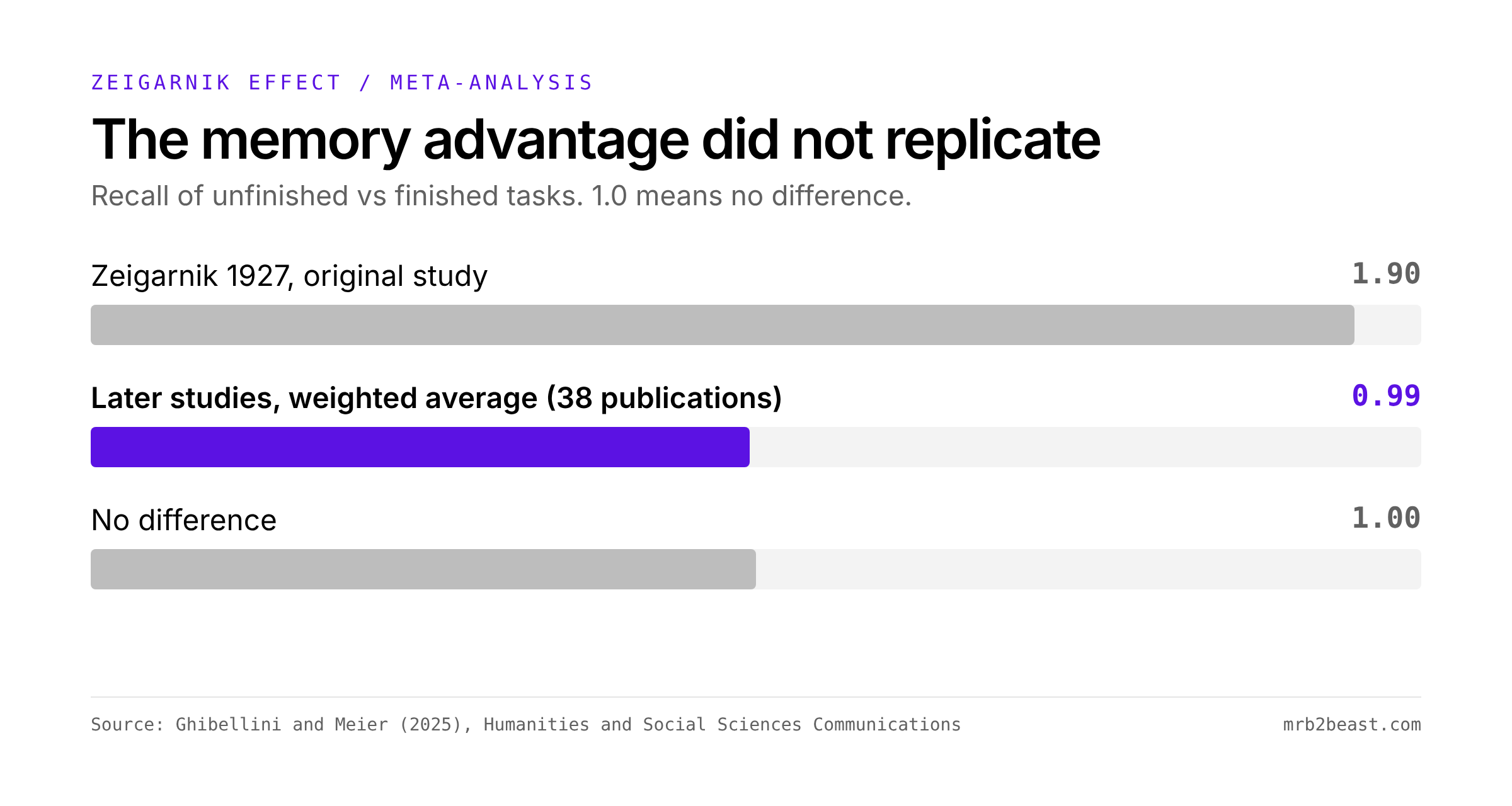
Their main measure was simple. How many unfinished tasks do people recall, divided by how many finished tasks they recall? A value of 1.0 means no difference. In their coding, the original Zeigarnik study came out at 1.90.
Across the 38 later publications, the weighted average was 0.99. In plain words: no memory advantage. A second measure pointed the same way. Unfinished tasks made up 49.16 percent of recalled tasks, almost exactly the 50 percent you would expect by chance.
Where a standardized effect size could be computed, in only 8 publications, it was small. The authors concluded that the Zeigarnik effect "lacks universal validity."
What is the Zeigarnik effect? The Zeigarnik effect is the claim that people remember interrupted or unfinished tasks better than completed ones. It goes back to a 1927 study by Bluma Zeigarnik in the Berlin lab of Kurt Lewin. A 2025 meta-analysis found no memory advantage for unfinished tasks across later studies.
Why did it work in 1927? The authors point to the setting. Professors in Europe enjoyed great respect, and participants wanted to please a powerful experimenter. When people care a lot about a task, the effect seems more likely. That kind of pressure is rarer in a modern lab.
The urge to resume does hold up
Here is the part that most posts leave out. In 1928, Maria Ovsiankina, also working with Lewin, asked a different question. Not "what do people remember?" but "what do people do?"
She interrupted participants and then left them alone with the unfinished task. Many went back to it without being asked.
The same 2025 meta-analysis pooled 20 publications on this. The weighted resumption rate was 66.79 percent, roughly 67 percent against a chance level of 50 percent.
What is the Ovsiankina effect? The Ovsiankina effect is the tendency to resume an interrupted task when you get the chance, even without a reason or reward. It was first described by Maria Ovsiankina in 1928. Unlike the Zeigarnik effect, it holds up well across later studies.
So the open loop is real. It is just not a memory. It is a pull to act.
A plan switches the pull off
If the open loop is a pull to act, what happens when you tell your brain when you will act?
In 2011, E. J. Masicampo and Roy Baumeister tested this in the Journal of Personality and Social Psychology. In their first study, 69 participants thought about two important tasks they had to finish in the next few days.
One group stopped there. A second group also wrote down in detail how, when and where they would complete the tasks. A control group thought about tasks they had already finished. Then everyone read the opening of a crime novel.
People with open tasks and no plan rated their intrusive thoughts at 3.00 on a 1 to 7 scale. With a plan, it was 1.77. The control group, whose tasks were already done, rated 1.82.
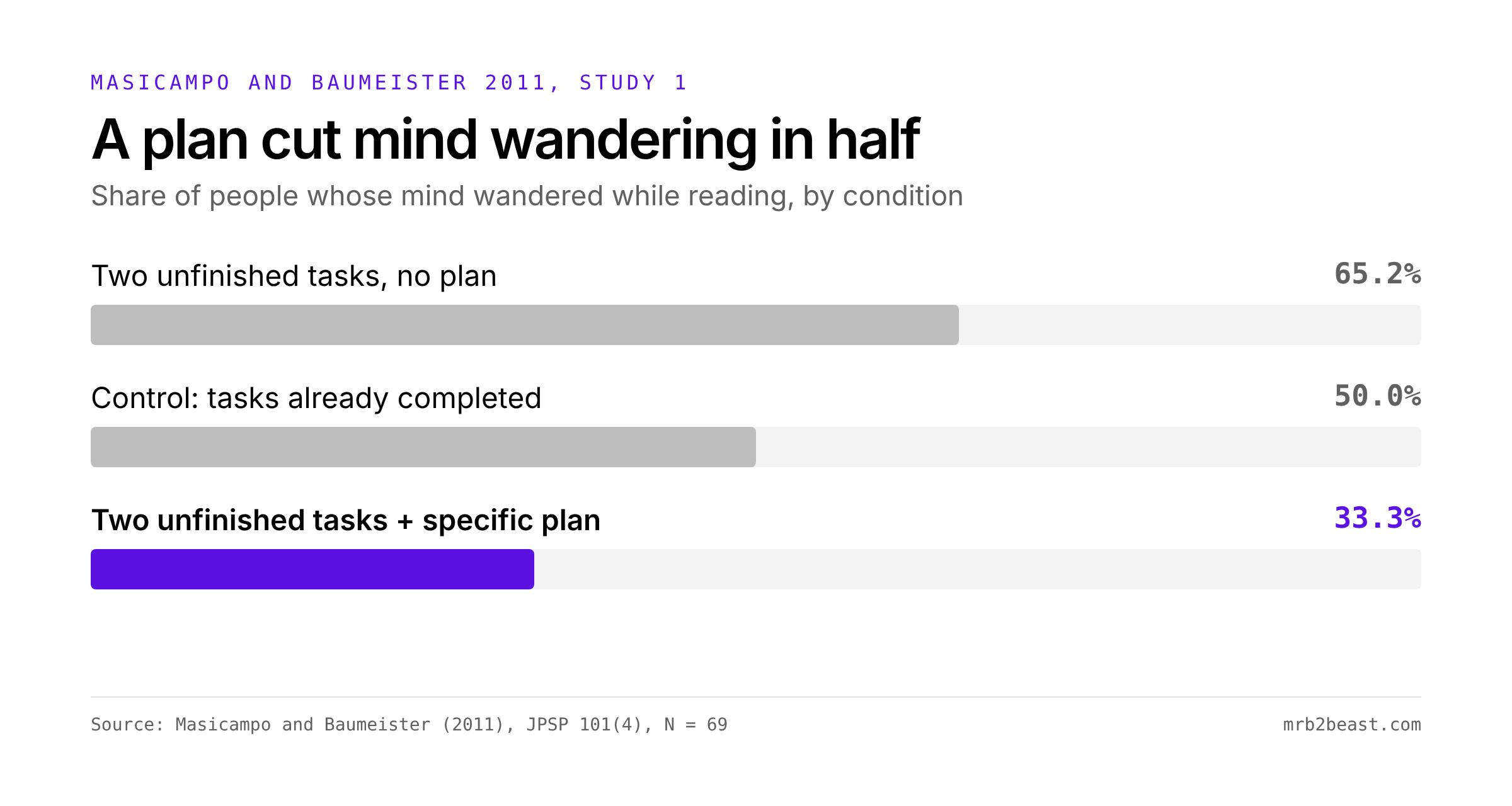
Mind wandering moved the same way. It hit 65.2 percent of the no-plan group, 50 percent of the control group and 33.3 percent of the plan group. Reading comprehension was also better with a plan.
Two more details matter. In a later study of the same paper, simply thinking through options did not help. Only a specific, committed plan reduced task-related thoughts. And the plan did not make people feel less anxious. It changed what occupied their minds, not their mood.
A fair caveat: these were small lab samples from one research group. A large preregistered replication of them does not appear in the published record. But a field study points the same way.
In 2016, Brandon Smit followed 103 employees and 1,127 work goals. Unfinished goals, especially important ones, made it harder to mentally detach after work. An end-of-day planning exercise for those goals helped, mainly for people who were highly involved in their jobs.
This also fits the wider evidence on if-then plans, which I covered in the research on how to achieve goals.
In short: the memory part of the Zeigarnik effect is weak. The pull to resume is real. And a specific plan quiets that pull without finishing anything.
The three mistakes people make with unfinished tasks
Once you see the research, the usual habits around open work look different.
Here is an example. A solo founder closes the laptop at 6:40 pm. The proposal is half written. Three client emails are unanswered. A bug report sits in the inbox. At 10 pm, all four are still running in the background.
Mistake 1: Trusting the open loop as a reminder
Many people leave tasks open on purpose, believing the itch will make them remember. The meta-analysis does not support that. Unfinished tasks were not recalled better than finished ones.
The itch is a pull, not a reliable memory. It costs attention without guaranteeing recall. If something matters, it needs a written place, not a feeling.
Mistake 2: Staying late to finish everything
The founder assumes the only way to stop thinking about work is to finish it. So the evening becomes a sprint to close every loop.
The Masicampo and Baumeister data suggest otherwise. With a plan, intrusive thoughts dropped to the level of people whose tasks were already done. Finishing was not required.
That means: you do not need an empty inbox to have a quiet evening. You need a decision about when the inbox gets handled.
Mistake 3: Writing a to-do instead of a plan
"Finish proposal" on a list is not a plan. It names the task. It does not say when, where or how.
In the 2011 experiments, considering options without committing did not reduce task-related thoughts. Only the specific plan did. A vague to-do keeps the loop open. A plan with a slot closes it for now.
How to stop thinking about work: the Close the Loop Shutdown
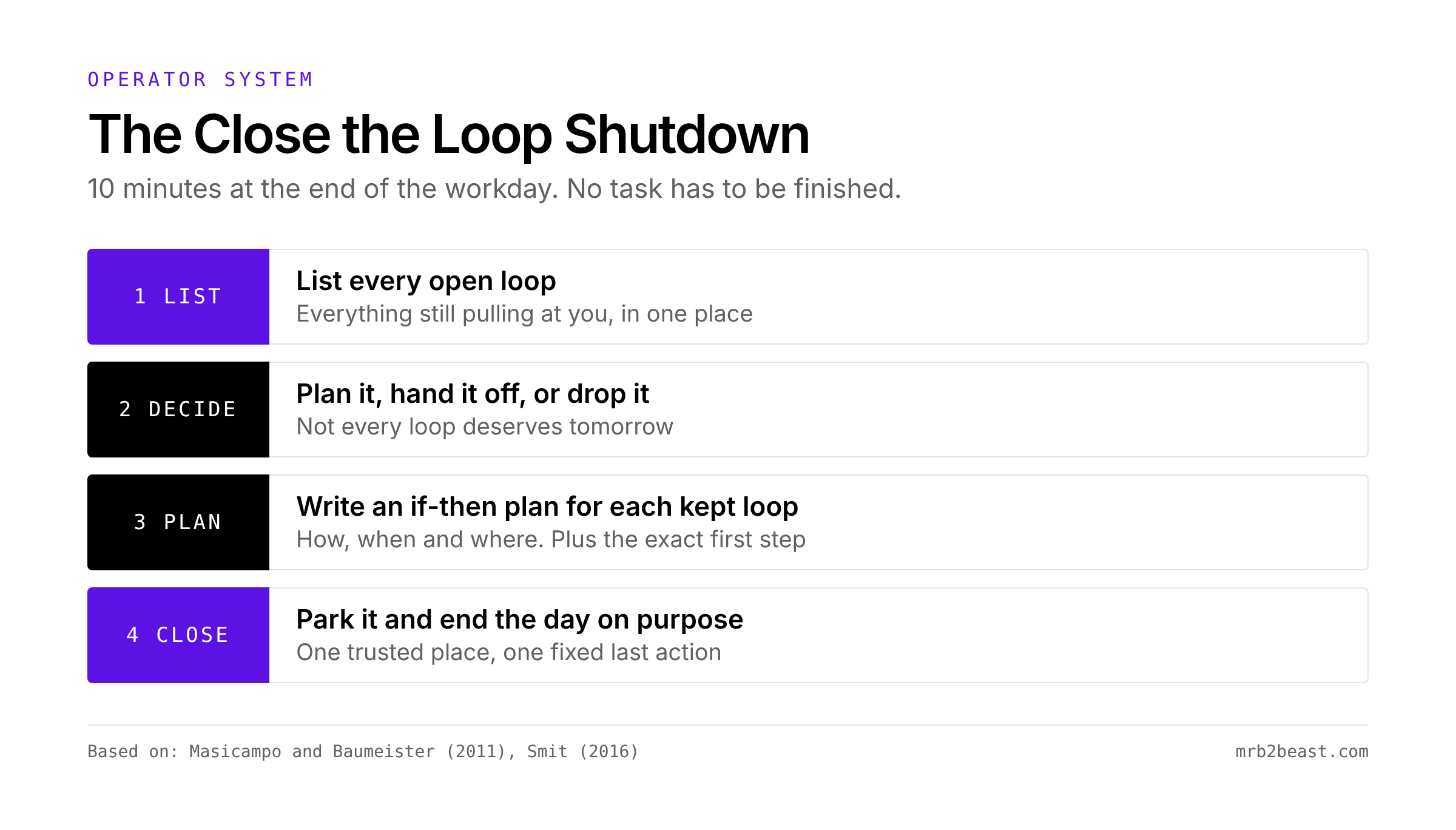
I am not saying unfinished tasks are harmless. I am saying the fix is a decision, not a finish line. Here is a routine for the last 10 minutes of your workday.
Step 1: List every open loop. Write down everything that is still pulling at you. Tasks, replies, half-made decisions. Put them in one place, not in your head.
Step 2: Decide what each loop deserves. For each item, choose one: plan it, hand it off, or drop it. Not every loop deserves a slot tomorrow. Dropping one on purpose closes it too.
Step 3: Write an if-then plan for each kept loop. Use the same three parts the experiment used: how, when and where. "If it is Wednesday at 9:00 at my desk, then I open the proposal and write the pricing section." Add the exact first step. The pull to resume is real, so give it a clear entry point.
Step 4: Park it and end the day on purpose. Keep all plans in one trusted place you will see tomorrow. Then do the same last action every day, like closing the laptop and writing the first task for tomorrow on top. The routine tells your brain the loop is handled.
This is the idea behind Gaapp.io, a goal planner that shows what is due today and which bigger goal it serves, so open loops already have a slot. Disclosure: I am building it. A paper notebook works too. The plan matters more than the tool.
Ask yourself this week:
- Which unfinished task kept coming back to me after work, and does it have a when and where yet?
- Am I staying late to finish things, or to quiet them?
- Do my to-dos name the task, or the moment I will do it?
Conclusion: you do not need to finish, you need to decide
Your brain does not need the task done. It needs to know when.
The Zeigarnik effect is one of the most repeated ideas in productivity writing. Its memory claim does not survive the data. What does survive is simpler and more useful: open tasks pull at you until you give them a place.
That place does not have to be a finished task. A plan with a time, a place and a first step is enough. You can set it up in 10 minutes tonight.
What you learned today
- A 2025 meta-analysis of 38 publications found no memory advantage for unfinished tasks. The recall ratio was 0.99, where the original study reported 1.90.
- The Ovsiankina effect holds up: interrupted tasks are resumed about 67 percent of the time, against a 50 percent chance level.
- A specific plan for how, when and where reduced intrusive thoughts to the level of finished tasks in a 2011 experiment. Finishing was not required.
FAQ
What is the Zeigarnik effect? The Zeigarnik effect is the claim that people remember unfinished or interrupted tasks better than completed ones. It comes from a 1927 study by Bluma Zeigarnik, inspired by Kurt Lewin noticing that a waiter remembered unpaid orders. Later research has not confirmed it reliably. A 2025 meta-analysis found no memory advantage on average.
Is the Zeigarnik effect real? Not as a general rule. A 2025 meta-analysis by Ghibellini and Meier pooled 38 publications and found a recall ratio of 0.99, meaning no memory advantage for unfinished tasks. The effect may appear in specific settings, for example when people are highly involved in a task. The related urge to resume tasks is far more reliable.
What is the difference between the Zeigarnik effect and the Ovsiankina effect? The Zeigarnik effect is about memory: the claim that unfinished tasks are recalled better. The Ovsiankina effect is about behavior: the tendency to go back to an interrupted task. The same 2025 meta-analysis found no reliable memory effect, but a resumption rate of about 67 percent, well above chance.
What are examples of the Zeigarnik effect? Common examples are TV cliffhangers, profile completion meters, unfinished courses and the waiter who remembers open orders but forgets paid ones. Most of these describe a pull to return to something. That matches the Ovsiankina effect, not better memory, which is the weaker claim.
How do I stop thinking about work after hours? Make a specific plan for every unfinished task before you stop. Write down how, when and where you will continue. In a 2011 experiment, this cut intrusive thoughts to the level of finished tasks. A 2016 field study of 103 employees found end-of-day planning helped people detach from work.
About the author
Tristan Eilenburg. One person. AI systems. Global reach. I write about building systems that work, with evidence instead of hype.
- X: @MrB2Beast
- LinkedIn: Tristan Eilenburg
- Instagram: @mrb2beast
- Building Gaapp.io (Instagram: @gaapp.io)
I write one of these every week. If this one taught you something, the newsletter is where the next one lands first.
Sources
- Ghibellini, R., and Meier, B. (2025). Interruption, recall and resumption: a meta-analysis of the Zeigarnik and Ovsiankina effects. Humanities and Social Sciences Communications, 12. https://doi.org/10.1057/s41599-025-05000-w
- Zeigarnik, B. (1927). Das Behalten erledigter und unerledigter Handlungen. Psychologische Forschung, 9, 1-85. https://www.gwern.net/doc/psychology/willpower/1927-zeigarnik.pdf
- Ovsiankina, M. (1928). Die Wiederaufnahme unterbrochener Handlungen. Psychologische Forschung, 11, 302-379. Summary: https://www.oeagp.at/wp-content/uploads/Lindorfer2012OvsiankinasPionierstudie.pdf
- Masicampo, E. J., and Baumeister, R. F. (2011). Consider it done! Plan making can eliminate the cognitive effects of unfulfilled goals. Journal of Personality and Social Psychology, 101(4), 667-683. https://doi.org/10.1037/a0024192 (author copy: https://users.wfu.edu/masicaej/MasicampoBaumeister2011JPSP.pdf)
- Smit, B. (2016). Successfully leaving work at work: The self-regulatory underpinnings of psychological detachment. Journal of Occupational and Organizational Psychology, 89(3). https://doi.org/10.1111/joop.12137
- Lindorfer, B. (2012). Zeigarniks Pionierstudie zum Behalten erledigter und unerledigter Handlungen. Phänomenal, Zeitschrift für Gestalttheoretische Psychotherapie, 1-2/2012, 71-73. https://www.oeagp.at/wp-content/uploads/Lindorfer2012ZeigarniksPionierstudie.pdf
- British Psychological Society Research Digest. Here is a simple way to improve your work-life boundaries. https://bps.org.uk/research-digest/heres-simple-way-improve-your-worklife-boundaries
- Gollwitzer, P. M., and Sheeran, P. (2006). Implementation intentions and goal achievement: A meta-analysis of effects and processes. Advances in Experimental Social Psychology, 38, 69-119. https://doi.org/10.1016/S0065-2601(06)38002-1