The 10,000 Hour Rule Was Never a Rule. Here Is What Practice Really Explains
Why the most famous number in learning is an average, not a threshold, and what to do with your practice time instead.
The 10,000 hour rule comes from a study of violin students. The best group had practiced 10,000 hours by age 20 on average. According to Anders Ericsson, who led that study, half of the ten violinists in the group had not reached that number.
And in 2014, a meta-analysis of 88 studies looked at practice and performance in real jobs. Deliberate practice explained less than 1 percent of the differences between people in professions.
So the number was never a threshold. And the "rule" works worst exactly where most of us spend our working lives.
The idea is not stupid. Practice matters, and nobody gets good at anything without it. It is just that the hours were never the active ingredient.
I want to show you where the number came from and what it actually measured. I want to show you what happened when researchers ran the violin study again. And I want to give you a practice system for operators, one that measures output instead of hours.
Key takeaways
- 10,000 hours was an average for the best violin students at age 20. Ericsson says half of them had not reached it.
- A 2014 meta-analysis found deliberate practice explained 26 percent of performance differences in games, 21 in music, 18 in sports, 4 in education and less than 1 in professions.
- A 2019 double-blind replication of the violin study found smaller effects. The best violinists had not practiced more than the good ones.
Where the 10,000 hour rule came from
In 1993, K. Anders Ericsson, Ralf Krampe and Clemens Tesch-Römer published a study in Psychological Review. They compared three groups of violinists at a music academy: the best students, good students, and students training to become music teachers.
Each violinist estimated how much they had practiced alone, year by year, since childhood. The pattern was clean. The better the group, the more hours of solitary practice they reported.
By age 18, the best violinists had reported an average of 7,410 hours. The good ones had 5,301 hours, and the future teachers 3,420. By age 20, the best group averaged about 10,000 hours.
In his 2008 book Outliers, Malcolm Gladwell turned that average into what he called the "10,000-hour rule." The message that spread was simple: put in 10,000 hours and you become an expert.
Ericsson objected in public. In a 2016 piece adapted from his book Peak, he made several points. The number 10,000 was arbitrary; Gladwell could just as well have used the 7,400 hours at age 18. It was an average, and half the best group had not reached it. And the violinists were promising students, not masters. Pianists who win international competitions, he wrote, have probably put in 20,000 to 25,000 hours by around age 30.
What is deliberate practice? Deliberate practice is practice designed to improve a specific part of performance, usually with a teacher, clear goals and immediate feedback. It is not the same as experience or repetition. Playing a concert is not deliberate practice. Working on one difficult passage, with someone correcting you each time, is.
In short: the rule was built on an average, from one study, of one instrument, at one age. Even its source did not call it a rule.
What the research actually shows
The common belief survived the critique. Most people still think practice explains most of the difference between average and excellent. Put in the work, and the gap closes.
The data is more modest than that.
The meta-analysis nobody puts on a poster
In 2014, Brooke Macnamara, David Hambrick and Frederick Oswald published a meta-analysis in Psychological Science. They combined 88 studies with 11,135 participants across five domains.
Overall, deliberate practice explained 12 percent of the differences in performance. That is not nothing. It is also far from "practice is everything."
The split by domain is the interesting part.
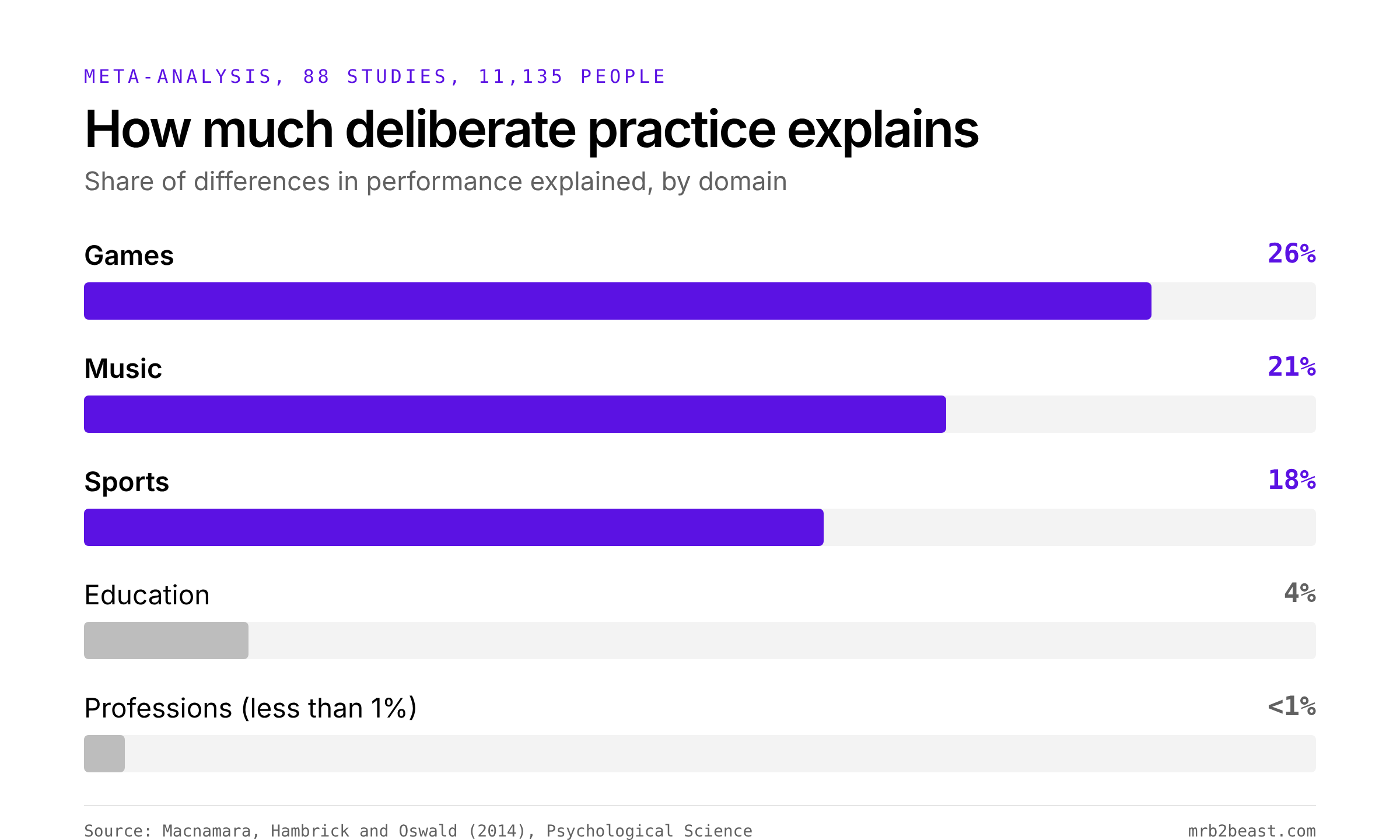
Games, music and sports sit around a fifth to a quarter. Education drops to 4 percent. Professions fall below 1 percent.
That pattern makes sense once you look at the domains. Chess, violin and swimming have stable rules, clear scores and well-known training methods. Most jobs have none of that. The task changes, the feedback is slow, and nobody agrees what a perfect rep looks like.
A later meta-analysis on sports, by Macnamara, Moreau and Hambrick in 2016, found the same shape. Practice explained 18 percent of performance differences overall, but only 1 percent among elite athletes. At the top, everyone practices a lot, so practice stops separating them.
The violin study, run again
In 2019, Brooke Macnamara and Megha Maitra repeated the original violin study with 39 violinists in three skill groups. They added one important safeguard: a double-blind procedure.
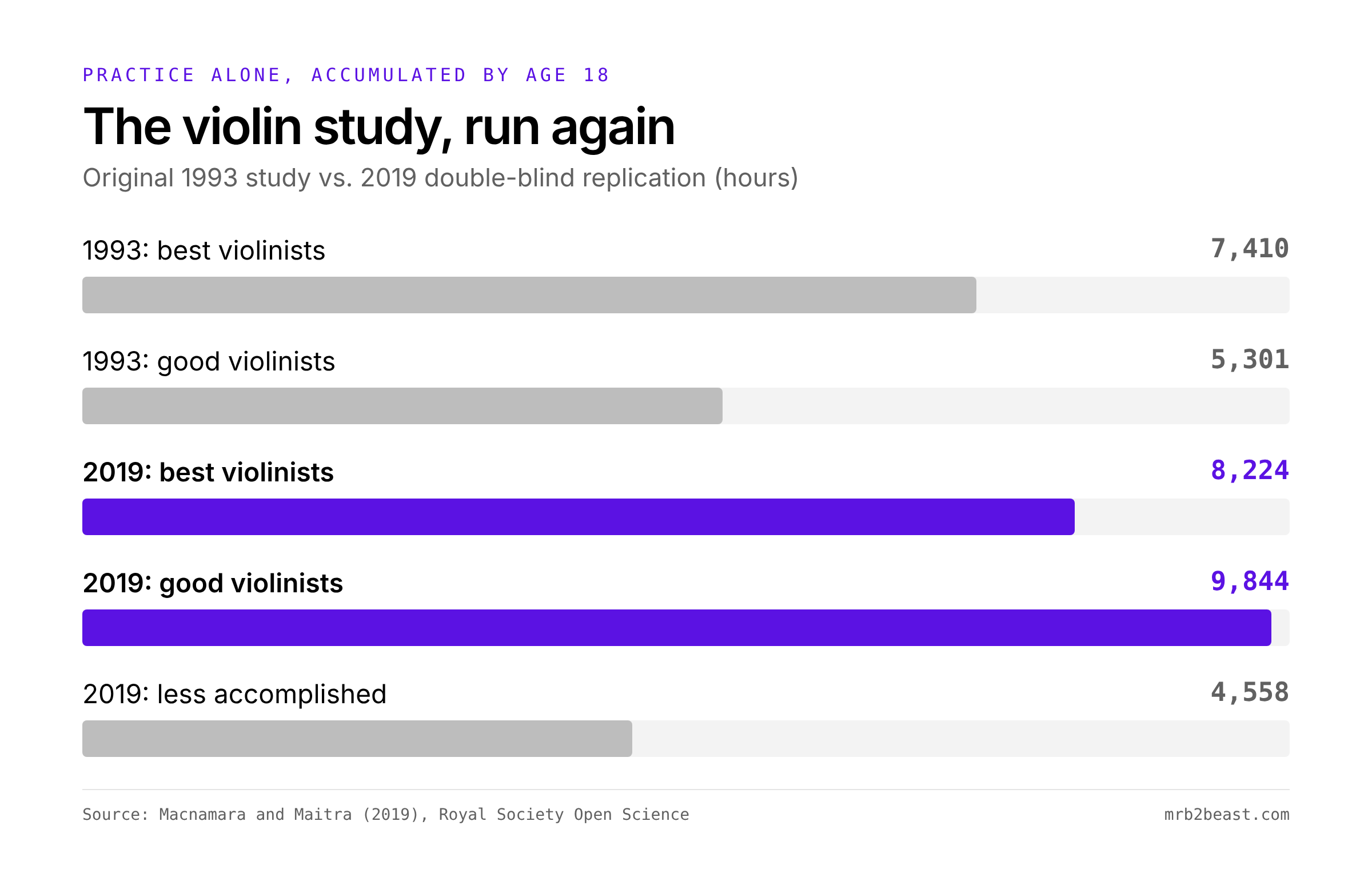
The good violinists had clearly practiced more than the less accomplished group. But the best violinists had not practiced more than the good ones. By age 18, the best group reported 8,224 hours on average, the good group 9,844.
Practice explained 26 percent of the variance in this replication. The original study reported 48 percent for a comparable comparison. The authors put it plainly: the core finding that practice corresponded to each skill level did not replicate.
The other side of the debate
To be fair, Ericsson did not accept these critiques. In 2019, Ericsson and Kyle Harwell argued that the meta-analysis used a definition of practice that was too broad.
When they reanalyzed only studies matching the original definition, practice explained 29 percent of the variance. After correcting for measurement error, their estimate rose to 61 percent. The debate is still open, and it hinges on what counts as deliberate practice.
That detail matters more than the percentages. Even the strongest defender of practice says the hours only count when the practice is designed, focused and corrected. Time alone was never the claim.
In short: practice helps, often a lot. But the amount of time is a weak predictor, and in most jobs it barely predicts anything. The quality and design of the practice is the part worth managing.
The three mistakes operators make with practice
If you run a business or a team, you rarely practice like a violinist. You learn on the job. That is where these mistakes show up.
Mistake 1: Counting hours instead of reps with feedback
Ten years of doing a job is not ten years of practice. Most of that time is performance: you do the task, it goes roughly fine, and you move on. Nothing tells you what to change.
The violin study measured practice alone, not concerts. Ericsson made the same point about the Beatles in Hamburg. A detailed biography put their playing time there at about 1,100 hours, and performing is not deliberate practice anyway.
Mistake 2: Practicing the whole job instead of one skill
Here is an example. A solo founder wants to get better at sales. She does 40 discovery calls a quarter and assumes the volume will make her good.
But "sales" is not a skill. It is a bundle of maybe ten skills. Opening a call, asking about budget, handling a price objection, writing a follow-up. Without picking one, there is nothing specific to correct.
That means: the hours spread across everything, and nothing gets enough focused reps to change.
Mistake 3: Measuring input because output is hard to see
Hours are easy to track. Results are not. So people log time on courses, books and tools, and call it progress.
But the meta-analysis tells you why this is risky in a job. If practice time explains less than 1 percent of performance in professions, then time is the wrong scoreboard. The output the skill should change is the right one.
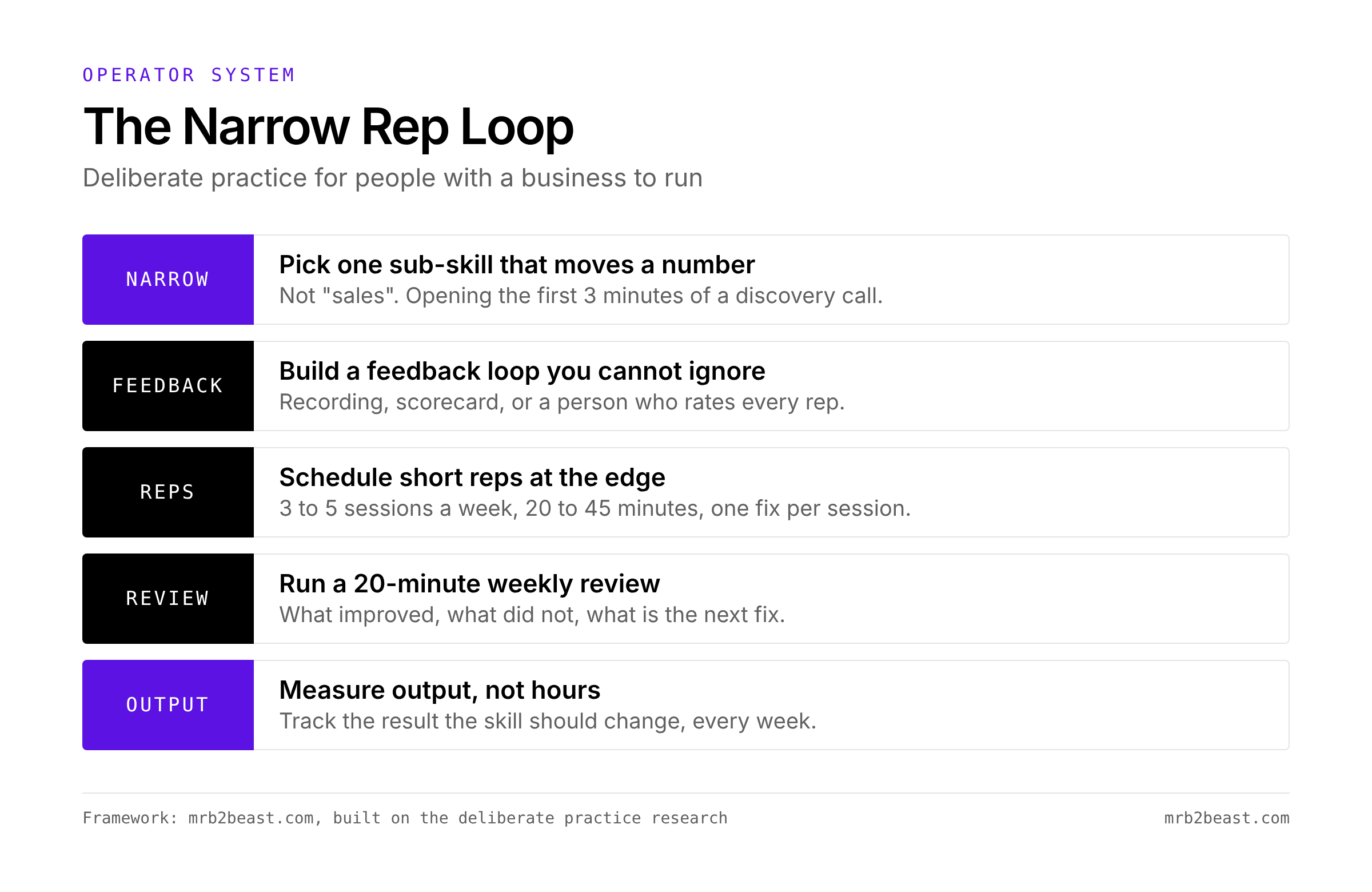
How long to learn a skill: the Narrow Rep Loop
The honest answer to "how long to learn a skill" is: it depends on the skill, your starting point and the quality of your practice. Nobody can give you a fixed number of hours. What you can control is the loop. Here is a version built for people with a business to run.
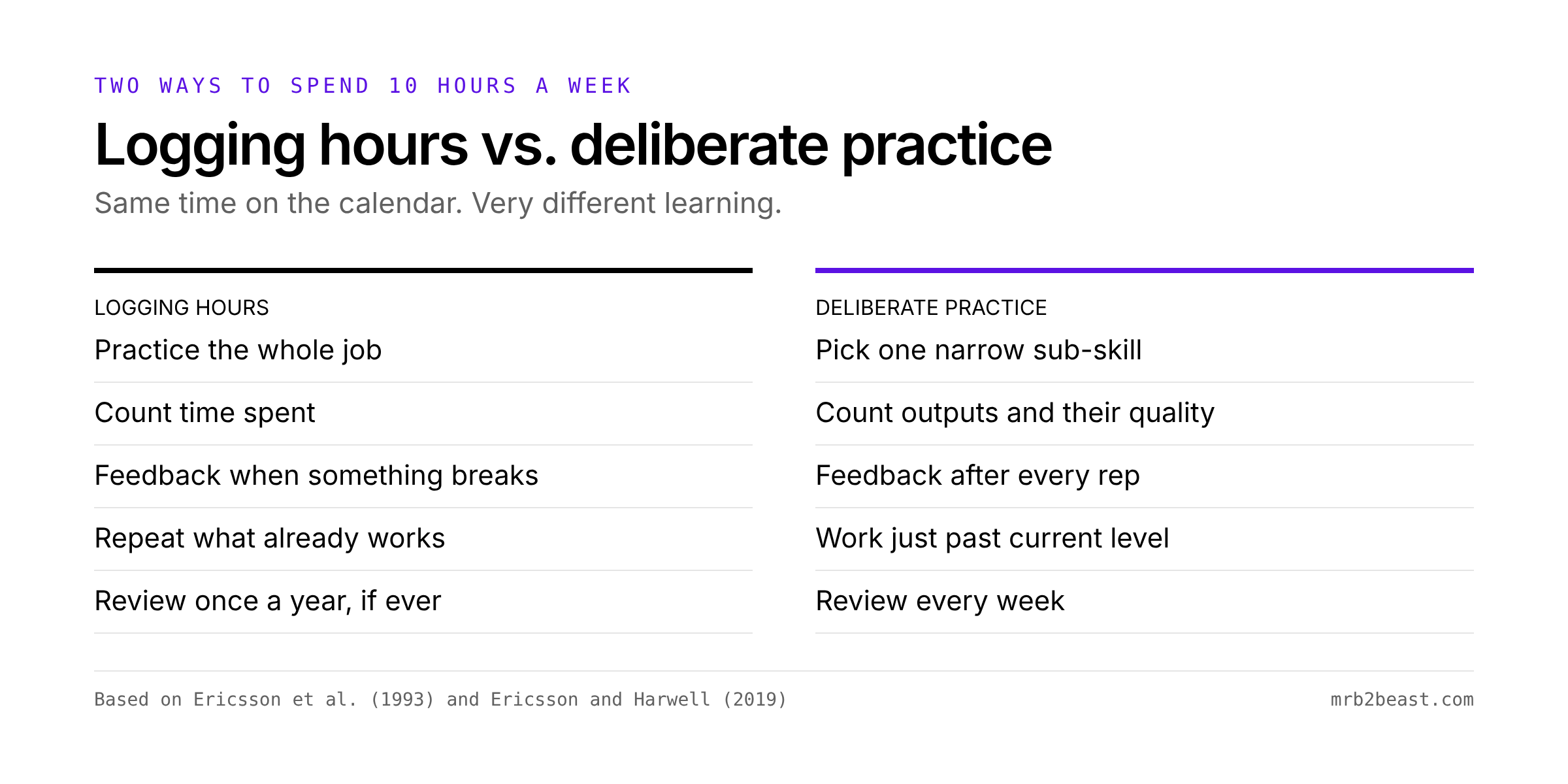
Step 1: Narrow. Pick one sub-skill that moves a number. Not "writing" but "headlines for my newsletter." Not "sales" but "the first three minutes of a discovery call." Choose the sub-skill that is closest to a result you care about.
Step 2: Feedback. Build a loop you cannot ignore. Record the call. Score the headline with a checklist. Ask one person who is better than you to rate five reps a week. Feedback that arrives months later, like a quarterly result, is too slow to steer practice.
Step 3: Reps. Schedule short sessions at the edge. Three to five sessions a week, 20 to 45 minutes each. Each session works on one fix only. If a rep feels easy, make the next one harder.
Step 4: Review. Run a 20-minute weekly review. Look at the feedback from the week. Write down what improved, what did not, and the one fix for next week. This is where practice turns into learning.
Step 5: Output. Measure the result, not the hours. Pick one output metric for the skill: reply rate, booked calls, open rate, time to first draft. Track it every week. If it does not move after six to eight weeks, change the drill, not the effort.
Connecting a skill to a bigger goal is the idea behind Gaapp.io, a learning goals app that links yearly goals to daily steps. It shows what is due today and which bigger goal it serves. Disclosure: I am building it. A paper notebook works too. What matters is that the weekly review and the output metric live in the same place.
If you want the chain from a yearly goal down to today, the article on how to achieve goals covers it. And if your reps keep slipping, the piece on how long it takes to form a habit is the next read.
Ask yourself this week:
- Which one sub-skill, if I improved it by 20 percent, would move a number I care about?
- Where does feedback on that skill come from today, and how long does it take to arrive?
- Am I tracking hours spent, or the output the skill is supposed to change?
Conclusion: the hours were never the point
10,000 hours was an average. Feedback was the method.
The 10,000 hour rule gave millions of people a useful message: skill is built, not handed out. It just put the wrong thing on the scoreboard.
The research says practice matters, but time alone predicts little, and in most jobs almost nothing. What you can manage is the design: one narrow skill, fast feedback, a weekly review and an output metric. Start with one skill this week.
What you learned today
- The 10,000 hours were an average for the best violin students at age 20, and Ericsson said half of that group had not reached it.
- Across 88 studies, deliberate practice explained 26 percent of performance differences in games but less than 1 percent in professions.
- In a 2019 replication, the best violinists had not practiced more than the good ones. Design your practice around feedback and output, not hours.
FAQ
Is the 10,000 hour rule true? Not as a rule. The 10,000 hours were an average for the best violin students at age 20 in a 1993 study. Half of them had not reached it. A 2014 meta-analysis found that deliberate practice explains only part of performance: 26 percent in games, less than 1 percent in professions.
How many hours does it take to master a skill? There is no fixed number. It depends on the domain, the level you aim for and how you practice. Ericsson himself estimated that top pianists have put in 20,000 to 25,000 hours by around age 30. For most work skills, the quality of feedback matters more than the total hours.
What is deliberate practice? Deliberate practice is practice designed to improve a specific part of performance, usually with clear goals, immediate feedback and often a teacher. It differs from experience or repetition. Ericsson and colleagues introduced the concept in 1993, and they argued that only this kind of practice reliably builds expert performance.
Did Malcolm Gladwell invent the 10,000 hour rule? Gladwell coined the term "10,000-hour rule" in his 2008 book Outliers. He based it on the 1993 violin study by Ericsson, Krampe and Tesch-Römer. Ericsson later wrote that Gladwell oversimplified the research: the figure was an average, it was arbitrary, and the violinists were not yet masters at 20.
How long does it take to learn a new skill? Basic competence in a narrow skill can come within weeks of focused practice with feedback. Expert level in a competitive field takes many years. The most useful approach is to pick one narrow sub-skill, get feedback on every rep, review weekly and track an output metric rather than hours.
About the author
Tristan Eilenburg. One person. AI systems. Global reach. I write about building systems that work, with evidence instead of hype.
- X: @MrB2Beast
- LinkedIn: Tristan Eilenburg
- Instagram: @mrb2beast
- Building Gaapp.io (Instagram: @gaapp.io)
I write one of these every week. If this one taught you something, the newsletter is where the next one lands first.
Sources
- Ericsson, K. A., Krampe, R. T., and Tesch-Römer, C. (1993). The role of deliberate practice in the acquisition of expert performance. Psychological Review, 100(3), 363-406. https://doi.org/10.1037/0033-295X.100.3.363
- Macnamara, B. N., Hambrick, D. Z., and Oswald, F. L. (2014). Deliberate practice and performance in music, games, sports, education, and professions: A meta-analysis. Psychological Science, 25(8), 1608-1618. https://doi.org/10.1177/0956797614535810 (press release: https://www.psychologicalscience.org/news/releases/becoming-an-expert-takes-more-than-practice.html)
- Macnamara, B. N., and Maitra, M. (2019). The role of deliberate practice in expert performance: Revisiting Ericsson, Krampe and Tesch-Römer (1993). Royal Society Open Science, 6, 190327. https://doi.org/10.1098/rsos.190327
- Macnamara, B. N., Moreau, D., and Hambrick, D. Z. (2016). The relationship between deliberate practice and performance in sports: A meta-analysis. Perspectives on Psychological Science, 11(3). https://doi.org/10.1177/1745691616635591
- Ericsson, K. A., and Harwell, K. W. (2019). Deliberate practice and proposed limits on the effects of practice on the acquisition of expert performance: Why the original definition matters and recommendations for future research. Frontiers in Psychology, 10, 2396. https://doi.org/10.3389/fpsyg.2019.02396
- Ericsson, A., and Pool, R. (2016, April 10). Malcolm Gladwell got us wrong: Our research was key to the 10,000-hour rule, but here is what got oversimplified. Salon, adapted from Peak: Secrets from the New Science of Expertise. https://www.salon.com/2016/04/10/malcolm_gladwell_got_us_wrong_our_research_was_key_to_the_10000_hour_rule_but_heres_what_got_oversimplified/
- Gladwell, M. (2008). Outliers: The Story of Success. Little, Brown and Company.