How to Write a Newsletter People Actually Open
Most newsletters do not fail on writing. They fail on rhythm and focus. Here is a system with four rules and one template.

If you want to know how to write a newsletter people open, look at the ones you delete. Five links, no clear topic, a subject line like "October update", and it arrives whenever the sender found time.
Nothing about that is bad writing. It is a missing system. The reader cannot tell what they will get, or when, or why this one matters more than the forty other emails that came in today.
The fix is boring and it works: one topic per issue, a fixed day, one link, and a subject line that makes a promise. I call it the four ones.
I will also show how my own newsletter runs: an AI agent drafts it on Mondays and schedules it for Tuesday at 15:00 German time, and I only step in to stop what I do not like.
Key takeaways
- Decide the reader, the promise and the send day before you write issue one. Most of the work is in those three decisions.
- Write each issue around one topic, one link and a subject line that tells the reader what they get.
- Open rates got less reliable with privacy features like Apple Mail Privacy Protection. Watch clicks and replies instead.
Why write a newsletter in 2026 at all?
Because you own it. A post on a social platform reaches whoever the feed decides to show it to. An email reaches the inbox of everyone who asked for it.
One creator in my X tips library puts it bluntly: only about 15 percent of your followers see a given post on X, while every person on your list gets the email. Treat the 15 percent as one person's estimate, not a measured law. And "gets the email" is not "reads the email". But the direction is right. A list is the one channel no algorithm can turn down.
That is why the newsletter sits at the end of my own loop. Articles go up on mrb2beast.com, each one is announced on X automatically, and readers land in the weekly newsletter. People who reply with a keyword under a lead magnet post on X get a DM with the link to my X tips cheat sheet, and the newsletter signup is on that page. The sheet is free to read, no signup required.
How to start a newsletter: three decisions before issue one
Most people start a newsletter by picking a tool. Do that last. These three decisions matter more.
1. Who is it for, and what is the promise?
Write one sentence: "Every [day], [reader] gets [one useful thing] about [topic]." If you cannot fill it in, you are not ready to send. If you can, the sentence becomes your signup page headline, your welcome email and your filter for every topic.
2. A fixed day and time
Readers build habits around senders who show up on schedule. Pick a day you can hold for a year, not a day that would be ideal if everything went well. Mine is one email per week, every Tuesday at 15:00 German time.
Weekly is a good default for one person. Daily burns you out. Monthly is so rare that readers forget they signed up.
3. Signup and welcome email
Use double opt-in: the reader confirms the address with one click before they are on the list. It costs you a few signups and keeps typos, fake addresses and spam traps out. Mine works that way, and a welcome email goes out automatically after the confirmation.
Then the boring part that keeps you out of the spam folder. In the US, the CAN-SPAM Act requires a valid physical postal address in every commercial email and a working opt-out that you honor within 10 business days. Gmail requires one-click unsubscribe from anyone sending more than 5,000 messages a day to Gmail accounts, and tells every sender to keep the spam rate below 0.10 percent and never reach 0.30 percent. Any decent newsletter tool handles most of this for you. Check that it does before you send.
How to write a newsletter: the four ones
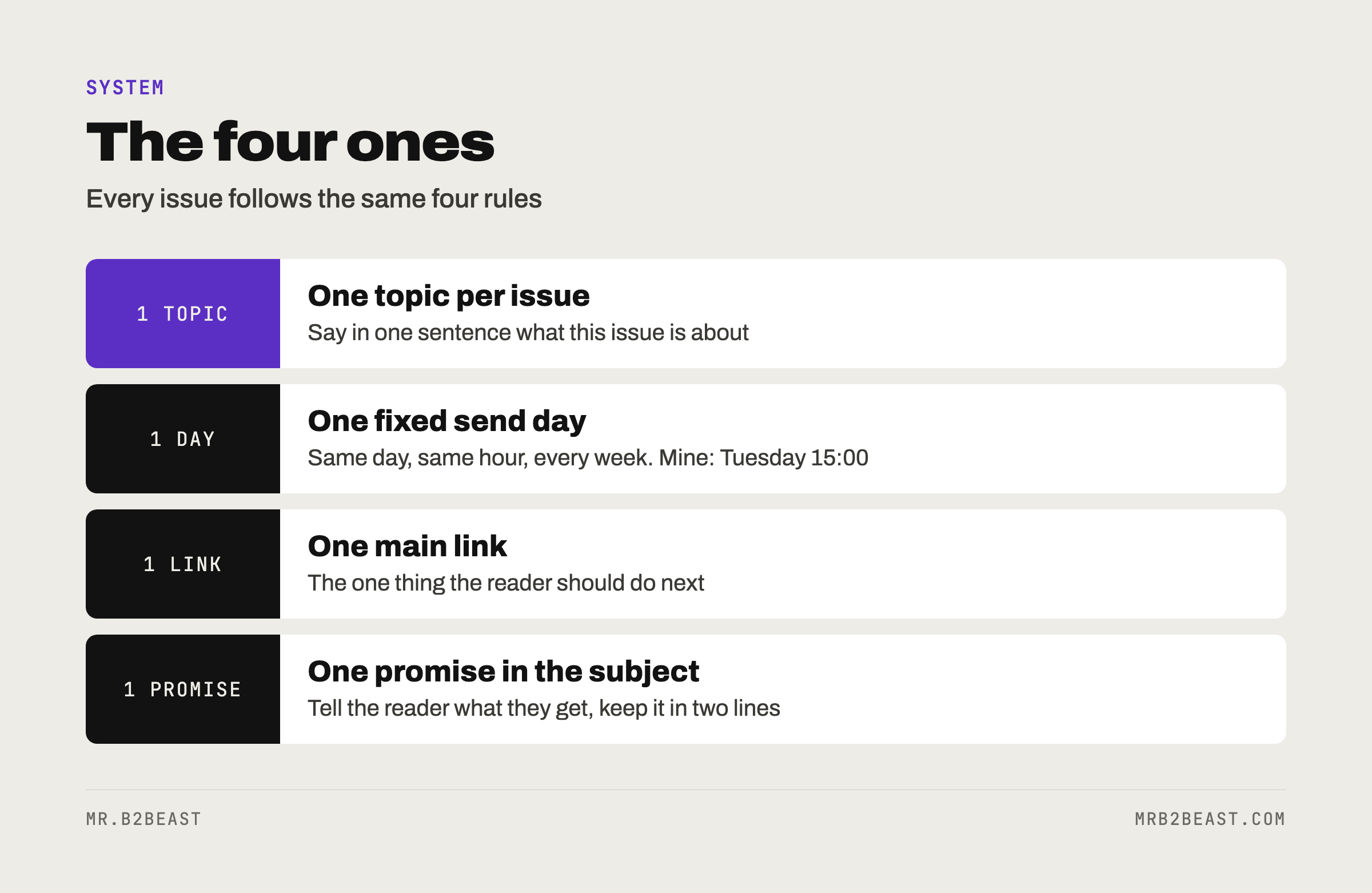
Here is the system. Every issue follows the same four rules.
One topic per issue
An issue with five topics is a digest. Digests can work, but they are hard to remember and harder to forward. One topic gives the issue a reason to exist and gives the reader one thing to take away.
The test: can you say in one sentence what this issue is about? "Why your yearly plan should have one goal" passes. "Some thoughts on planning, tools and a few links" does not.
One fixed send day
Same day, same hour, every week. Consistency is the cheapest trust signal you have. It also helps you: a fixed deadline every week stops the issue from growing forever. Work expands to fill the time available, which is Parkinson's law in practice.
One main link
Every extra link splits attention. Pick the one thing you want the reader to do next: read the full article, reply with an answer, try one step. Put that link in the middle of the email and once more near the end. Everything else can wait for next week.
One promise in the subject line
The subject line is the only part most people ever read. Write it as a promise, not a label.
| Label | Promise |
|---|---|
| Newsletter #14 | The one question that kills a bad goal |
| October update | Why I stopped approving my own posts |
| Thoughts on planning | Plan next year around one goal |
| New article! | A 15-minute weekly review that actually sticks |
The promise has to be kept in the first two lines of the email. A subject that teases and a body that rambles teaches readers to stop opening. Use the preview text, the short line most inboxes show next to the subject, to finish the thought.
The body: what to put inside
Newsletter writing is shorter than article writing, and that makes it harder. You have three jobs.
Open with the point. No "Hope you had a great week." Start with the claim or the question the subject line promised.
Prove it once. One story, one number or one example. Not three. If you have a study or a source, link to the article where you explain it properly, and keep the newsletter short.
End with a step. Something the reader can do today in under fifteen minutes. A newsletter that changes one small thing gets opened again.
Write like you talk to one person. "You", not "you all". Short sentences. Read it out loud once before you schedule it. Anything you stumble over, your reader will skip.
A newsletter template you can copy
Paste this into your editor. It is short on purpose.
Subject: [A promise in under 50 characters]
Preview text: [Finishes the promise, one line]

[Opening line: the claim or question from the subject.]

[The idea in two or three short paragraphs.]

[The proof: one story, one number or one example.]

The step for this week:
[One thing the reader can do in under 15 minutes.]

[Main link: read the full piece / try it / reply]

[Sign-off with your name]

P.S. [One line: next week's topic, or a question to reply to.]
The P.S. is not decoration. Many readers skim to the end, and a question there is the easiest way to get replies.
Newsletter ideas when you think you have nothing to say
You will run out of ideas around issue six. Everyone does. Keep a running list and pull from these sources:
- Something you shipped. What you built this week and one thing you would do differently.
- A mistake. What broke, how you noticed, what you changed. These get the most replies.
- A number you track. What moved, what did not, and your best guess why.
- A claim you checked. A popular statistic and what the original source actually says.
- A reader question. Answer it in full and credit the question.
- A tool you dropped. Why it stopped earning its place.
- Your article, shorter. If you write longer pieces, the newsletter is the five-minute version with one link to the full one.
If you also post on X, the reverse works too: a good newsletter issue can become a thread.
What is the 3/2/1 newsletter?
The 3/2/1 format comes from James Clear's newsletter: three short ideas from him, two quotes from others and one question for the reader. It goes out every Thursday, and his site says it reaches over 3,000,000 people.
The interesting part is where it came from. Clear writes that for years he published two articles a week, each often taking over 20 hours. He then asked what he would send with only two to four hours a week. The format was the answer.
So the lesson is not "copy 3/2/1". The lesson is that a fixed format is a constraint that makes a weekly send sustainable. If you have collected ideas and quotes, 3/2/1 suits you. If you think in one argument at a time, the one-topic issue suits you better. Pick one format and keep it for at least twelve issues before you judge it.
Can ChatGPT or another AI write your newsletter?
It can draft one. Whether you should send that draft is a different question.
Here is my setup. Since 2026-10-20, an AI agent writes the newsletter on Mondays and schedules it for Tuesday at 15:00. I do not approve it beforehand. I can stop it before it sends. The welcome email goes out automatically after someone confirms. It is part of a small AI operating system I run as one person.
It is too early for results, and I will not pretend otherwise. But my X posts run on the same principle, one agent writes and a second one checks, and that taught me two things.
First, automated drafts fail in boring ways. Three weekly recap posts once sat in the queue with unfilled placeholders where a number and a post link should have been. They stayed drafts and never went out.
Second, a checker that rejects nothing is not proof that everything is fine. In the first batch of 24 posts, the checking agent rejected none. That might mean the posts were good. It might also mean the checker was too soft.
If you let AI draft your newsletter, three rules:
- Give it a short list of facts it may use and forbid everything else. Invented numbers are the most common failure.
- Give it your format, the four ones or 3/2/1, so every issue has the same shape.
- Keep a stop button and read the preview before it sends. Veto takes a minute. Cleaning up a wrong email to your whole list takes much longer.
For the general logic of handing a process to software, see AI workflow automation: write the process first, then automate it.
How to tell if people actually open it
Here is the uncomfortable part. Open rates are not what they used to be.
Apple's Mail Privacy Protection hides the reader's IP address and, according to Apple, keeps senders from seeing whether the email was opened. So for every reader who has it turned on, your tool cannot know whether they really opened. Your open rate becomes partly a guess, and you cannot tell by how much.
So watch three numbers instead:
- Clicks on the one link. Mail Privacy Protection targets opens, not link clicks.
- Replies. The strongest signal that someone read it to the end.
- Unsubscribes after a specific issue. A spike tells you a topic or tone missed.
Do not chase the open rate itself. When a number becomes the target, people start gaming it, for example with clickbait subject lines that break the promise rule. The goal tracker article explains why tracking the wrong number can make you worse.
Plan a year of issues, not one issue
A weekly newsletter is about 52 issues a year. That is not a writing task. It is a yearly goal, and it fails the same way yearly goals fail: strong in January, silent by March.
Treat it like one. Set one milestone per quarter, such as "12 issues sent and a template that saves an hour", plan only the next quarter in detail, and name the step for this week. The full method is in yearly planning.
If you want to see the four ones in action, my own newsletter is one email per week, double opt-in, and you can sign up on the newsletter page.
FAQ
How do you make a newsletter step by step? Write one sentence that names your reader and your promise. Pick a send day you can hold for a year. Set up a double opt-in signup and a welcome email. Then write each issue around one topic, one link and a subject line that makes a promise, and send it on the same day every week.
How long should a newsletter be? Long enough to deliver the one point in the subject line, and no longer. For most one-topic issues, that is a few minutes of reading. If you need more space, publish the full piece as an article and link to it from the newsletter.
How often should I send a newsletter? Weekly is a strong default for one person: often enough that readers remember you, rare enough to keep quality up. What matters more than the frequency is that you hold it. A weekly newsletter that skips every third week loses trust faster than a steady monthly one.
What is the 3/2/1 newsletter? It is James Clear's format: three short ideas from him, two quotes from others and one question for the reader, sent every Thursday. He built it as a format he could produce in two to four hours a week. It works best for people who collect ideas and quotes.
Are newsletters still relevant in 2026? Yes, mainly because you own the list. Social feeds decide who sees a post, while an email reaches every subscriber's inbox. Open rates are harder to read since privacy features like Apple Mail Privacy Protection, so judge your newsletter by clicks and replies.
About the author
Tristan Eilenburg. One person. AI systems. Global reach. I write about building systems that work, with evidence instead of hype.
- X: @MrB2Beast
- LinkedIn: Tristan Eilenburg
- Instagram: @mrb2beast
The newsletter goes out once a week. If this one taught you something, the newsletter is where the next one lands first.
Sources
- Clear, J. The 3-2-1 Newsletter. https://jamesclear.com/3-2-1
- Apple. Use Mail Privacy Protection on iPhone. Apple Support, iPhone User Guide. https://support.apple.com/guide/iphone/use-mail-privacy-protection-iphf084865c7/ios
- Google. Email sender guidelines. Gmail Help. https://support.google.com/a/answer/81126
- Federal Trade Commission. CAN-SPAM Act: A Compliance Guide for Business. https://www.ftc.gov/business-guidance/resources/can-spam-act-compliance-guide-business