92 Percent of Resolutions Fail? The Study Is Missing. New Years Resolution Statistics, Checked
The most quoted failure rate has no traceable study. The real data is less dramatic and more useful.

Every December, the same number comes back: 92 percent of New Year resolutions fail. It is usually credited to the University of Scranton.
The Scranton research exists. It just says something else. In a 2002 study in the Journal of Clinical Psychology, 46 percent of resolvers were still succeeding after six months. That is not 8 percent. And among people who wanted the same change but did not make a resolution, only 4 percent were.
The 92 percent figure does not appear in the published abstracts of the two Scranton resolution studies.
The pessimism is not stupid. Most resolutions do fade. It is just the wrong number, and it hides the part you can change.
I want to show you where the 92 percent figure comes from, and what the real new years resolution statistics say. I want to show you the surprise in the largest resolution experiment so far: the group with the most structure did worst. And I want to give you a four-step system you can set up before January, or this week.
Key takeaways
- The 92 percent failure rate has no traceable primary study. The Scranton papers report 46 percent success at six months and 19 percent at two years.
- In a Swedish experiment with 1,066 people, approach goals ("start doing X") beat avoidance goals ("stop doing Y"): 58.9 versus 47.1 percent.
- The group with one named supporter and monthly check-ins did best. The group that also got SMART goals and interim deadlines did worst.
What the research actually shows
The common belief: almost nobody keeps a resolution, so why bother. The research supports the first half only loosely, and the second half not at all.
Where the 92 percent comes from
The number spread through a statistics website called Statistic Brain. Articles from around 2013 cite its "New Years Resolution Statistics" page, with the source given as "University of Scranton" and "Journal of Clinical Psychology". No paper title, no year, no table.
On January 1, 2013, a Forbes headline said that just 8 percent of people achieve their resolutions. From there, it became the standard line. The Statistic Brain page is now offline.
The University of Scranton connection is real. John Norcross, a psychologist there, ran two well-known studies on resolutions. But their published numbers look different.
The two Scranton studies
Study one: 200 resolvers, two years. In 1988, Norcross and Dominic Vangarelli followed 200 New Year resolvers. 77 percent maintained their pledge for one week. After one month, it was 55 percent. After three months, 43 percent. After six months, 40 percent. After two years, 19 percent.
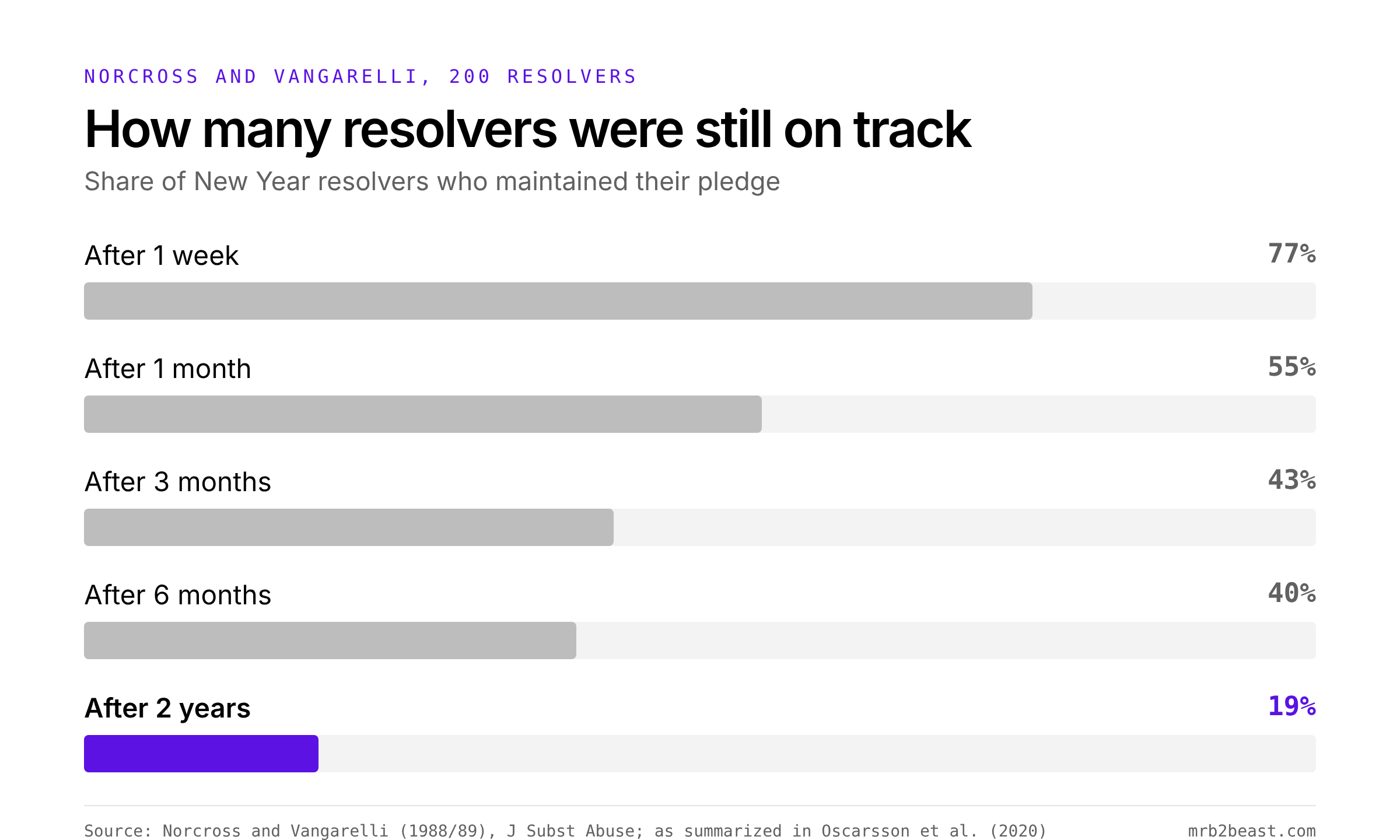
That is a steep decline. It is also more than double the 8 percent figure, two years later.
The same paper has a detail almost nobody quotes. Among the successful resolvers, 53 percent had at least one slip. The average number of slips over the two years was 14. The people who made it did not have perfect streaks. They restarted.
Study two: resolvers versus non-resolvers. In 2002, Norcross, Marci Mrykalo and Matthew Blagys followed 159 resolvers and 123 comparable people who wanted to change a problem later. At six months, 46 percent of resolvers were continuously successful. Among non-resolvers, it was 4 percent.
One caveat. This was not a randomized test of resolutions. The non-resolvers had chosen to wait, which may say something about their readiness. Still, the published data points away from "resolutions are pointless", not towards it.
The largest experiment so far
In 2020, Martin Oscarsson, Per Carlbring, Gerhard Andersson and Alexander Rozental published a study in PLOS ONE. They recruited 1,066 adults in Sweden in late December 2016 and followed them for a full year.
At the end of the year, 55 percent of those who responded said they had sustained their resolution. The most common resolutions were physical health (33 percent), weight loss (20 percent) and eating habits (13 percent).
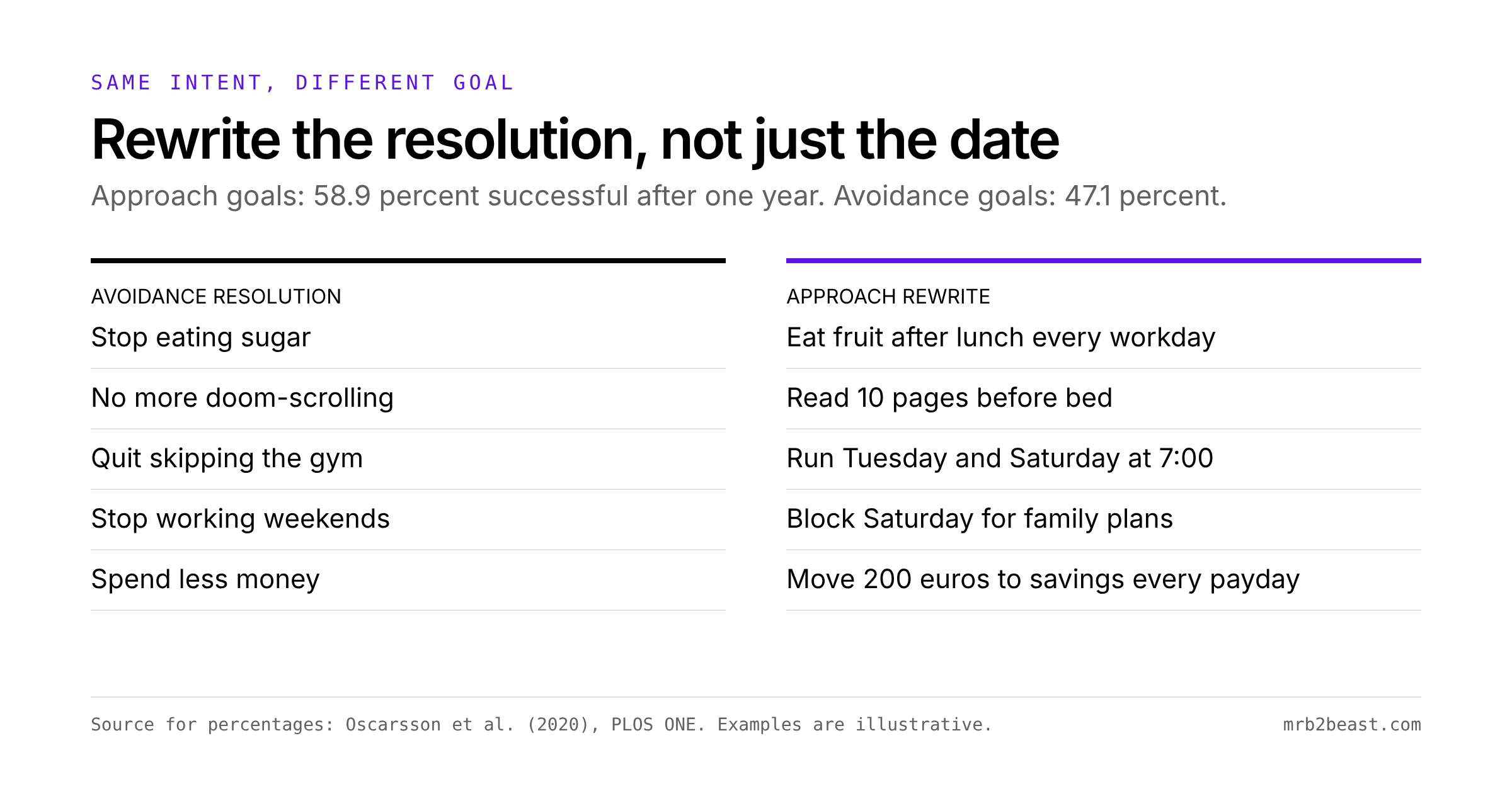
What is an approach goal? An approach goal names something you move towards: "run twice a week", "eat fruit after lunch". An avoidance goal names something you move away from: "stop eating sugar", "quit skipping the gym". In the Oscarsson study, 58.9 percent of people with approach resolutions considered themselves successful, against 47.1 percent with avoidance resolutions. The difference was statistically significant, with a small effect size.
The people were randomized into three groups. Group 1 got brief information and three check-ins. Group 2 also named one person to support them, got monthly check-ins and one email on handling obstacles. Group 3 got all of that, plus training in SMART goals, approach wording and interim goals, and three more emails.
You would expect Group 3 to win. It did not.
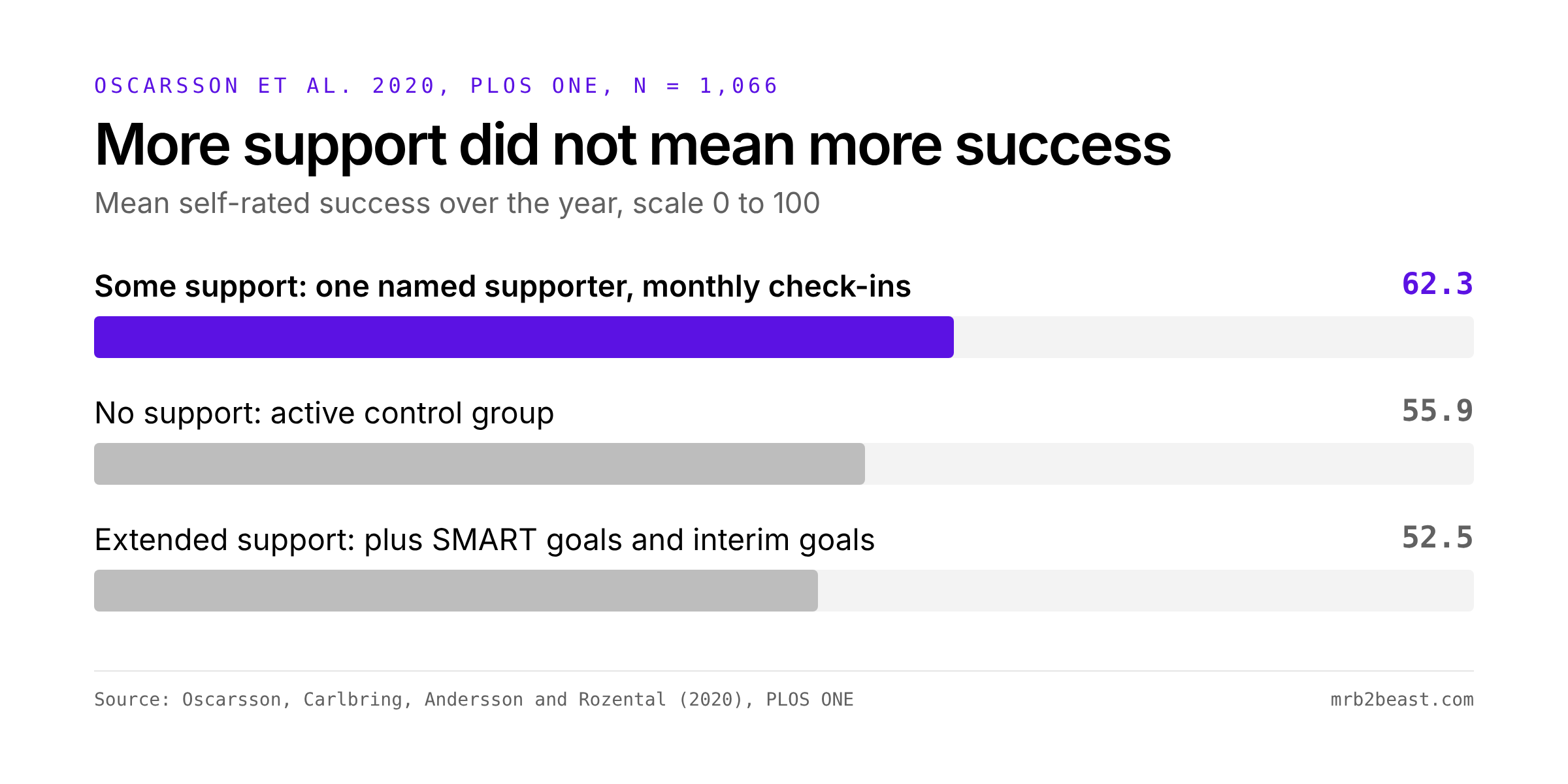
On a self-rated success scale from 0 to 100, the "some support" group averaged 62.3. The control group averaged 55.9. The "extended support" group averaged 52.5, and it did not beat the control group.
The authors offer a plausible explanation. A specific goal with deadlines also makes every miss visible. Someone with a vague goal can feel successful after any progress. Someone with six interim deadlines has six chances to feel they failed.
In short: resolutions fade, but far fewer fail than the 92 percent myth claims. What helped in the best data was simple: an approach goal, one person in the loop and regular check-ins. More rules did not help.
The three mistakes that make resolutions fail
The research does not say resolutions are useless. It says most people set them up badly.
Mistake 1: Writing a "stop" instead of a "start"
Here is an example. A solo founder writes "stop working weekends" on January 1. It is a clear wish. But it gives no instruction for a Saturday morning when the inbox is full.
An avoidance goal only tells you what not to do. The empty space gets filled by the old habit. In the Oscarsson data, 64.5 percent of people already wrote approach goals. The other third started at a disadvantage.
"Block Saturday for family plans" gives the founder something to do, and something to check.
Mistake 2: Treating the first slip as the end
Many January articles now mention Quitters Day, the day people supposedly give up on their resolutions.
What is Quitters Day? Quitters Day is a name popularized by the fitness app Strava for the mid-January date when its activity data showed motivation dropping. The date moves. Coverage placed it on Thursday, 17 January in the UK in 2019, and on Monday, 17 January in 2022. Today it is often listed as the second Friday of January. It comes from company data released to the press, not from a peer-reviewed study.
The real risk is not the date. It is the story that comes with it: one missed week means you are a quitter. The Norcross data says the opposite. Most people who succeeded had slipped, many times.
In the Oscarsson study, at the end of January, 88.8 percent of those who responded still rated themselves successful. Those were motivated volunteers, and response rates fell during the year. Still, January is not where most resolutions end. They end when a slip gets read as a verdict.
Mistake 3: Adding structure instead of a person
When a resolution wobbles, the instinct is to add more rules, metrics and deadlines. The Oscarsson results suggest that more structure is not automatically better.
What separated the best group was not a smarter goal formula. It was a named supporter and a regular check-in. That fits a 2016 meta-analysis by Benjamin Harkin and colleagues: across 138 studies, monitoring progress improved goal attainment, with an average effect of d = 0.40. It worked best when progress was recorded and shared.
How to keep a resolution: the February Rewrite
The system has one idea behind it. Plan for the resolution to wobble, and decide now how you will fix it.
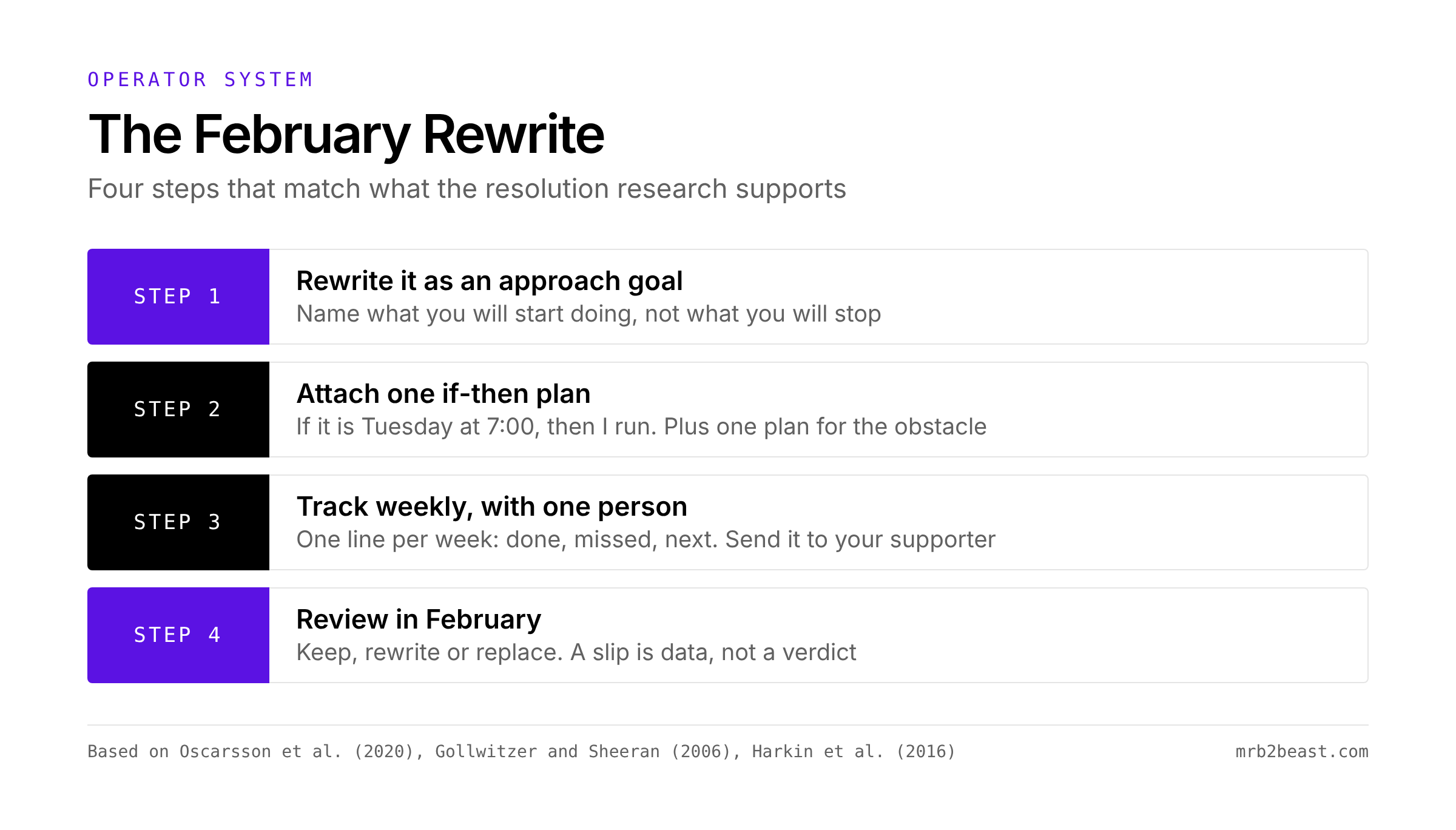
Step 1: Rewrite it as an approach goal. Take each resolution and ask: what will I start doing? "Stop eating sugar" becomes "eat fruit after lunch every workday". "Spend less" becomes "move 200 euros to savings every payday". If you cannot name the action, the resolution is not ready yet.
Step 2: Attach one if-then plan. Give the action a time and a place: "If it is Tuesday or Saturday at 7:00, then I run from my front door." Add one plan for your most likely obstacle: "If it rains, then I do 20 minutes indoors." A meta-analysis of 94 tests by Peter Gollwitzer and Paschal Sheeran found a medium to large effect for these plans, d = 0.65. More detail is in how to achieve goals.
Step 3: Track weekly, with one person. Write one line per week: what you did, what you missed, what is next. Send it to one named person. That is close to what the best group in the Swedish experiment had.
This is the idea behind Gaapp.io, a goal tracker app that connects yearly goals to daily steps and shows what is due today and which bigger goal it serves. Disclosure: I am building it. A paper notebook works too. What matters is that the record exists and someone else sees it.
Step 4: Review in February. Put a 20-minute review in your calendar now, for the first weekend in February. Look at four weeks of lines. For each resolution, decide: keep, rewrite or replace. A slip is data, not a verdict. And you do not need to wait for next January to restart. Any Monday works, as covered in the fresh start effect.
Ask yourself this week:
- Which of my resolutions starts with "stop", "no more" or "less"?
- Who is the one person who will see my weekly line?
- When exactly is my February review, and is it in the calendar?
Conclusion: the number was wrong, the fade is real
Most resolutions do not fail on Quitters Day. They fail when the first slip gets read as a verdict.
The 92 percent figure travels because it confirms what people already feel. But the Scranton data it is credited to shows 46 percent success at six months. The largest experiment found that about half of responders still felt successful after a year.

The fade is real, and the steepest drop comes in the first month. That is why the setup matters: an approach goal, an if-then plan, one person and a planned review.
What you learned today
- The 92 percent failure rate has no traceable primary study. Scranton research found 46 percent of resolvers succeeding at six months, against 4 percent of non-resolvers.
- Approach goals beat avoidance goals in a 1,066-person experiment, 58.9 versus 47.1 percent. Extra SMART training did not beat the control group.
- More than half of the successful resolvers in a two-year study slipped at least once. Plan the restart, not the perfect streak.
FAQ
What percentage of New Year resolutions fail? There is no reliable source for the popular 92 percent figure. In a Scranton study, 40 percent of resolvers were still on track after six months and 19 percent after two years. A 2002 study found 46 percent success at six months. In a 2020 Swedish study, 55 percent of responders felt successful after one year.
Is the 92 percent statistic about resolutions true? It does not trace back to a primary study. It spread through a statistics website called Statistic Brain, which credited the University of Scranton and the Journal of Clinical Psychology without naming a paper. The published Scranton studies report much higher success rates: 46 percent at six months in 2002.
What is Quitters Day? Quitters Day is the mid-January date when people supposedly give up on their resolutions. The name was popularized by Strava, based on drops in logged activity. The date changes from year to year and is now often given as the second Friday of January. It comes from company data, not a peer-reviewed study.
Why do New Year resolutions fail? Common reasons in the research are avoidance wording, no concrete plan and treating a slip as failure. In one study, approach goals succeeded more often than avoidance goals, 58.9 versus 47.1 percent. In another study, 53 percent of successful resolvers had slipped at least once. They restarted instead of quitting.
How can I keep my New Year resolution? Write it as something you will start doing, not stop doing. Attach an if-then plan with a time and a place. Track progress weekly and share it with one person. Then schedule a review in early February to keep, rewrite or replace each resolution based on what actually happened.
About the author
Tristan Eilenburg. One person. AI systems. Global reach. I write about building systems that work, with evidence instead of hype.
- X: @MrB2Beast
- LinkedIn: Tristan Eilenburg
- Instagram: @mrb2beast
- Building Gaapp.io (Instagram: @gaapp.io)
I write one of these every week. If this one taught you something, the newsletter is where the next one lands first.
Sources
- Norcross, J. C., Mrykalo, M. S., and Blagys, M. D. (2002). Auld lang syne: Success predictors, change processes, and self-reported outcomes of New Year's resolvers and nonresolvers. Journal of Clinical Psychology, 58(4), 397-405. https://doi.org/10.1002/jclp.1151 (abstract: https://pubmed.ncbi.nlm.nih.gov/11920693/)
- Norcross, J. C., and Vangarelli, D. J. (1988-1989). The resolution solution: Longitudinal examination of New Year's change attempts. Journal of Substance Abuse, 1(2), 127-134. https://doi.org/10.1016/S0899-3289(88)80016-6 (abstract: https://pubmed.ncbi.nlm.nih.gov/2980864/)
- Oscarsson, M., Carlbring, P., Andersson, G., and Rozental, A. (2020). A large-scale experiment on New Year's resolutions: Approach-oriented goals are more successful than avoidance-oriented goals. PLOS ONE, 15(12), e0234097. https://doi.org/10.1371/journal.pone.0234097
- Shaar, M. J., and Schraff, B. (2013). Getting Ready for New Year's Resolutions. Positive Psychology News. Example of the Statistic Brain citation ("University of Scranton and Journal of Clinical Psychology"). https://positivepsychologynews.com/news/marie-josee-shaar-and-barclay-schraff/2013121127692
- Diamond, D. (2013, January 1). Just 8% of People Achieve Their New Year's Resolutions. Here's How They Do It. Forbes. (APS summary: https://www.psychologicalscience.org/?p=81914) https://www.forbes.com/sites/dandiamond/2013/01/01/just-8-of-people-achieve-their-new-years-resolutions-heres-how-they-did-it/
- road.cc (2019, January 18). Have you given up on your New Year's resolutions yet? Strava Quitters' Day data. https://road.cc/content/news/254770-have-you-given-your-new-years-resolutions-yet
- Yahoo News (2022). What is Quitter's Day and when does it take place? https://news.yahoo.com/quitter-day-does-place-102447999.html
- Gollwitzer, P. M., and Sheeran, P. (2006). Implementation intentions and goal achievement: A meta-analysis of effects and processes. Advances in Experimental Social Psychology, 38, 69-119. https://doi.org/10.1016/S0065-2601(06)38002-1
- Harkin, B., Webb, T. L., Chang, B. P. I., Prestwich, A., Conner, M., Kellar, I., Benn, Y., and Sheeran, P. (2016). Does monitoring goal progress promote goal attainment? A meta-analysis of the experimental evidence. Psychological Bulletin, 142(2), 198-229. https://eprints.whiterose.ac.uk/91437/