Why the most quoted goal statistic is fiction, and what the research says actually works.

You have probably heard this one. In 1953, researchers asked the graduating class of Yale who had written goals. Only 3 percent did. Twenty years later, those 3 percent were worth more than the other 97 percent combined.
It is the most quoted statistic in the history of how to achieve goals. It is in books, keynotes and countless LinkedIn posts.
It never happened.
The Yale library has a public FAQ page that says so. The Harvard library has one too, for the Harvard MBA version of the same story. Neither library has ever found the study, because there was no study.
The idea behind it is not stupid. It is just built on the wrong evidence. And when you look at the real evidence, a better answer shows up.
I want to show you where the myth came from. I want to show you why the popular replacement is weaker than people think. And I want to give you a system that the research actually supports, one you can set up this week.
Key takeaways
- The Yale 1953 and Harvard 1979 goal studies do not exist. Both university libraries confirm it.
- The study most often cited as the "real" replacement was a conference talk, not a peer-reviewed paper.
- What has strong evidence: if-then plans (implementation intentions) and tracking your progress. Writing a goal down is only the first step.
Where the myth came from
The story has no author, but it has a trail.
According to the Yale University Library, the claim appeared in Success magazine in September 1991. The writer traced it to an audio tape by the motivational speaker Zig Ziglar. Ziglar, in turn, had no concrete source for it.
In December 1996, Fast Company went looking as well. The writer Lawrence Tabak followed the trail to a 1995 self-help book. Its author could not document the study either. The magazine summed it up plainly: the study does not exist.
That was almost 30 years ago. The story still travels, because it is a perfect story. It is simple, precise and flattering. If you write things down, you join the 3 percent.
That is the problem. A number that precise feels like data. It is not.
What the research actually shows
Most people believe the lesson still holds, even if the study was fake. Write your goals down and you are more likely to reach them.
That sounds reasonable. It is also only partly supported.
The replacement study is thinner than you think
When the myth fell apart, a new study took its place. In 2007, Gail Matthews, a psychology professor at Dominican University of California, presented research on written goals at a conference of the Western Psychological Association.
She recruited 267 people and 149 finished the study. They were split into five groups for four weeks. The groups went from simply thinking about goals, to writing them down, to writing them down plus action commitments, plus sharing them with a friend, plus weekly progress reports to that friend.
The group with weekly progress reports did best. On her rating scale, it averaged 7.60 against 4.28 for the group that only thought about its goals. In press coverage, this became the line you see everywhere: 76 percent versus 43 percent.
Here is the part most posts leave out. The study was presented as a conference talk. It does not appear to have been published as a peer-reviewed journal article. The sample was small, and 44 percent of the people who signed up did not finish.
And look at which group won. Not the one that only wrote goals down. The one that wrote them down, made specific commitments and reported progress every week.
In short: even the replacement study does not say "write it down and you are done." It says the opposite.
The two tools with strong evidence
When you move from single studies to meta-analyses, the picture gets much clearer. Two tools stand out.
First: if-then plans. In 2006, Peter Gollwitzer and Paschal Sheeran combined 94 independent tests of what psychologists call implementation intentions. These are plans in the form "If situation X happens, then I will do Y." The average effect on goal achievement was d = 0.65. In psychology, that is a medium to large effect.
What is an implementation intention? An implementation intention is a plan that links a specific situation to a specific action: "If it is Tuesday at 7:00, then I go for a run." It is different from a goal, which only names the outcome. The if-then format moves the decision from the moment of action to the moment of planning. That is why it works when motivation is low.
Second: tracking your progress. In 2016, Benjamin Harkin and colleagues analyzed 138 studies with 19,951 participants in Psychological Bulletin. Interventions that made people monitor their progress improved goal attainment with an average effect of d = 0.40. The effect was stronger when progress was physically recorded and when it was reported to others or made public.
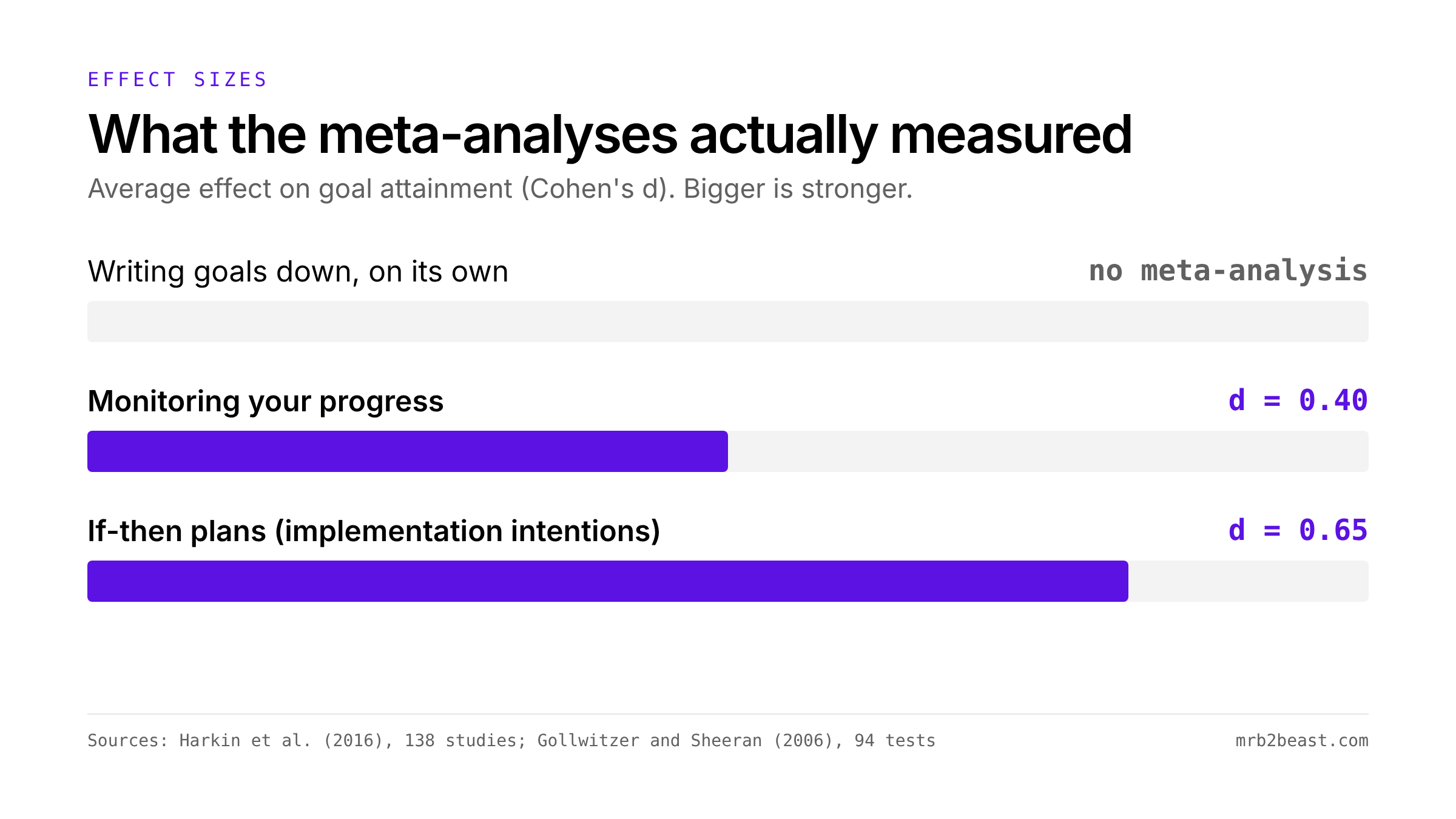
Notice what is missing from that chart. There is no meta-analysis that isolates the act of writing a goal down. Writing is the container. The plan and the tracking are the content.
What one sentence can do
One field experiment shows how large the gap can be.
In 2002, Sarah Milne, Sheina Orbell and Paschal Sheeran asked 248 adults to exercise more. One group got nothing extra. One group got persuasive material about the health benefits of exercise. A third group got the same material plus one extra step: write down the day, time and place for exercising next week.
The motivation group did no better than the control group. 35 percent of them exercised at least once a week, against 38 percent in the control group. In the group with the one-sentence plan, it was 91 percent.
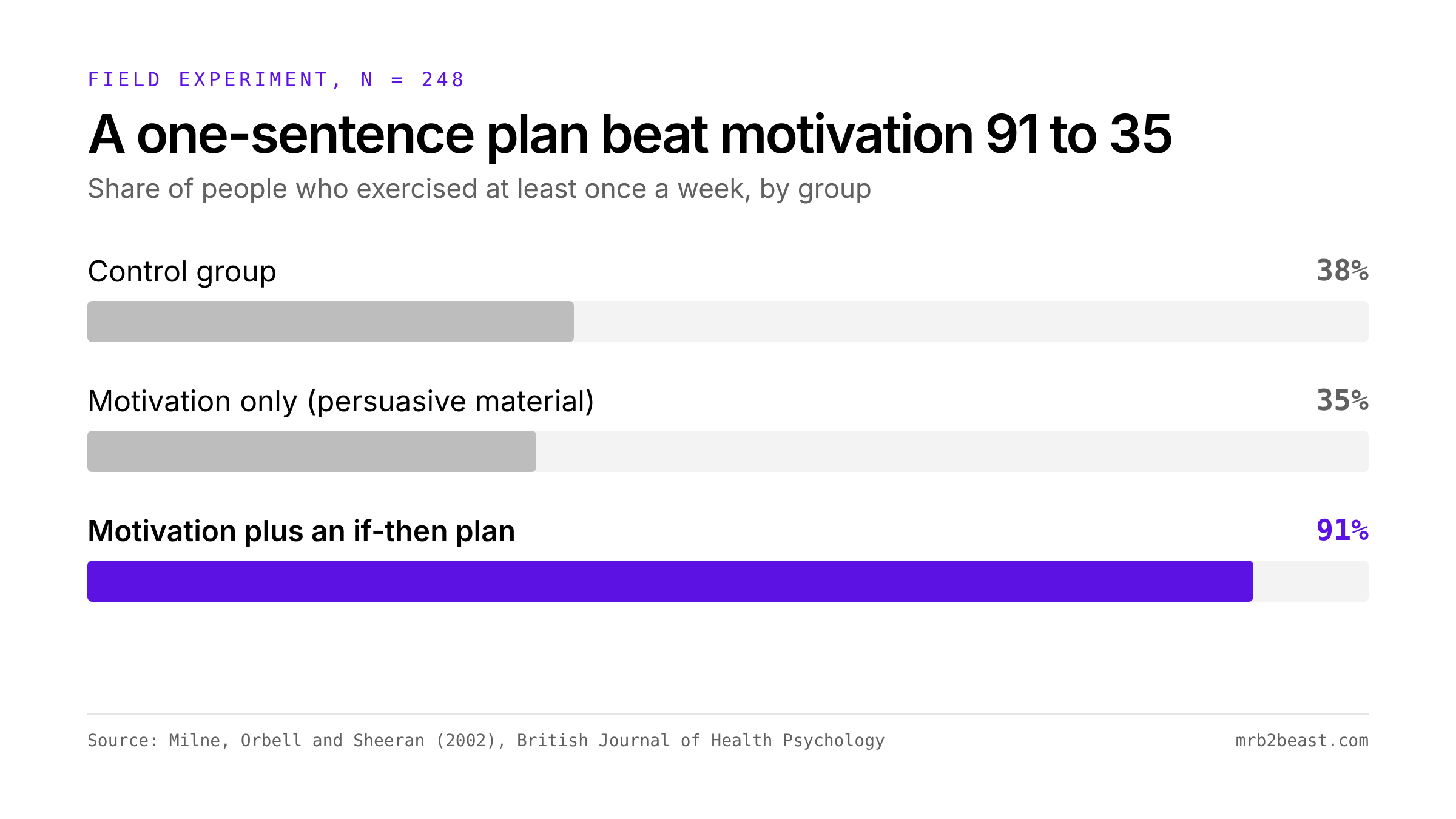
Motivation alone did nothing. A plan with a day, a time and a place more than doubled the result.
In short: the gap is not between people who write goals and people who do not. It is between people who plan the when and where, and people who hope.
The three mistakes almost everyone makes with goals
Once you see the research, the common mistakes are easy to spot.
Mistake 1: Writing the goal, but not the plan
A written goal is a wish with better handwriting. "Get fit this year" names an outcome. It does not tell you what to do on a Tuesday evening when you are tired.
Anyone who stops at the goal leaves every daily decision to willpower. The research above suggests that is exactly where most goals die.
Mistake 2: Setting yearly goals with no link to today
Yearly goals are useful. A year is long enough to change something real. But a yearly goal is too far away to guide a single day.
Here is an example. A solo founder writes "reach 10,000 newsletter subscribers" in January. By March, nothing in the calendar connects to that number. The goal is not wrong. It is just not connected to anything due this week.
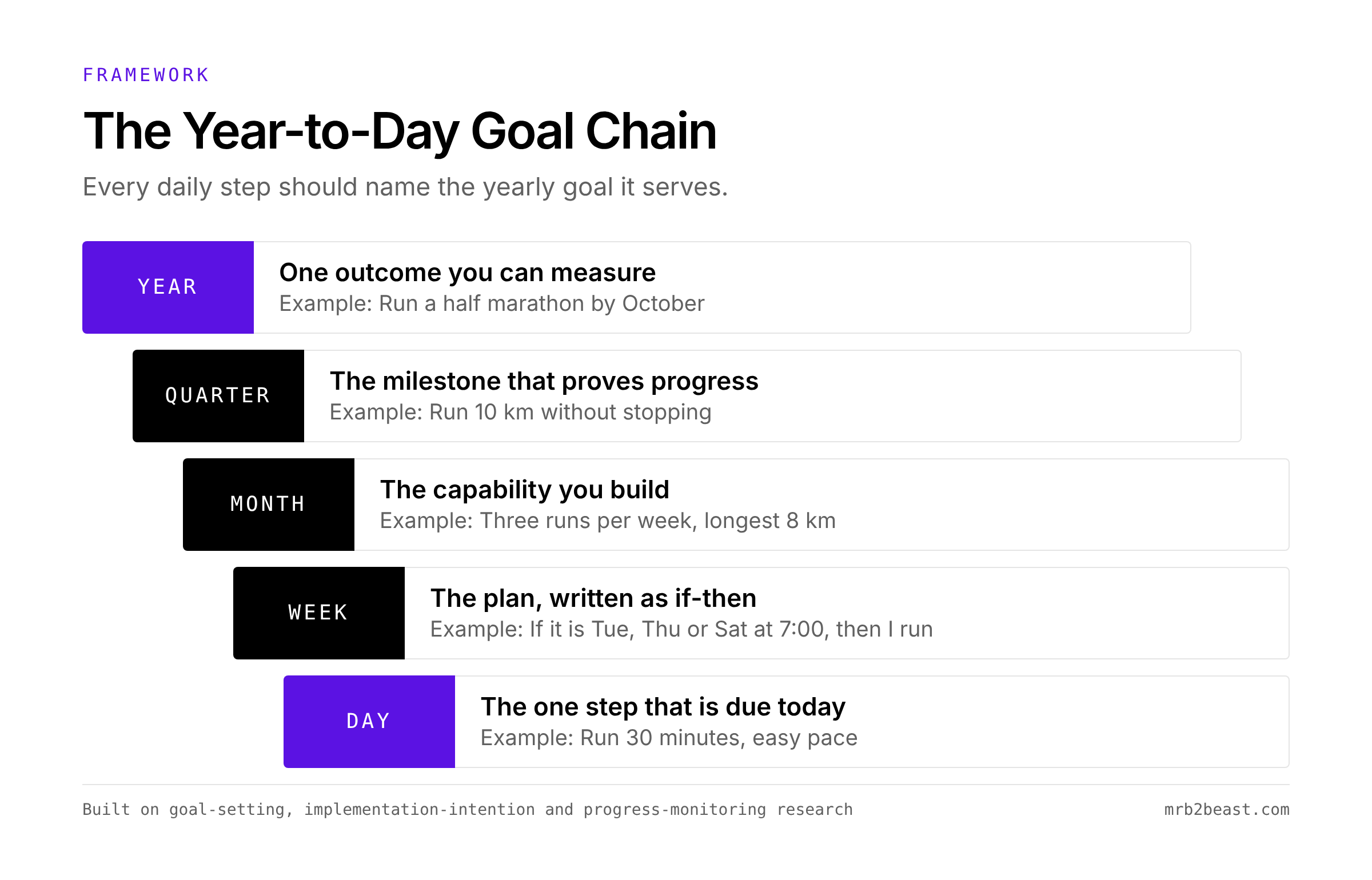
That means: a yearly goal needs a chain. Quarter, month, week and day, each one serving the level above.
Mistake 3: No feedback loop
Without tracking, you do not know if you are on course until it is too late. Harkin and colleagues found that monitoring helps most when the record is physical and visible to someone else.
This matches the Matthews result. The winning group was the one with weekly progress reports, not the one with the nicest written goal.
How to achieve goals: the Year-to-Day Goal Chain
I am not saying that writing goals down is useless. I am saying it is incomplete. Here is a system that adds the two parts with the strongest evidence.
Step 1: Pick one outcome for the year. Make it specific and measurable. Goal-setting research by Edwin Locke and Gary Latham has shown for decades that specific, hard goals beat vague "do your best" goals. One goal per area of life is enough.
Step 2: Break it down into quarter, month and week. Each level answers one question. Quarter: what milestone proves progress? Month: what capability do I need to build? Week: what exactly do I do?
Step 3: Write the week as if-then plans. Not "run more," but "If it is Tuesday, Thursday or Saturday at 7:00, then I run from my front door." Name the situation, the time and the place. Add one plan for your most likely obstacle: "If it rains, then I do the 20-minute indoor session."
Step 4: Track it where you can see it, and show someone. Record each completed step, every day. Once a week, compare it with your monthly milestone and send a two-line update to one person.
This chain is the idea behind Gaapp.io, a goal tracking app that shows what is due today and which yearly goal it serves. Disclosure: I am building it. A paper notebook works too. The system matters more than the tool.
Ask yourself this week:
- Can I name the one step that is due today, and which yearly goal it serves?
- Do my plans say when and where, or only what?
- Who sees my progress, and how often?
Conclusion: goals are not the system
The Yale study never happened. The lesson people took from it was half right.
Writing goals down is a good start. It is not what makes the difference. What makes the difference is a plan that tells you when and where to act, and a record that shows you whether it is working.
The good news: both cost nothing. You can set them up in 20 minutes.
What you learned today
- The Yale 1953 and Harvard 1979 goal studies were never conducted. Both university libraries say so.
- The most cited replacement study was a conference talk with 149 participants, and its winning group did far more than write goals down.
- If-then plans (d = 0.65 across 94 tests) and progress tracking (d = 0.40 across 138 studies) are the tools with strong evidence. Use both.
FAQ
Does writing down your goals actually work? Writing goals down helps as a first step, but there is little strong evidence for writing alone. The best-known study was presented at a conference and not published in a peer-reviewed journal. Its best group also made action commitments and sent weekly progress reports. The strong evidence is for if-then plans and progress tracking.
Was the Harvard or Yale goal study real? No. The Yale University Library and the Harvard Library both state that they have never found such a study. Fast Company investigated the Yale version in 1996 and could not document it either. The story spread through motivational talks and books.
What is an implementation intention? An implementation intention is an if-then plan: "If situation X occurs, then I will do Y." A meta-analysis of 94 tests by Gollwitzer and Sheeran (2006) found a medium to large effect on goal achievement. It works because it removes the decision from the moment of action.
How do you track progress on your goals? Record each step physically or in an app, review it weekly against a milestone, and share it with at least one person. A meta-analysis of 138 studies found that progress monitoring improves goal attainment, especially when the record is physical and shared.
What are the steps to achieve a goal? Pick one measurable outcome. Break it into quarterly, monthly and weekly targets. Write the weekly actions as if-then plans with a time and a place. Track progress daily and review it every week with someone you trust.
About the author
Tristan Eilenburg. One person. AI systems. Global reach. I write about building systems that work, with evidence instead of hype.
- X: @MrB2Beast
- LinkedIn: Tristan Eilenburg
- Instagram: @mrb2beast
- Building Gaapp.io (Instagram: @gaapp.io)
I write one of these every week. If this one taught you something, the newsletter is where the next one lands first.
Sources
- Yale University Library. "Did a study of the Yale class of 1953 find that the 3% who had written goals...?" Ask Yale Library FAQ. https://ask.library.yale.edu/faq/175224
- Harvard Library. FAQ on the "Harvard Goals Study." https://ask.library.harvard.edu/faq/82314
- Tabak, L. (1996, December 31). If Your Goal Is Success, Don't Consult These Gurus. Fast Company. https://www.fastcompany.com/27953/if-your-goal-success-dont-consult-these-gurus
- Matthews, G. (2007). The Impact of Commitment, Accountability, and Written Goals on Goal Achievement. Podium presentation, 87th Convention of the Western Psychological Association, Vancouver. https://scholar.dominican.edu/psychology-faculty-conference-presentations/3/ and research summary: https://www.dominican.edu/sites/default/files/2020-02/gailmatthews-harvard-goals-researchsummary.pdf
- Gollwitzer, P. M., and Sheeran, P. (2006). Implementation intentions and goal achievement: A meta-analysis of effects and processes. Advances in Experimental Social Psychology, 38, 69-119. https://doi.org/10.1016/S0065-2601(06)38002-1
- Harkin, B., Webb, T. L., Chang, B. P. I., Prestwich, A., Conner, M., Kellar, I., Benn, Y., and Sheeran, P. (2016). Does monitoring goal progress promote goal attainment? A meta-analysis of the experimental evidence. Psychological Bulletin, 142(2), 198-229. https://eprints.whiterose.ac.uk/91437/
- Milne, S., Orbell, S., and Sheeran, P. (2002). Combining motivational and volitional interventions to promote exercise participation: Protection motivation theory and implementation intentions. British Journal of Health Psychology, 7(2), 163-184. https://doi.org/10.1348/135910702169420
- Locke, E. A., and Latham, G. P. (2002). Building a practically useful theory of goal setting and task motivation: A 35-year odyssey. American Psychologist, 57(9), 705-717.