Your Goal Tracker Can Make You Worse. Here Is What to Track Instead
Why tracking the wrong number backfires, and how to build a goal tracker that cannot be fooled by its own data.

In September 2016, the US Consumer Financial Protection Bureau fined Wells Fargo 100 million dollars. Employees had opened roughly 1.5 million deposit accounts and 565,000 credit card accounts that may not have been authorized. A year later, the bank raised its own estimate to about 3.5 million.
Nobody at Wells Fargo stopped tracking. The bank tracked sales with great discipline. It just tracked a number that could be pushed up without serving a single customer.
That is the uncomfortable side of every goal tracker. Tracking works. It also works on the wrong thing.
The idea that you should track your goals is not wrong. It is one of the better-supported ideas in goal research. It is just incomplete.
I want to show you how tracking backfires, from a bank to a pedometer. I want to show you the detail in the research that tells you what to track instead. And I want to give you a simple goal tracker setup you can build this week.
Key takeaways
- Tracking changes behavior, but it improves the number you track, not automatically the goal behind it. Track behavior, and behavior moves. Track outcomes, and outcomes move.
- When a number becomes the target, people find ways to move the number. Economists call this Goodhart's law.
- Measurement can also cost you enjoyment. In one experiment, 27.3 percent of tracked readers kept reading after tracking stopped, against 48.5 percent of untracked readers.
What the research actually shows
The common belief is simple: what gets measured gets done. Put a number on your goal, watch it, and you will move toward it.
The first half is true. The second half is where it gets interesting.
Tracking works, but on what you track
In the pilot article of this series on how to achieve goals, I covered the headline number. In 2016, Benjamin Harkin and colleagues combined 138 studies with 19,951 participants. Monitoring progress improved goal attainment with an average effect of d = 0.40.
Fewer people read the next part of the paper. The authors split the studies by what people monitored and what the researchers measured afterwards.
Monitoring behavior had a large effect on behavior: d = 0.79 across 17 studies. Its effect on outcomes was d = 0.14 across 8 studies, and that was not statistically reliable. Monitoring outcomes worked the other way round. It had an effect of d = 0.62 on outcomes across 30 studies, and only d = 0.17 on behavior, again not reliable.
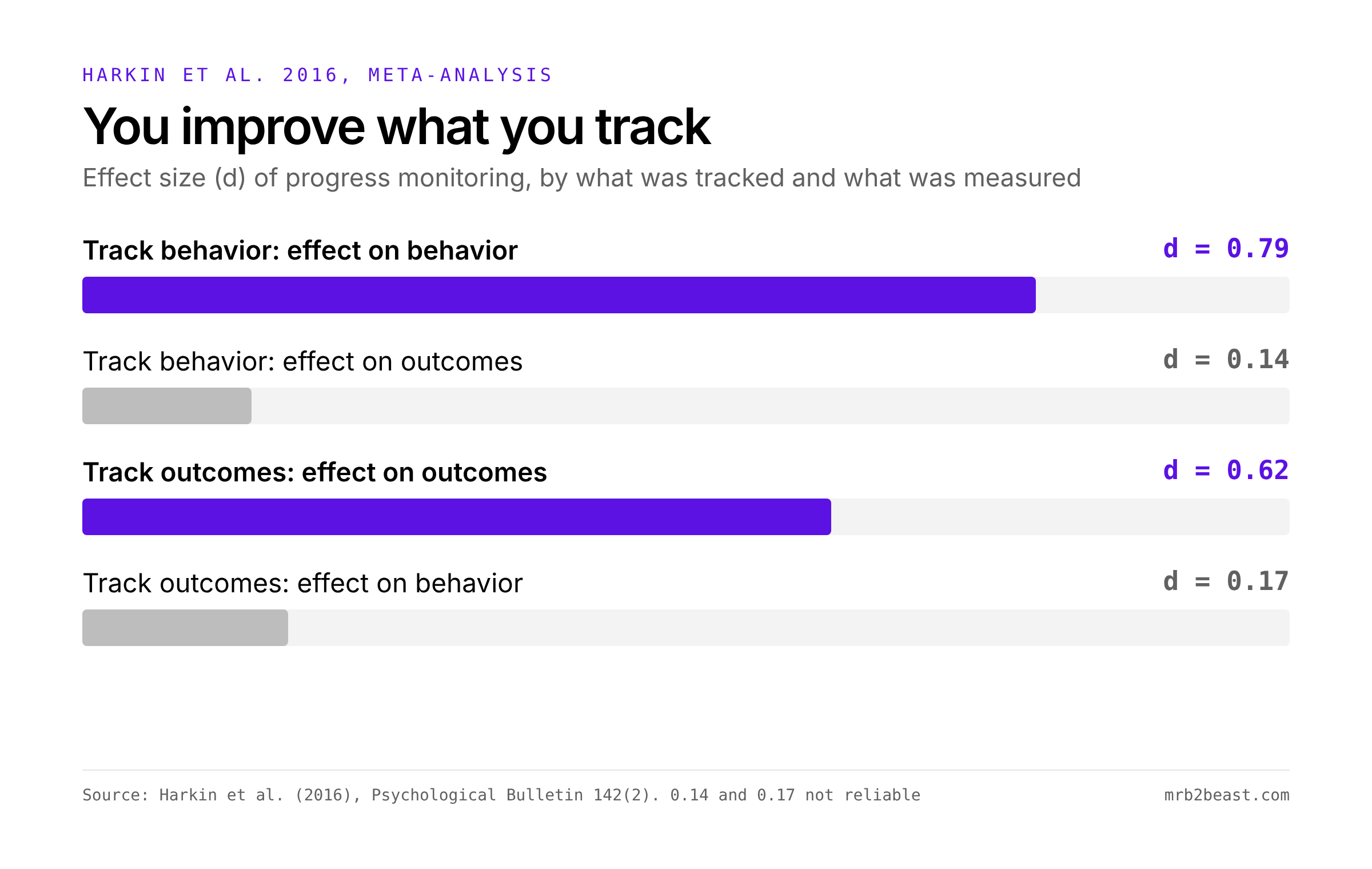
The authors give a plain reason. A goal can be reached through many different behaviors. So the number you watch shapes which part of the system moves.
That sounds like a technicality. It is the core design problem of any goal tracker. If you only count actions, you get more actions. Whether they produce the result is a separate question.
When a measure becomes a target
In July 1975, the economist Charles Goodhart presented a paper on UK monetary policy at a Reserve Bank of Australia conference. It contains the line now known as Goodhart's law: "Any observed statistical regularity will tend to collapse once pressure is placed upon it for control purposes."
The version everyone quotes came later. In 1997, the anthropologist Marilyn Strathern wrote about audits in British universities. Her sentence was shorter: "When a measure becomes a target, it ceases to be a good measure."
What is Goodhart's law? Goodhart's law says that a number stops being a reliable signal once people are rewarded for moving it. The number was useful because it went up with the thing you cared about. Once it becomes the target, people find cheaper ways to raise the number. The link breaks.
The psychologist Donald Campbell described the same pattern for social programs. His version was published in 1979. The more a number is used for decisions, the more it gets corrupted. And the more it distorts the process it is meant to monitor.
The bank that hit its numbers
Wells Fargo is the textbook case. Its retail bank pushed cross-selling hard, and its sales model relied on growth in sales volume year after year. Employees under pressure opened accounts customers had not asked for.
The board commissioned an independent investigation, released in April 2017. It found that about 5,300 employees had been fired for sales practice violations between January 2011 and March 2016.
The detail nobody quotes is in the same report. Leadership knew many sales plans could not be met. Internally, they were called "50/50 plans," meaning only half the regions were expected to reach them.
The bank did have a quality check. It tracked how many new accounts were actually funded by customers. The report also quotes a January 2012 email from a marketing leader. The message employees received, he wrote, was that "Solutions continue to be king." In context, solutions meant products sold. The guard rail was not strong enough to stop it.
The cost nobody tracks: enjoyment
Goodhart is about gaming. A second cost is quieter, and it hits people who are not gaming anything.
In 2016, Jordan Etkin of Duke University published six experiments in the Journal of Consumer Research. The title is direct: "The Hidden Cost of Personal Quantification."
People who saw their output did more. They walked more steps, read more pages, colored more shapes. But they enjoyed the activity less. Etkin found that measurement made the activity feel more like work.
The most telling result came in the reading study. After the tracking stopped, participants could choose whether to keep reading. Among those who had not been measured, 48.5 percent kept going. Among those who had been, it was 27.3 percent.
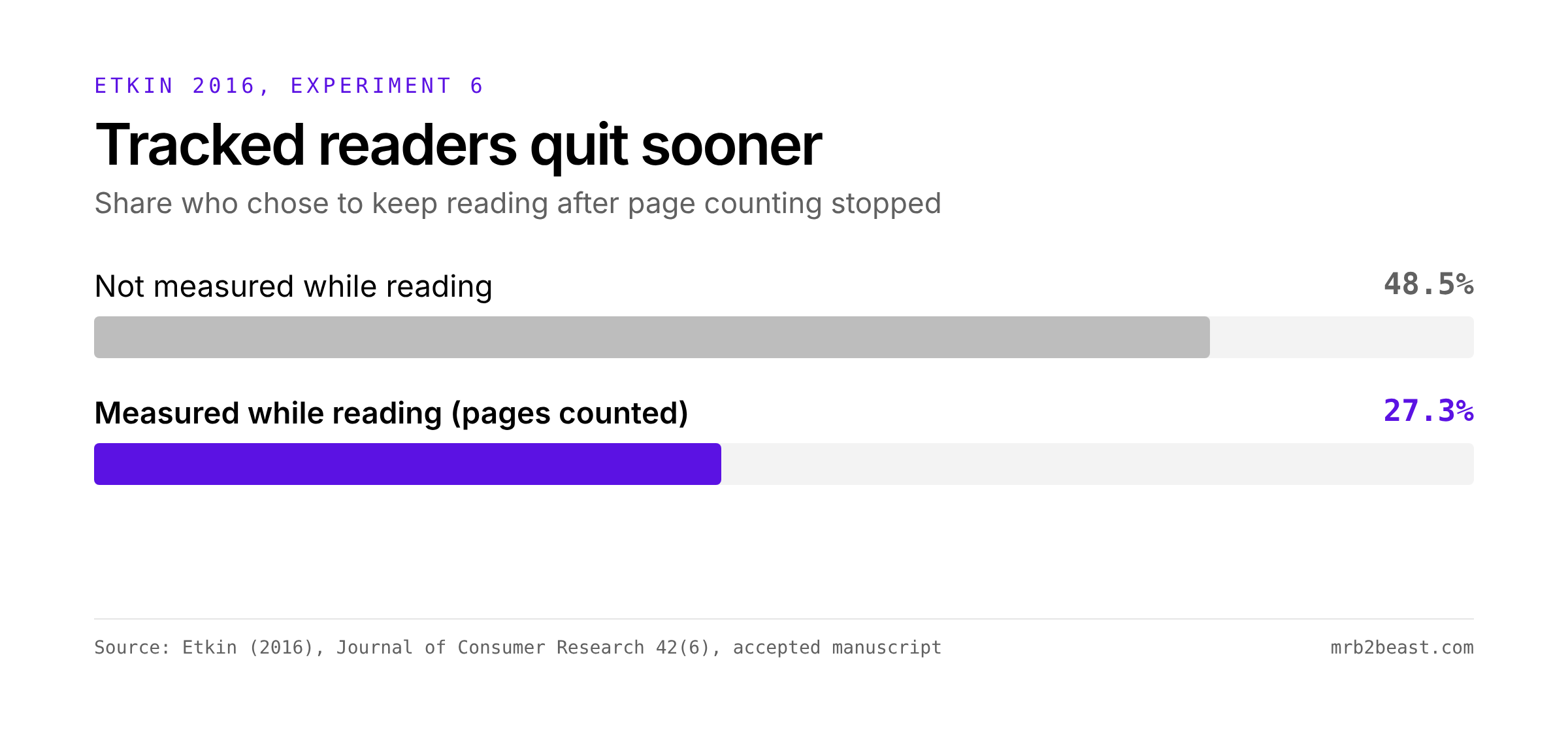
One caveat is fair. These were short lab tasks, and the effect was strongest for activities people did for fun. When reading was framed as work, the drop in enjoyment largely disappeared.
In short: tracking moves the number you watch. If that number can be pushed up cheaply, it will be. And if the activity is something you enjoy, counting it can make you want it less.
The three mistakes almost everyone makes with a goal tracker
These mistakes are not about discipline. They are about design.
Mistake 1: Tracking only activity
Most trackers count what is easy to count. Workouts logged. Posts published. Calls made. These are behaviors, and Harkin shows that tracking behavior moves behavior.
But nothing in the tracker tells you whether the behavior is working. You can hit every checkbox for twelve weeks and still not be closer to the goal.
Mistake 2: Treating the input as the goal
Here is an example. A solo founder wants more revenue from her newsletter. She sets a target of three issues per week and tracks it every day.
By week six, she has a perfect streak. She has also started shipping shorter, thinner issues to keep the count. Open rates drop. Paid upgrades stay flat. The tracker is green, and the goal is drifting away.
Nobody cheated. The number simply became easier to move than the thing it stood for. That is Goodhart's law at the scale of one person.
Mistake 3: Never changing the metric
Most people choose their tracking metric once, in January, and never look at it again. That is how the Wells Fargo pattern scales down to a single person.
A metric is a hypothesis: "If this number goes up, my goal gets closer." Hypotheses can be wrong. A tracker without a rule for replacing the metric will keep rewarding you for the wrong thing.
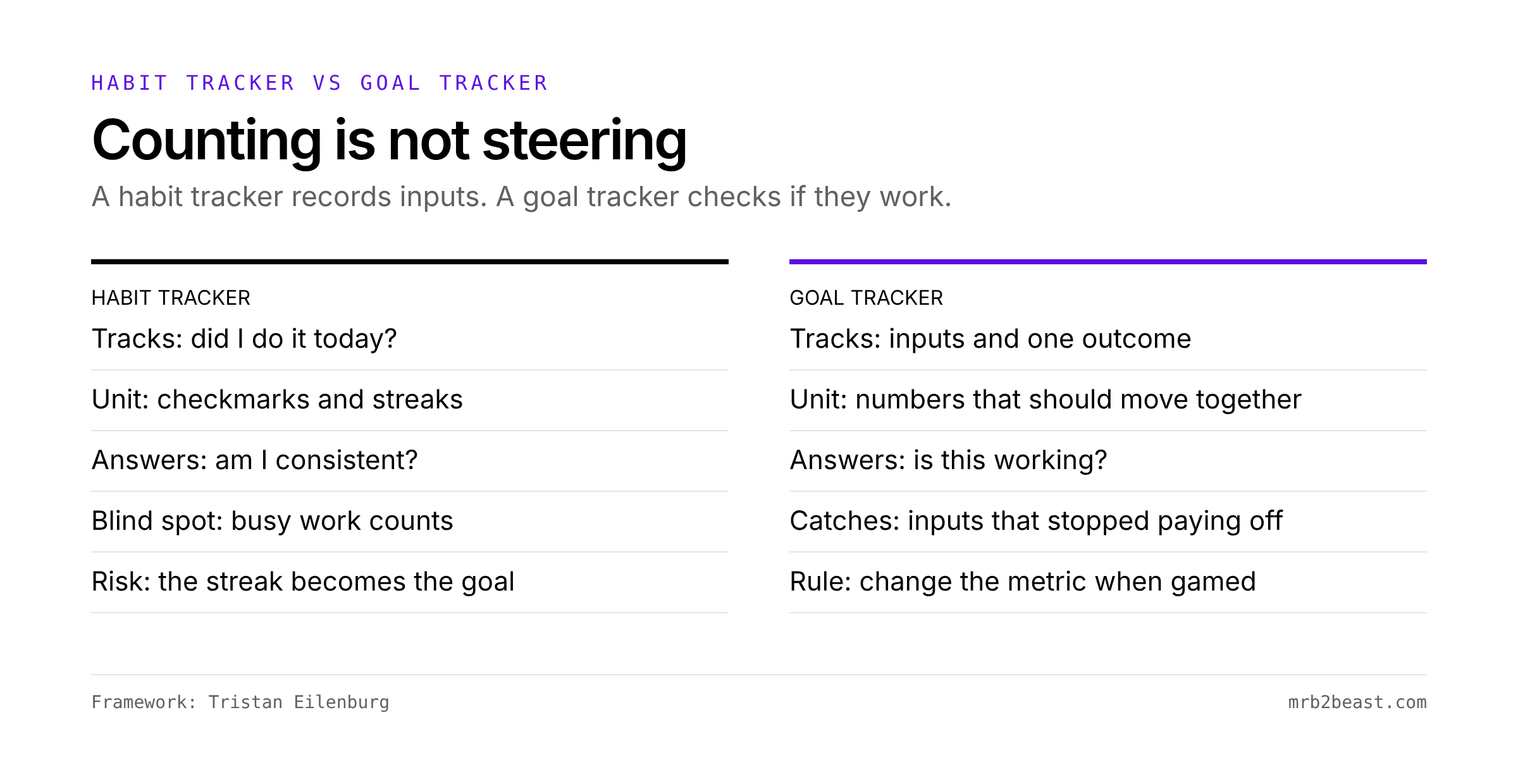
This is also the honest answer to the habit tracker vs goal tracker question. A habit tracker counts inputs. A goal tracker checks whether those inputs still move the outcome. You can use both, as long as you know which one is answering which question.
The Honest Goal Tracker: what to track and how
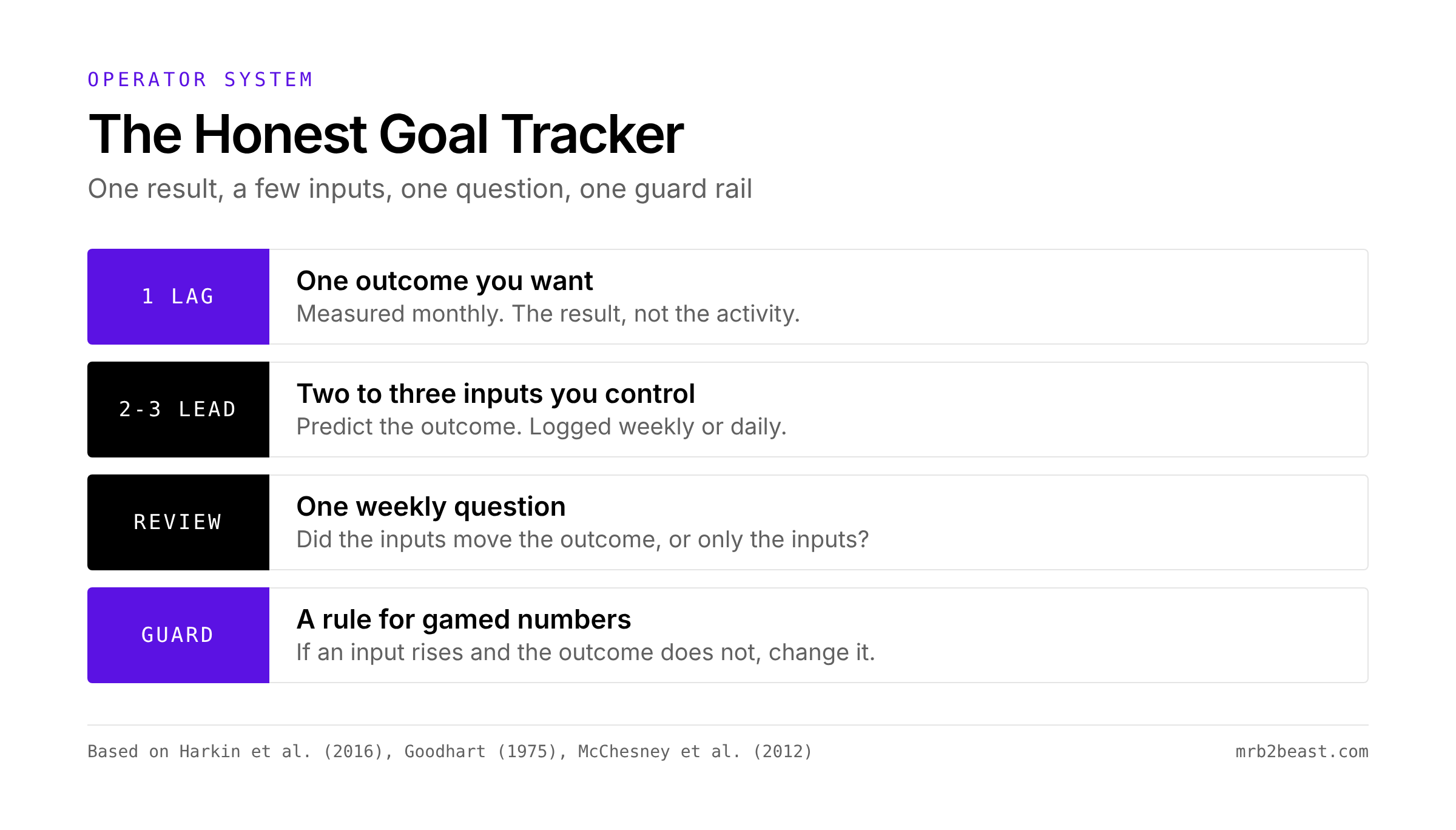
The structure below borrows two terms from The 4 Disciplines of Execution by Chris McChesney, Sean Covey and Jim Huling (2012). A lag measure tracks the result. A lead measure tracks an activity that predicts the result and that you can influence directly.
The research adds two parts the classic version tends to skip: a weekly check and a guard rail.
Step 1: Pick one lag measure. This is the outcome you actually want: revenue from the newsletter, kilograms lost, chapters finished and edited. Check it monthly. It moves slowly, and that is fine. It is the number that cannot lie for long.
Step 2: Pick two to three lead measures. These are inputs you control that should move the lag measure. For the newsletter founder: issues sent, and replies started with readers. Log them daily or weekly. Two to three is enough. More inputs make it easier to look busy.
Step 3: Ask one question every week. Not "did I hit my inputs?" but "did my inputs move the outcome, or only themselves?" Write the answer in one line. Over a few weeks, the pattern becomes visible.
Step 4: Set a rule for gamed numbers. Decide it in advance: if a lead measure rises for four weeks and the lag measure does not, the lead measure gets replaced. Add one quality check next to every count, the way Wells Fargo tracked whether new accounts were funded. And keep things you do for joy off the tracker, or track them loosely.
This structure is the idea behind Gaapp.io, a goal tracker that connects the yearly outcome to what is due today. Disclosure: I am building it. A paper notebook works too. What matters is that the inputs and the outcome sit on the same page.
The weekly question connects to something the progress principle shows too. Seeing real progress on meaningful work motivates. Seeing a checkbox move does not count as progress if the goal stands still.
Ask yourself this week:
- Which number in my tracker could I raise without getting any closer to my goal?
- Is there one outcome on my tracker, or only activities?
- Am I tracking something I used to enjoy, and do I still enjoy it?
Conclusion: track the goal, not just the count
A goal tracker is only as honest as the number you put in it.
Tracking is one of the most useful things you can do for a goal. The meta-analysis is clear on that. But tracking is a lever, and a lever moves whatever it is attached to.

Attach it to one outcome and a few inputs. Check every week whether they still move together. And when a number starts rewarding the wrong behavior, change the number, not your standards.
What you learned today
- Tracking moves what you track: behavior tracking moved behavior (d = 0.79), outcome tracking moved outcomes (d = 0.62).
- Goodhart's law: once a number becomes the target, people find cheaper ways to raise it. Wells Fargo ended up with about 3.5 million potentially unauthorized accounts.
- Measuring an enjoyable activity can reduce enjoyment. Only 27.3 percent of tracked readers kept reading, against 48.5 percent of untracked ones.
FAQ
What is a goal tracker? A goal tracker is a system, on paper or in an app, that records progress toward a goal over time. A good one tracks both the outcome you want and the few inputs you expect to drive it. That way it shows whether your effort is working, not only whether you showed up.
What should I track in a goal tracker? Track one outcome, called a lag measure, and two to three inputs you control, called lead measures. Review weekly whether the inputs move the outcome. Research by Harkin and colleagues shows that tracking behavior mostly moves behavior, and tracking outcomes mostly moves outcomes, so you need both.
What is the difference between a habit tracker and a goal tracker? A habit tracker records whether you did an action, usually as checkmarks or streaks. A goal tracker connects those actions to a result and checks whether they are paying off. A habit tracker answers "am I consistent?" A goal tracker answers "is this working?"
What is Goodhart's law? Goodhart's law is the observation that a measure stops being reliable once it becomes a target. It goes back to economist Charles Goodhart in 1975. The popular wording, "When a measure becomes a target, it ceases to be a good measure," comes from anthropologist Marilyn Strathern in 1997.
What are lead and lag measures? A lag measure tracks the result you want, such as revenue or weight. A lead measure tracks an activity that predicts that result and that you can influence directly, such as sales calls or daily meals. The terms were popularized by The 4 Disciplines of Execution (2012).
About the author
Tristan Eilenburg. One person. AI systems. Global reach. I write about building systems that work, with evidence instead of hype.
- X: @MrB2Beast
- LinkedIn: Tristan Eilenburg
- Instagram: @mrb2beast
- Building Gaapp.io (Instagram: @gaapp.io)
I write one of these every week. If this one taught you something, the newsletter is where the next one lands first.
Sources
- Consumer Financial Protection Bureau. (2016, September 8). Consumer Financial Protection Bureau fines Wells Fargo $100 million for widespread illegal practice of secretly opening unauthorized accounts. https://www.consumerfinance.gov/about-us/newsroom/consumer-financial-protection-bureau-fines-wells-fargo-100-million-widespread-illegal-practice-secretly-opening-unauthorized-accounts/
- Wells Fargo and Company. (2017, August 31). Wells Fargo Reports Completion of Expanded Third-Party Review of Retail Banking Accounts. Form 8-K, Exhibit 99.1. https://www.sec.gov/Archives/edgar/data/0000072971/000007297117000428/wfcexhibit99108312017.htm
- Wells Fargo and Company. (2017, April 10). Wells Fargo Board Releases Findings of Independent Investigation of Retail Banking Sales Practices and Related Matters. Filed with the SEC (DEFA14A). https://www.sec.gov/Archives/edgar/data/72971/000119312517118654/d375947ddefa14a.htm
- Harkin, B., Webb, T. L., Chang, B. P. I., Prestwich, A., Conner, M., Kellar, I., Benn, Y., and Sheeran, P. (2016). Does monitoring goal progress promote goal attainment? A meta-analysis of the experimental evidence. Psychological Bulletin, 142(2), 198-229. https://eprints.whiterose.ac.uk/91437/
- Etkin, J. (2016). The hidden cost of personal quantification. Journal of Consumer Research, 42(6), 967-984. https://doi.org/10.1093/jcr/ucv095 (accepted manuscript: https://marketing.wharton.upenn.edu/wp-content/uploads/2016/10/Etkin-Jordan-11-12-15-Hidden-Cost.pdf)
- Goodhart, C. A. E. (1976). Problems of Monetary Management: The U.K. Experience. Papers in Monetary Economics, Vol. I. Reserve Bank of Australia (conference held July 1975). Bibliography entry: https://www.rba.gov.au/publications/rdp/1990/9013/conference-volumes.html
- Strathern, M. (1997). Improving ratings: audit in the British University system. European Review, 5(3), 305-321. https://www.cambridge.org/core/journals/european-review/article/improving-ratings-audit-in-the-british-university-system/FC2EE640C0C44E3DB87C29FB666E9AAB
- Campbell, D. T. (1979). Assessing the impact of planned social change. Evaluation and Program Planning, 2(1), 67-90. Reprinted in Journal of MultiDisciplinary Evaluation, 7(15), 2011. https://jmde.journals.publicknowledgeproject.org/index.php/jmde_1/article/view/297
- McChesney, C., Covey, S., and Huling, J. (2012). The 4 Disciplines of Execution: Achieving Your Wildly Important Goals. Free Press. https://www.franklincovey.com/courses/the-4-disciplines/discipline-2-act/