Positive Thinking Can Drain Your Drive. Why the WOOP Method Works Better
Dreaming about the finish line feels like progress. The research says it can quietly cost you energy, effort and results.

In 2011, psychologists Heather Barry Kappes and Gabriele Oettingen asked students to imagine a perfect future. Then they measured their blood pressure.
Students who fantasized about academic success saw their systolic blood pressure drop by an average of 7.11 mmHg. That is a body relaxing, not a body getting ready to work. In another study from the same paper, students who imagined a perfect week reported accomplishing less by the end of it.
Positive fantasies made people calmer. They did not make them more productive.
Positive thinking is not useless. Oettingen herself found that positive expectations predict success. The problem is one specific kind of positive thinking: daydreaming about the outcome as if it had already happened.
I want to show you what this research actually measured, including the parts that are weaker than the headlines suggest. I want to show you why the WOOP method, short for Wish, Outcome, Obstacle, Plan, fixes the problem. And I want to give you a weekly review based on it, one you can run in 15 minutes.
Key takeaways
- In lab studies, positive fantasies about the future lowered energy, measured as a drop in systolic blood pressure and in self-rated energy.
- Positive expectations ("I can do this") predicted better outcomes. Positive fantasies ("I see myself there") predicted worse ones.
- WOOP adds an obstacle and an if-then plan to the fantasy. A 2021 meta-analysis found a small to medium effect, and a smaller one after correcting for publication bias.
What the research actually shows
The common belief is simple. Visualize your success, and you are more likely to reach it. Vision boards, morning visualizations and "see yourself at the finish line" are built on this idea.
Oettingen has studied this belief for about three decades. Her results point the other way, with one important exception.
Fantasies are not expectations
The key distinction comes from a 2002 paper by Oettingen and Doris Mayer. They measured two things separately.
Expectations are judgments about how likely success is, based on your track record. Fantasies are free images of the desired future, whether or not they are likely.
Then they followed people over time. In one study, 83 graduate students were surveyed before looking for jobs. Of those, 40 completed the follow-up two years later. Those with positive expectations had received more job offers (r = .41) and earned higher salaries. Those with positive fantasies had sent fewer applications (r = -.40), received fewer offers (r = -.39) and earned less.
The same pattern showed up in 51 patients before hip replacement surgery. Two weeks after the operation, positive fantasies before surgery were linked to worse hip motion (r = -.43) and worse stair walking. Positive expectations were linked to better recovery.
An earlier study by Oettingen and Thomas Wadden followed 25 women in a weight-loss program for a year. The more positive their fantasies about weight loss, the less weight they lost. The more positive their expectations, the more they lost.
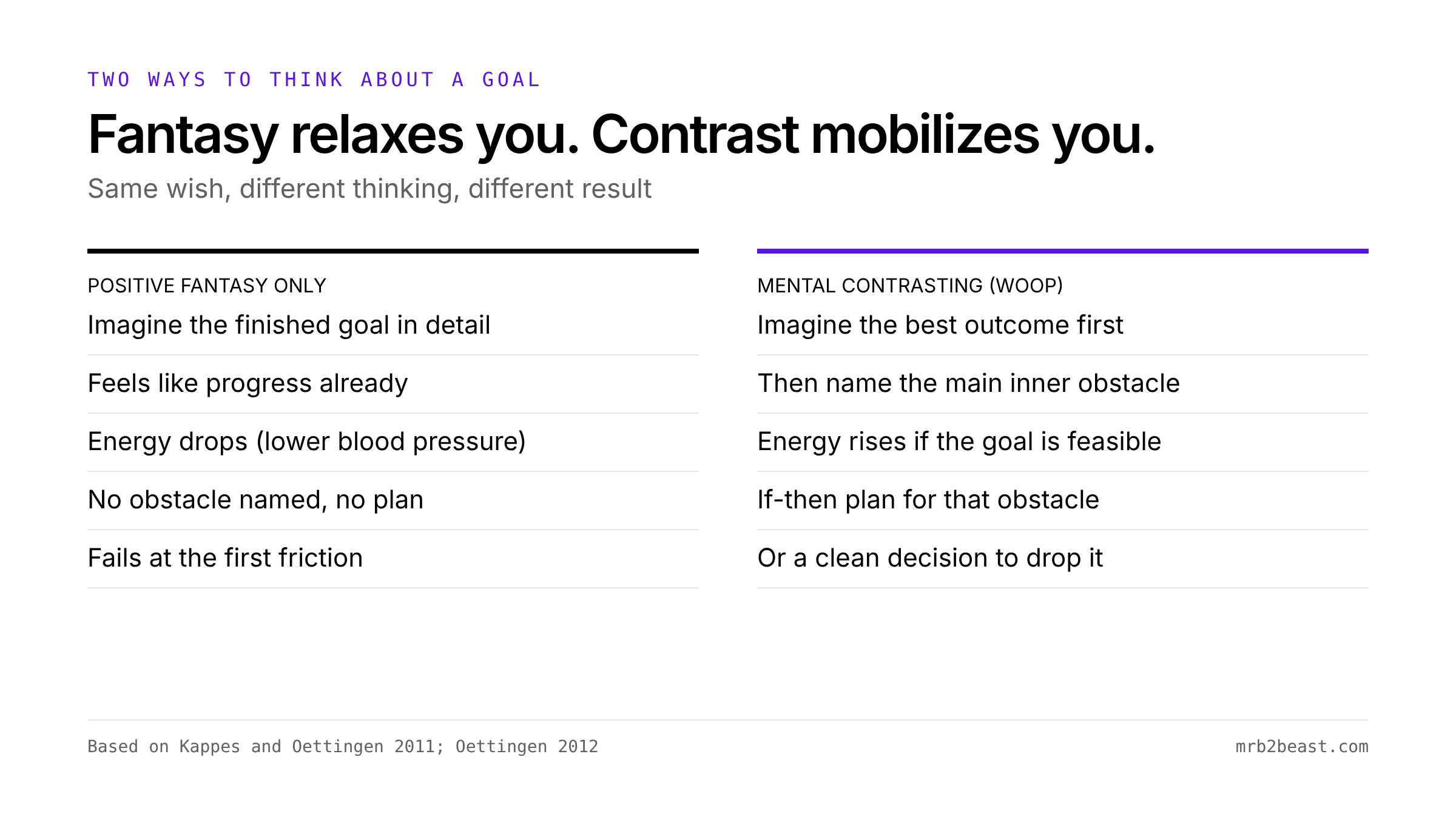
What is mental contrasting? Mental contrasting means imagining a desired future and then, directly after, imagining the main obstacle in your present reality that stands in the way. The order matters: future first, then reality. Oettingen describes it as the opposite of indulging (only the future) and dwelling (only the problems). WOOP is the practical four-step version of it.
The part the headlines skip
These findings are real. They also need two honest qualifiers.
First, the job, hip and weight-loss studies are correlational and small. They show a link, not proof that fantasies caused the worse results.
Second, the blood pressure effects are modest. In the first study of the 2011 paper, 164 women imagined themselves looking glamorous in high heels. Their systolic blood pressure fell by 1.73 mmHg. In the control group, which questioned the fantasy, it rose by 0.23 mmHg. That is a statistically significant difference, but a small one.
The stronger evidence is experimental. In Study 3, 40 students wrote about the coming week. Those told to imagine it going perfectly felt less energized (2.27 vs 3.00 on a 5-point scale). A week later, they rated their own accomplishments lower (5.74 vs 6.57). The drop in energy explained the drop in results.
What happens when you add the obstacle and the plan
If fantasy alone relaxes you, the fix is not to stop wishing. It is to add the reality check, then a plan.
In 2009, Gertraud Stadler, Oettingen and Peter Gollwitzer ran a randomized trial with 256 women aged 30 to 50. All received health information about exercise. Half also learned mental contrasting with implementation intentions, the scientific name for WOOP.
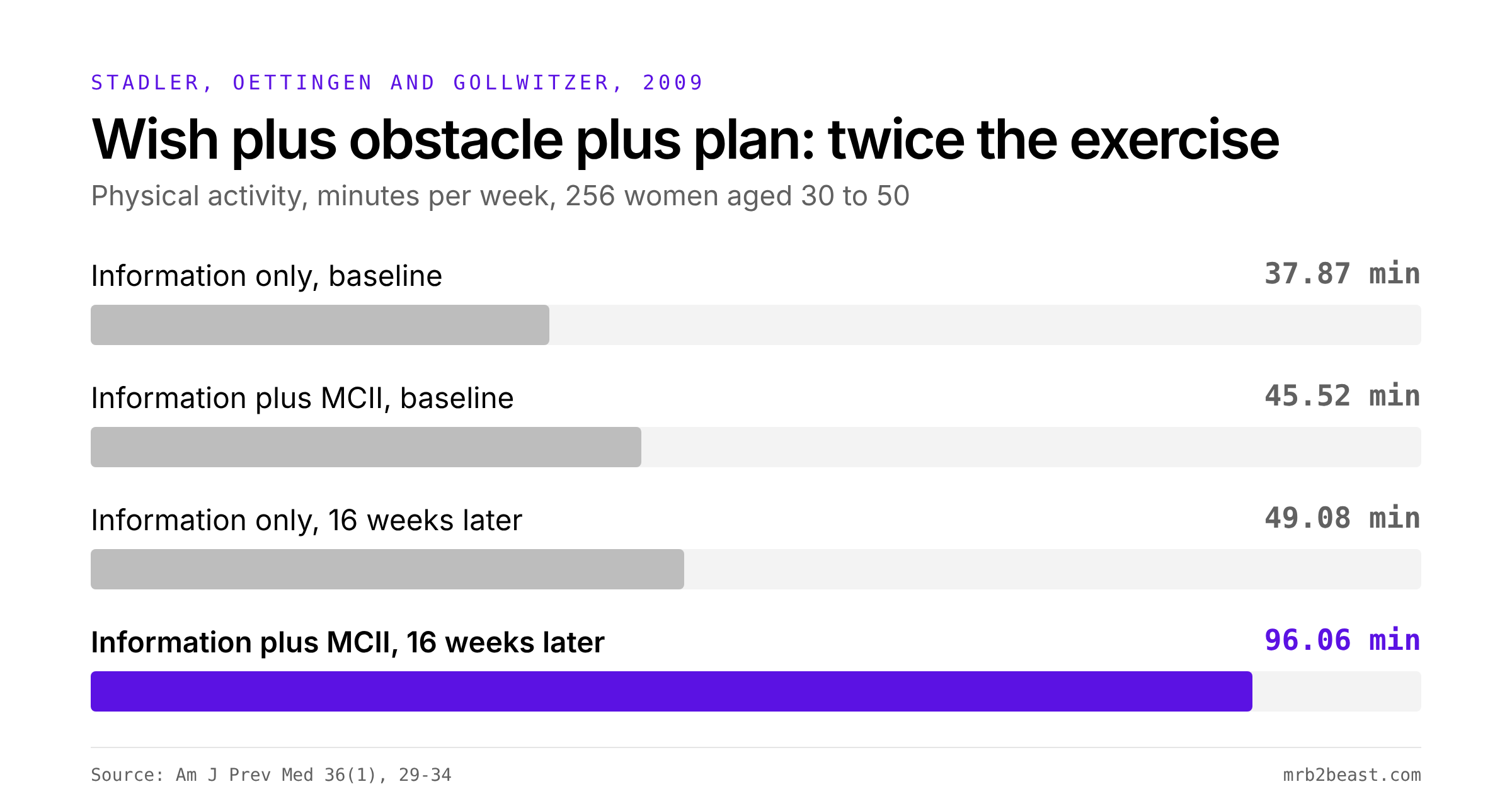
Sixteen weeks later, the information-only group exercised 49.08 minutes per week. The WOOP group exercised 96.06 minutes. The authors summarize it as twice as physically active, or nearly one hour more per week.
A smaller study by Angela Duckworth and colleagues tested the same technique with 66 high school students preparing for the PSAT. After one 30-minute session, the WOOP group completed 140 practice questions on average. The control group completed about 84.
What the meta-analysis says
Single trials can mislead. So in 2021, Guoxia Wang, Yi Wang and Xiaosong Gai pooled 24 studies with 15,907 participants.
The overall effect of mental contrasting with implementation intentions was Hedges g = 0.336. That is small to medium. It held for health goals (g = 0.379), academic goals (g = 0.255), personal goals and relationship goals.
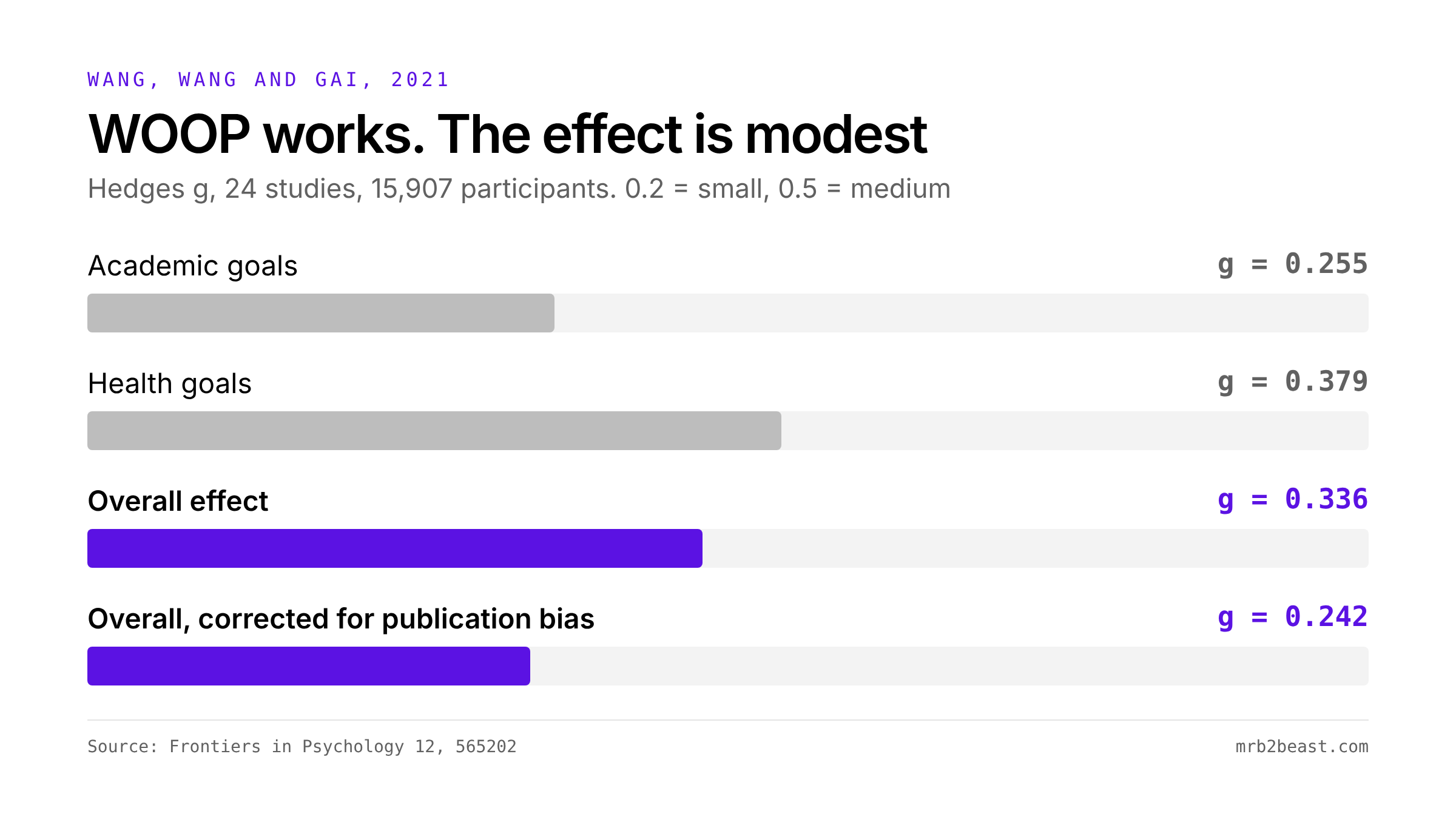
The authors also found signs of publication bias. After a statistical correction, the overall effect dropped to g = 0.242. Still positive, still useful, but smaller than the best single trials suggest. The authors also note that the number of studies was small.
For comparison, the meta-analysis of if-then plans alone, covered in how to achieve goals, found d = 0.65. Those were different studies with different outcomes, so this is not a head-to-head test. It does suggest that much of the punch in WOOP comes from the Plan step.
In short: dreaming alone can lower your energy. Dreaming, then naming the obstacle, then planning around it reliably moves behavior, by a modest but real amount.
The three mistakes people make with positive thinking and goals
Once you know the research, you can spot where goal setting goes soft.
Mistake 1: Treating the vision as the work
A vision board or a long visualization feels productive. In the lab, that good feeling was the problem. The fantasy delivers a small dose of the reward before any of the work is done.
Here is an example. A solo founder spends Sunday evening picturing the launch: the sign-ups, the messages, the relief. On Monday, the actual first step, writing the landing page, feels heavier than it did before. Nothing is wrong with the vision. It just used up the energy that the page needed.
Mistake 2: Naming outside obstacles instead of inner ones
When people list obstacles, they tend to list the weather, the client, the calendar. WOOP asks for the obstacle inside you: the habit, the emotion, the excuse.
That is not a moral point. It is practical. You can write an if-then plan for your own reaction. You cannot write one for the economy.
Mistake 3: Keeping every goal alive
This is the detail almost nobody quotes. Mental contrasting does not make you commit to everything.
In his 2012 review, Oettingen describes what happens when expectations of success are low. People who contrast tend to let go and pursue other wishes instead. She calls this active goal disengagement from unfeasible outcomes.
That is a feature. A list of twelve half-alive goals costs attention every week. WOOP gives you a clean way to say: this one is not feasible right now, and that is fine.
The WOOP method as a weekly goal review
The original WOOP is a short exercise you can do anytime. Here it is adapted as a weekly review, so it connects to the goals you are already working on.
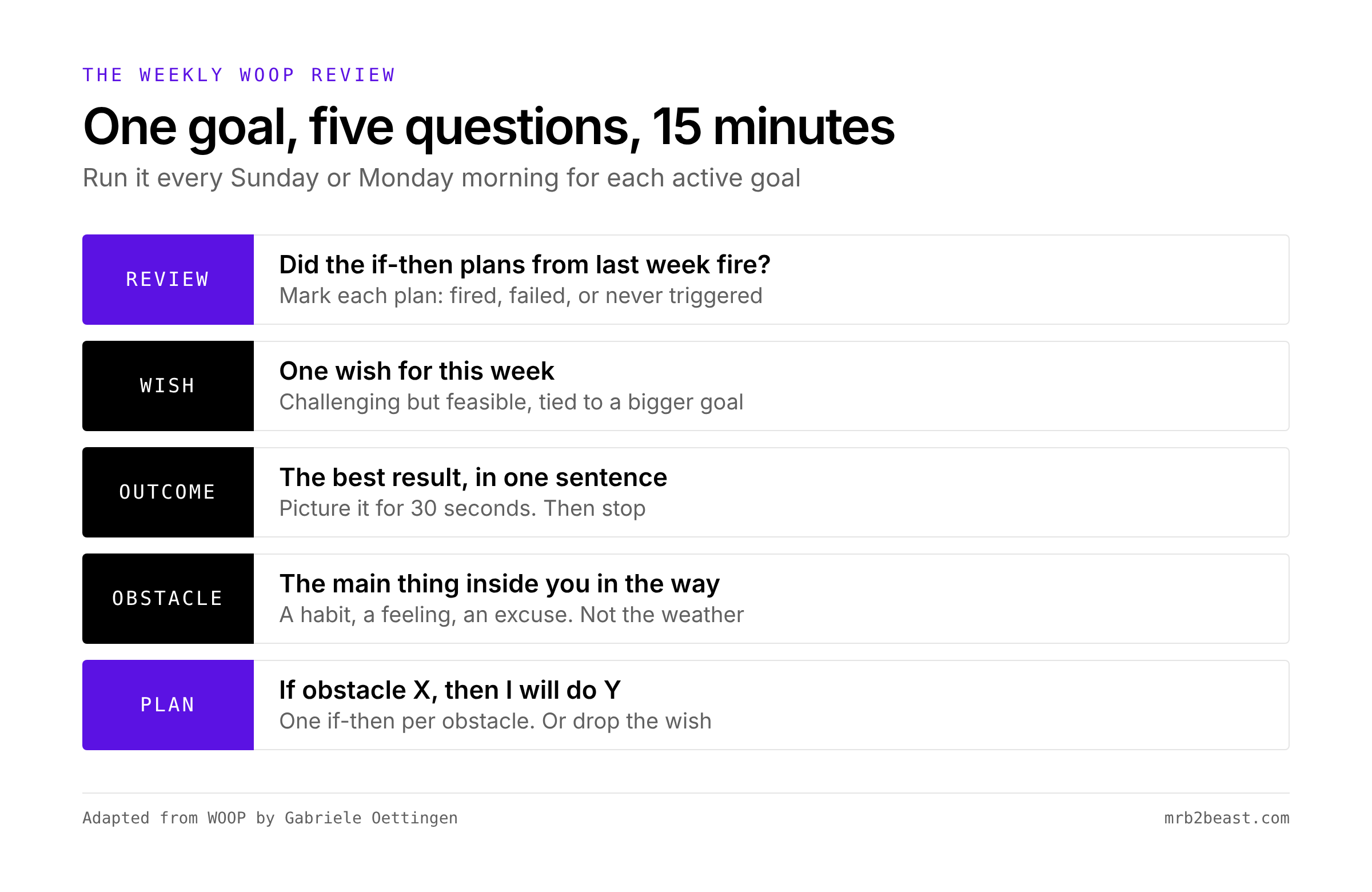
Step 1: Review. Look at the if-then plans from last week. Mark each one: fired and worked, fired and failed, or never triggered. A plan that never triggered was aimed at the wrong situation. Rewrite it.
Step 2: Wish. Pick one wish for the coming week per active goal. It should be challenging but feasible, and serve a bigger goal. "Send the proposal to three new prospects" works. "Grow the business" does not.
Step 3: Outcome. Write the best result in one sentence. Then picture it for about 30 seconds. That is enough to feel why it matters. Do not keep going. This is exactly where positive thinking turns into a fantasy that relaxes you.
Step 4: Obstacle. Ask: what inside me is most likely to stop this? Be specific. "I will open my inbox first and lose the morning" is an obstacle. "I am busy" is not.
Step 5: Plan. Turn the obstacle into an if-then: "If I feel the urge to check email before 10:00, then I open the proposal draft first." One plan per obstacle. If you cannot write a plan you believe in, drop the wish for this week. That is mental contrasting doing its job.
This loop is the idea behind Gaapp.io, a goal setting app that connects yearly goals to daily steps and shows what is due today and which bigger goal it serves. Disclosure: I am building it. A paper notebook works too. What matters is that the plans and the results from last week live in the same place.
Ask yourself this week:
- Which of my goals do I enjoy imagining more than I enjoy working on?
- What is the one inner obstacle that stopped me last week?
- Which goal would I drop if I contrasted it honestly?
Conclusion: keep the dream, add the friction
A fantasy feels like progress. That is exactly why it can replace it.
The work of Oettingen does not say that optimism is bad. Believing you can succeed predicted better results in each of the field studies above. What hurts is the fantasy that skips the hard part.

So keep the wish. Picture the outcome briefly. Then look straight at what will get in the way, and decide in advance what you will do when it shows up.
What you learned today
- Positive fantasies lowered energy in experiments, measured as lower systolic blood pressure and lower self-rated energy, and predicted worse outcomes in field studies.
- Positive expectations are different. Believing you can succeed predicted more job offers and better recovery after surgery.
- WOOP (mental contrasting plus if-then plans) has a small to medium effect across 24 studies, g = 0.336, or 0.242 after correcting for publication bias.
FAQ
What is the WOOP method? WOOP stands for Wish, Outcome, Obstacle, Plan. It is a goal technique developed by psychologist Gabriele Oettingen. You name a wish, imagine the best outcome, identify the main inner obstacle, and write an if-then plan for it. In research, it is called mental contrasting with implementation intentions, or MCII.
Does visualization work? It depends on what you visualize. Imagining only the successful outcome lowered energy in experiments and was linked to worse results in field studies. Visualizing the outcome and then the obstacle that stands in the way, as in mental contrasting, increased effort and goal attainment in several randomized trials.
What is mental contrasting? Mental contrasting is imagining a desired future, then imagining the present obstacle that stands in its way. The order matters: future first, then reality. When success seems feasible, it strengthens commitment. When success seems unlikely, it helps people let go of the goal and invest their energy elsewhere.
Is positive thinking bad for goals? Not in general. Oettingen distinguishes positive expectations from positive fantasies. Expecting success, based on your past performance, predicted better outcomes in her studies. Fantasizing about success, regardless of likelihood, predicted worse ones. The useful version of positive thinking is confidence combined with a realistic look at the obstacles.
How effective is WOOP? A 2021 meta-analysis of 24 studies with 15,907 participants found an overall effect of g = 0.336, small to medium. After correcting for possible publication bias, it was g = 0.242. Effects appeared for health, academic, personal and relationship goals. Individual trials, such as one on exercise, showed larger effects.
About the author
Tristan Eilenburg. One person. AI systems. Global reach. I write about building systems that work, with evidence instead of hype.
- X: @MrB2Beast
- LinkedIn: Tristan Eilenburg
- Instagram: @mrb2beast
- Building Gaapp.io (Instagram: @gaapp.io)
I write one of these every week. If this one taught you something, the newsletter is where the next one lands first.
Sources
- Kappes, H. B., and Oettingen, G. (2011). Positive fantasies about idealized futures sap energy. Journal of Experimental Social Psychology, 47(4), 719-729. https://doi.org/10.1016/j.jesp.2011.02.003 (PDF: https://www.psy.uni-hamburg.de/arbeitsbereiche/paedagogische-psychologie-und-motivation/personen/oettingen-gabriele/dokumente/kappes-oettingen-2011.pdf)
- Oettingen, G., and Mayer, D. (2002). The motivating function of thinking about the future: Expectations versus fantasies. Journal of Personality and Social Psychology, 83(5), 1198-1212. https://doi.org/10.1037/0022-3514.83.5.1198 (PDF: https://www.psy.uni-hamburg.de/arbeitsbereiche/paedagogische-psychologie-und-motivation/personen/oettingen-gabriele/dokumente/oettingen-mayer-2002.pdf)
- Oettingen, G., and Wadden, T. A. (1991). Expectation, fantasy, and weight loss: Is the impact of positive thinking always positive? Cognitive Therapy and Research, 15(2), 167-175. https://doi.org/10.1007/BF01173206
- Stadler, G., Oettingen, G., and Gollwitzer, P. M. (2009). Physical activity in women: Effects of a self-regulation intervention. American Journal of Preventive Medicine, 36(1), 29-34. https://doi.org/10.1016/j.amepre.2008.09.021 (PDF: https://www.socmot.uni-konstanz.de/sites/default/files/09_Stadler_Oettingen_Gollwitzer_Physical_Activity_in_Wom.pdf)
- Duckworth, A. L., Grant, H., Loew, B., Oettingen, G., and Gollwitzer, P. M. (2011). Self-regulation strategies improve self-discipline in adolescents: Benefits of mental contrasting and implementation intentions. Educational Psychology, 31(1), 17-26. https://doi.org/10.1080/01443410.2010.506003
- Wang, G., Wang, Y., and Gai, X. (2021). A meta-analysis of the effects of mental contrasting with implementation intentions on goal attainment. Frontiers in Psychology, 12, 565202. https://doi.org/10.3389/fpsyg.2021.565202
- Oettingen, G. (2012). Future thought and behaviour change. European Review of Social Psychology, 23(1), 1-63. https://doi.org/10.1080/10463283.2011.643698
- Gollwitzer, P. M., and Sheeran, P. (2006). Implementation intentions and goal achievement: A meta-analysis of effects and processes. Advances in Experimental Social Psychology, 38, 69-119. https://doi.org/10.1016/S0065-2601(06)38002-1
- WOOP My Life. Official WOOP website by Gabriele Oettingen. https://woopmylife.org