Starting on Monday Works. Waiting for Monday Does Not. The Fresh Start Effect
Why "I will start Monday" is not just an excuse, and why it still costs you more than you think.

"I will start on Monday" is usually mocked as procrastination. The data says Monday actually works.
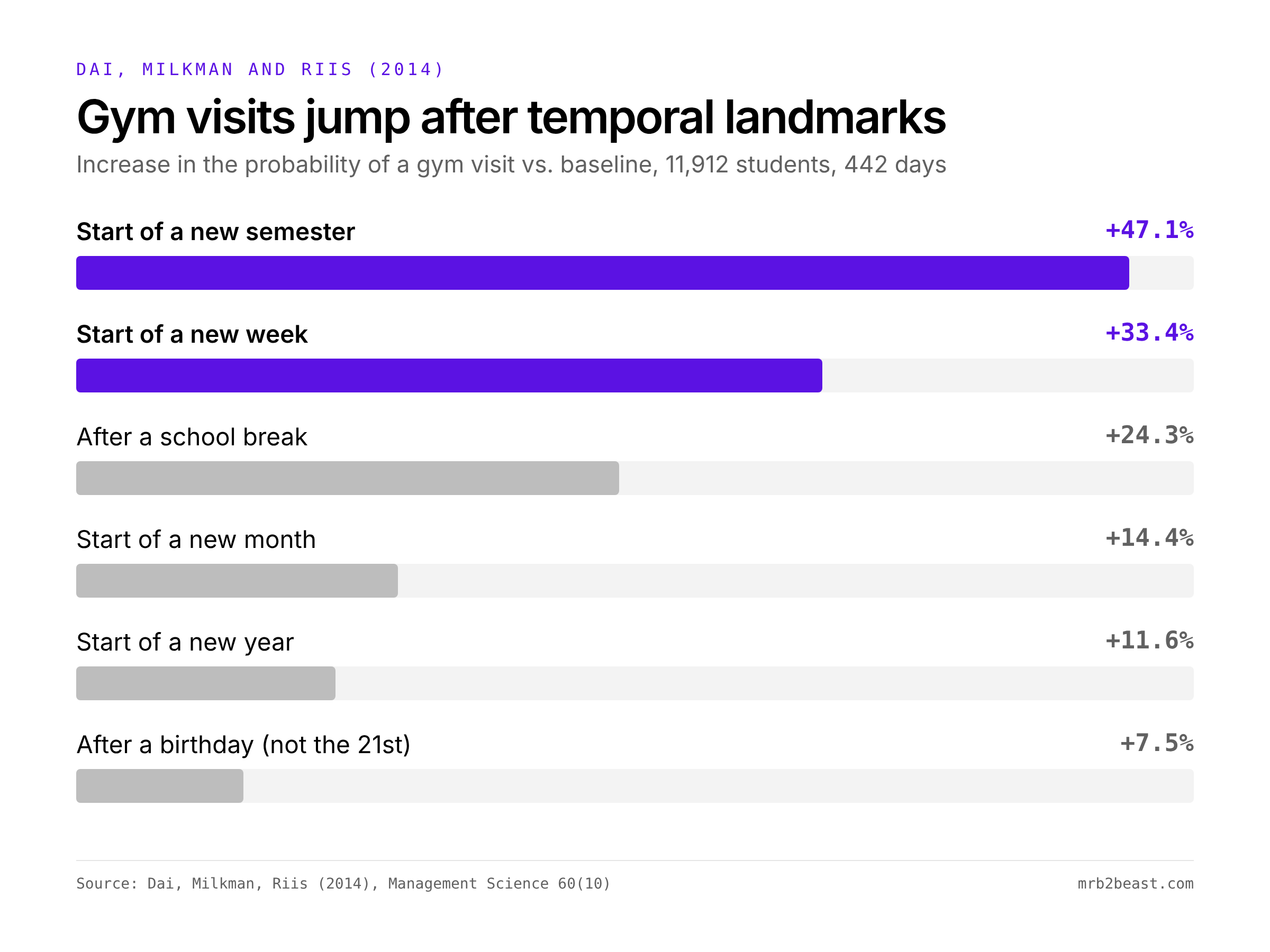
In a study of 11,912 university gym members, the probability of a gym visit rose 33.4 percent at the start of a new week. That is the fresh start effect, documented by Hengchen Dai, Katherine Milkman and Jason Riis in 2014.
But a 2020 experiment found the other half of the story. When people could see a new month coming on their calendar, they put in about 40 percent less effort on the day before it.
So the start date helps. The waiting hurts.
The popular takeaway is "use New Year, Mondays and birthdays to start your goals." That advice is not wrong. It is just incomplete. A fresh start is a good launch pad and a bad engine.
I want to show you what the original research found, including the numbers that rarely get quoted. I want to show you the dark side that came later: waiting for the date, and the fade after it. And I want to give you a simple system to use landmarks on purpose, starting this week.
Key takeaways
- Temporal landmarks really do raise goal behavior. Gym visits rose 33.4 percent at the start of a week, and goal commitments rose 145.3 percent at the start of a year.
- Anticipating a landmark lowers effort before it. In one experiment, people clicked about 40 percent less for charity on the day before a visible new month.
- In field experiments, fresh start framing works, but in absolute terms it is modest. The start date is a trigger, not a system.
What the research actually shows
The common belief has two versions. Version one: New Year and Mondays are magical restart buttons. Version two: they are a fantasy, and real people just start now.
The research supports neither version fully.
What is the fresh start effect? The fresh start effect is the rise in goal-directed behavior right after a temporal landmark, such as a new week, month, year or a birthday. Dai, Milkman and Riis named it in 2014. Their explanation: landmarks open a new "mental accounting period", which puts past failures in the old period and makes people think about the big picture of their lives.
Three datasets, one pattern
The 2014 paper in Management Science used three archival datasets. None of them was a lab experiment.
Google searches. The researchers analyzed daily US searches for "diet" from 2004 to mid-2012, a total of 3,104 days. Relative to baseline, searches rose 14.4 percent at the start of a week, 3.7 percent at the start of a month, and 82.1 percent at the start of a year. After federal holidays, they rose 10.2 percent.
Gym visits. The second dataset covered 11,912 undergraduates at one university gym over 442 days. The probability of a visit rose at the start of a new semester, week, month and year, and after school breaks.
Commitment contracts. The third dataset came from stickK, a website where people put money or reputation on a goal. It held 66,062 contracts from 43,012 users. Contract creation rose 62.9 percent at the start of a week, 23.6 percent at the start of a month and 145.3 percent at the start of a year. After federal holidays, it rose 55.1 percent.
The details nobody quotes
Two details from the paper rarely make it into the popular versions.
First, birthdays are weak. On stickK, contracts rose only 2.6 percent after a birthday. In the gym data, the effect was 7.5 percent, and only after the researchers excluded 21st birthdays. Students who turned 21 went to the gym less afterwards, not more.
Second, the effect fades. Gym attendance was highest right after a new semester or a birthday, and declined as the semester or the year of life went on. It reached its lowest level in the final month before the next birthday.
What is a temporal landmark? A temporal landmark is a moment that splits time into "before" and "after". Some are on the calendar, like a Monday, the first of the month or New Year. Others are personal, like a birthday, a move or a new job. They work because they feel like a boundary, not because of the date itself.
Landmarks can be made, not just found
The 2015 follow-up in Psychological Science shows how flexible this is. People who had signed up for a goal reminder could choose a date from a list. For half of them, March 20 was labeled "The First Day of Spring". For the other half, the same date was "The Third Thursday in March".
With the spring label, 25.61 percent chose March 20. With the plain label, 7.23 percent did. A second study using "the first day of summer break" found 28.57 percent versus 4.35 percent.
Same day. Different label. That matters for the system later: you do not need to wait for New Year. You can name your own boundary.
In short: the fresh start effect is real and well documented. It is strongest for initiating goals, it can be created by framing, and it fades as the new period gets older.
The three mistakes people make with fresh starts
The research gives you a tool. Most people use it in a way that cancels out its benefit.
Mistake 1: Waiting for the big landmark
Here is an example. A solo founder decides in October to start a weekly newsletter. It feels like a January project. So October, November and December pass with nothing shipped.
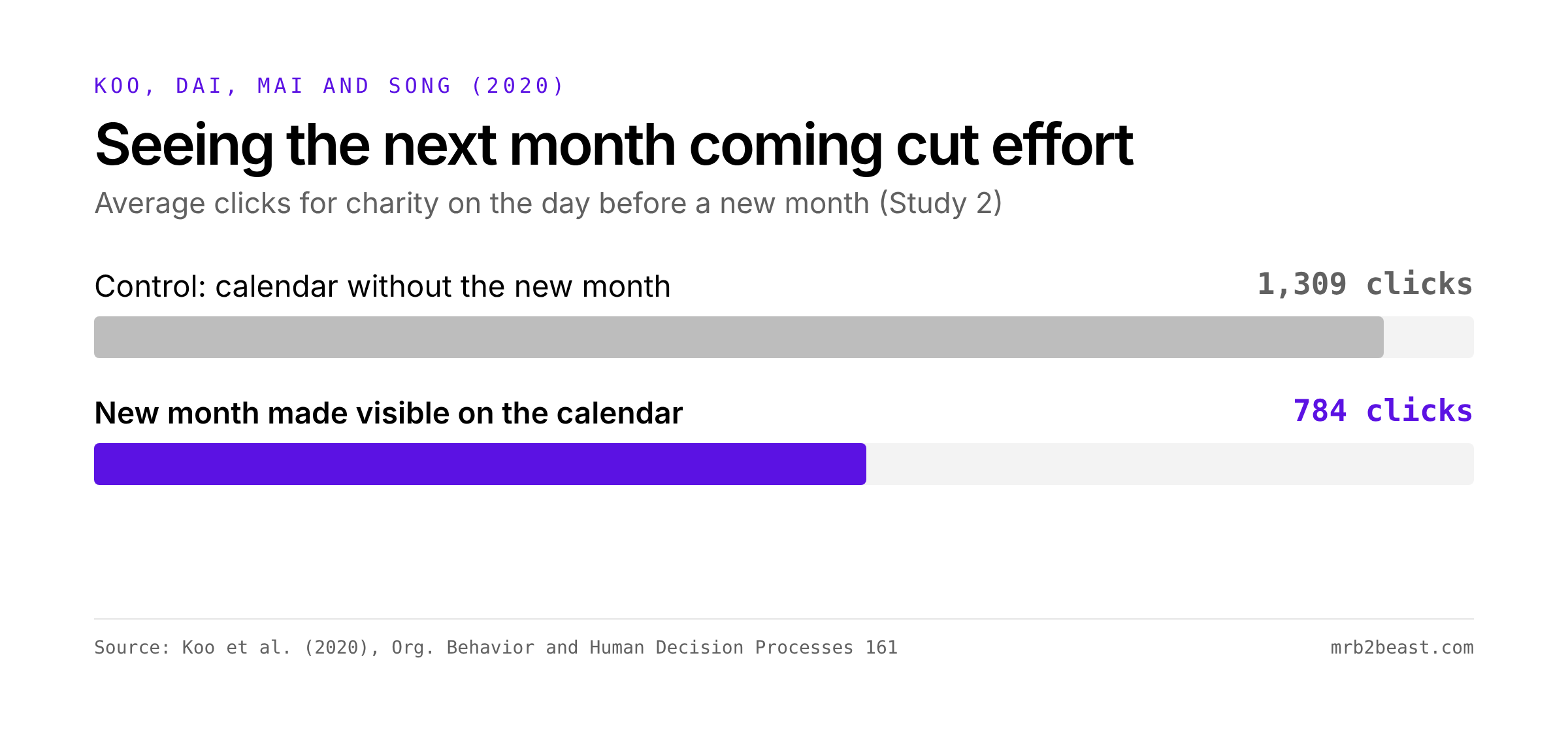
In 2020, Minjung Koo, Hengchen Dai, Ke Michael Mai and Camilla Song tested this pattern. In a seven-day "Click Marathon", students could click a button every day, and each click raised money for a charity. For one group, the calendar made the coming new month visible.
On the day before the new month, that group averaged 783.91 clicks. The control group averaged 1,309.08. That is about 40 percent less effort, on a goal the students had chosen to join.
Their explanation: when a fresh start is coming, people see their future self as a different person who will take over. That belief licenses slacking today. And in their data, people did not reliably work harder after the landmark to make up for it.
Mistake 2: Treating the start date as the system
A fresh start raises the chance that you begin. It does not keep you going.
The field evidence is honest about this. In 2021, John Beshears, Hengchen Dai, Katherine Milkman and Shlomo Benartzi ran a field experiment with 6,082 university employees. Mailings offered to raise retirement savings now or at a future date. For some, that date was framed as a fresh start, like "after your next birthday" or the first day of spring.
The framing worked. Take-up of the future savings increase rose by 1.3 to 1.4 percentage points, a 50 to 54 percent relative increase. But the control group started at only 2.6 percent. Average contributions over eight months rose by 17 to 19 basis points.
Placebo dates that do not feel like new beginnings, such as Thanksgiving, showed no positive effect. Real, useful at scale, and small for any one person. The headline percentage looks big because the base is tiny.
Mistake 3: Having one restart per year
If New Year is your only fresh start, a bad February leaves you waiting ten months for the next one. That is how one missed week turns into a lost year.
The gym data points the other way. The start of a week had a larger effect on gym visits than the start of a year: 33.4 percent versus 11.6 percent. Small, frequent landmarks are not a weaker version of New Year. In that dataset, they were stronger.
The habit research makes a related point. Missing a single day did not materially hurt habit formation, as covered in how long it takes to form a habit. A slip needs a quick restart, not a ceremony.
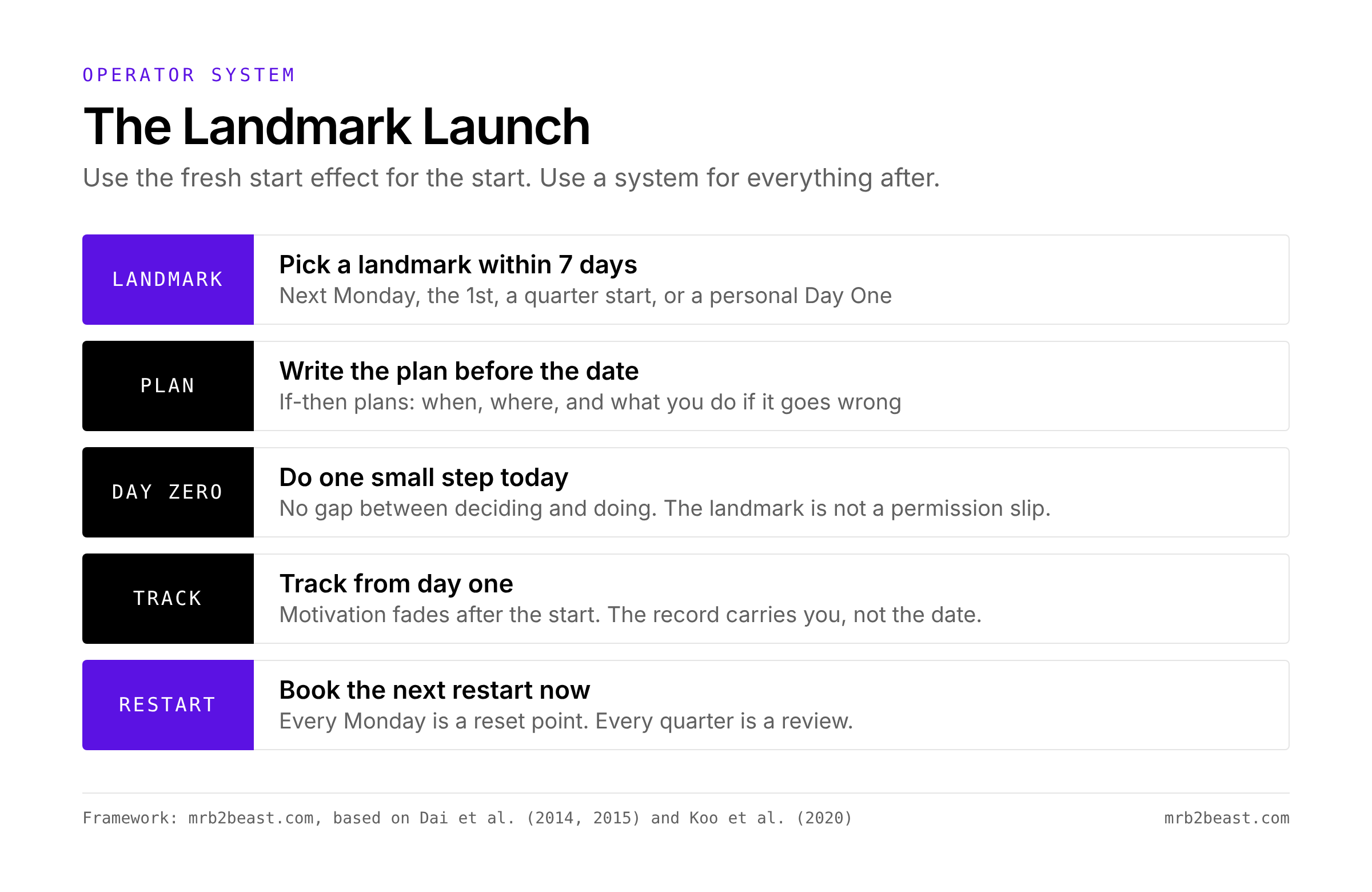
How to use the fresh start effect: the Landmark Launch
The goal is simple. Keep the boost of a fresh start, and remove the two costs: the waiting before it and the fade after it.

Step 1: Pick a landmark within seven days. Next Monday, the first of the month or the start of a quarter. Or name a personal Day One, like "the first day after the product launch". The spring study shows the label does real work. Never pick a date more than a week away, because the waiting itself lowers effort.
Step 2: Write the plan before the date. The landmark gives you the motivation. The plan decides what you do with it. Write two or three if-then plans: "If it is Monday, Wednesday or Friday at 7:00, then I write for 30 minutes." Add one plan for the most likely obstacle. The research on if-then plans is covered in how to achieve goals.
Step 3: Do one small step today. This is the fix for the Koo result. Do a two-minute version of the goal before the landmark arrives. Open the document. Write the headline. The landmark is a launch date, not a permission slip to do nothing until then. Koo and colleagues found that the slump was weaker when people were reminded of the everyday things they already do for their goal.
Step 4: Track from day one. Motivation fades as the new period gets older. That is what the gym data shows. A record of what you did carries you through the middle, when the "new" has worn off. Mark each completed step and look at it weekly.
Step 5: Book the next restart now. Put the next landmarks into your calendar today: every Monday as a reset, every quarter start as a review. If you slip, you restart next Monday, not next January.
This chain is the idea behind Gaapp.io, a yearly goals planner that connects yearly goals to daily steps and shows what is due today and which bigger goal it serves. Disclosure: I am building it. A paper notebook works too. What matters is that the start date, the plan and the record live in one place.
Ask yourself this week:
- Which goal am I quietly saving for "January" or "after the launch"?
- What is the two-minute version of it that I can do today?
- Which Monday or quarter start is my next planned restart?
Conclusion: use the date, do not wait for it
A fresh start is a good launch pad and a bad engine.
The fresh start effect is one of the better documented findings in motivation research. Mondays, new months and new quarters really do make people more likely to begin. You can even create the boundary yourself with a label.
But the date does not carry the goal. Waiting for it costs effort, and the boost fades as the new period ages. Use the landmark for the launch. Use a plan and a record for everything after.
What you learned today
- The fresh start effect is real: gym visits rose 33.4 percent at the start of a week, and goal contracts rose 145.3 percent at the start of a year.
- Anticipating a landmark lowers effort before it. In one experiment, a visible new month cut clicks for charity by about 40 percent the day before.
- In field experiments, fresh start framing helps, but modestly. Pair every start date with an if-then plan, a step today and tracking from day one.
FAQ
What is the fresh start effect? The fresh start effect is the increase in goal-directed behavior after temporal landmarks such as a new week, month, year or birthday. Dai, Milkman and Riis documented it in 2014 using Google searches for "diet", gym visits and commitment contracts. Landmarks seem to separate people from past failures and make them think about the bigger picture.
Why do people start goals on Monday? Monday marks the start of a new week, which feels like a clean break from the past. In one study, the probability of a gym visit rose 33.4 percent at the start of a week, and goal contracts on stickK rose 62.9 percent. The risk is waiting several days for Monday instead of taking a small step now.
What is the best time to start a goal? The research suggests a near landmark, such as the next Monday or the first of the month, combined with a small step today. Starting at a landmark raises motivation, but anticipating a landmark that is far away can reduce effort before it. A date within a week gives you the boost without a long waiting period.
What are temporal landmarks? Temporal landmarks are moments that divide time into before and after. Calendar landmarks include Mondays, the first of the month, New Year and holidays. Personal landmarks include birthdays, moves or a new job. A 2015 study showed that labeling a date as "the first day of spring" made people more likely to pick it for starting a goal.
Do New Year resolutions work? Some do. In a 2020 Swedish study with 1,066 participants, 55 percent of those who responded at the one-year follow-up said they had sustained their resolution. Approach goals ("start doing X") did better than avoidance goals, 58.9 versus 47.1 percent. The results were self-reported, and the date alone was not what made them stick.
About the author
Tristan Eilenburg. One person. AI systems. Global reach. I write about building systems that work, with evidence instead of hype.
- X: @MrB2Beast
- LinkedIn: Tristan Eilenburg
- Instagram: @mrb2beast
- Building Gaapp.io (Instagram: @gaapp.io)
I write one of these every week. If this one taught you something, the newsletter is where the next one lands first.
Sources
- Dai, H., Milkman, K. L., and Riis, J. (2014). The fresh start effect: Temporal landmarks motivate aspirational behavior. Management Science, 60(10), 2563-2582. https://doi.org/10.1287/mnsc.2014.1901 (PDF: https://faculty.wharton.upenn.edu/wp-content/uploads/2014/06/Dai_Fresh_Start_2014_Mgmt_Sci.pdf)
- Dai, H., Milkman, K. L., and Riis, J. (2015). Put your imperfections behind you: Temporal landmarks spur goal initiation when they signal new beginnings. Psychological Science, 26(12), 1927-1936. https://doi.org/10.1177/0956797615605818 (full text: https://www.ncbi.nlm.nih.gov/pmc/articles/PMC4839284/)
- Koo, M., Dai, H., Mai, K. M., and Song, C. E. (2020). Anticipated temporal landmarks undermine motivation for continued goal pursuit. Organizational Behavior and Human Decision Processes, 161, 142-157. https://doi.org/10.1016/j.obhdp.2020.06.002 (preprint: https://anderson-review.ucla.edu/wp-content/uploads/2021/03/Koo-Dai-Mai0Song_TemporalLandmark2020_SSRN-id3621221.pdf)
- Beshears, J., Dai, H., Milkman, K. L., and Benartzi, S. (2021). Using fresh starts to nudge increased retirement savings. Organizational Behavior and Human Decision Processes, 167, 72-87. https://doi.org/10.1016/j.obhdp.2021.06.005 (full text: https://www.ncbi.nlm.nih.gov/pmc/articles/PMC8341022/)
- Oscarsson, M., Carlbring, P., Andersson, G., and Rozental, A. (2020). A large-scale experiment on New Year's resolutions: Approach-oriented goals are more successful than avoidance-oriented goals. PLOS ONE, 15(12), e0234097. https://doi.org/10.1371/journal.pone.0234097
- Association for Psychological Science. Why Monday is the best day for setting new goals. Minds for Business. https://www.psychologicalscience.org/news/minds-business/why-monday-is-the-best-day-for-setting-new-goals.html
- Gollwitzer, P. M., and Sheeran, P. (2006). Implementation intentions and goal achievement: A meta-analysis of effects and processes. Advances in Experimental Social Psychology, 38, 69-119. https://doi.org/10.1016/S0065-2601(06)38002-1