The famous productivity rule started as satire about clerks, and the best-known deadline study behind it was just retracted.
"Work expands so as to fill the time available for its completion." You have seen this line, known as Parkinson's law, in almost every productivity post.
It was never meant as a productivity rule. It is the first sentence of a satirical essay that C. Northcote Parkinson, a naval historian, published in The Economist on 19 November 1955. Parkinson himself called it a "commonplace observation." His actual joke was about bureaucracy: between 1914 and 1928, the Royal Navy went from 62 capital ships to 20, while Admiralty officials grew from 2,000 to 3,569.
And there is a second surprise. One of the most cited studies for "use deadlines to beat procrastination" was retracted in September 2026.
The idea is not stupid. People do slow down when time is loose. It is just more specific than the slogan suggests.
I want to show you what Parkinson actually wrote and why his data was a punchline. I want to show you what experiments say about deadlines, including the study that just fell. And I want to give you a timebox system that uses only the parts that hold up.
Key takeaways
- Parkinson's law comes from a 1955 satire about growing government staff. The famous line was a throwaway opener, not a finding.
- Lab and field studies do show that tight time limits speed up work. Longer limits also make people believe a task is bigger than it is.
- The well-known 2002 study on evenly spaced deadlines was retracted in 2026 after data anomalies and a failed replication.
Where Parkinson's law came from
Parkinson was a historian, not a psychologist, and in 1955 he was Raffles Professor of History at the University of Singapore.
His essay opens with an elderly lady who spends a whole day sending one postcard. She needs an hour to find the card, another to find her glasses, and twenty minutes to decide on an umbrella. A busy person would need three minutes in total.
Then the essay turns to its real subject. Parkinson claims that the number of officials has no relation to the amount of work. He gives two mock axioms. Factor I: an official wants to multiply subordinates, not rivals. Factor II: officials make work for each other, which keeps everyone busy.
The Admiralty numbers
His proof was a table of Admiralty statistics for 1914 and 1928.
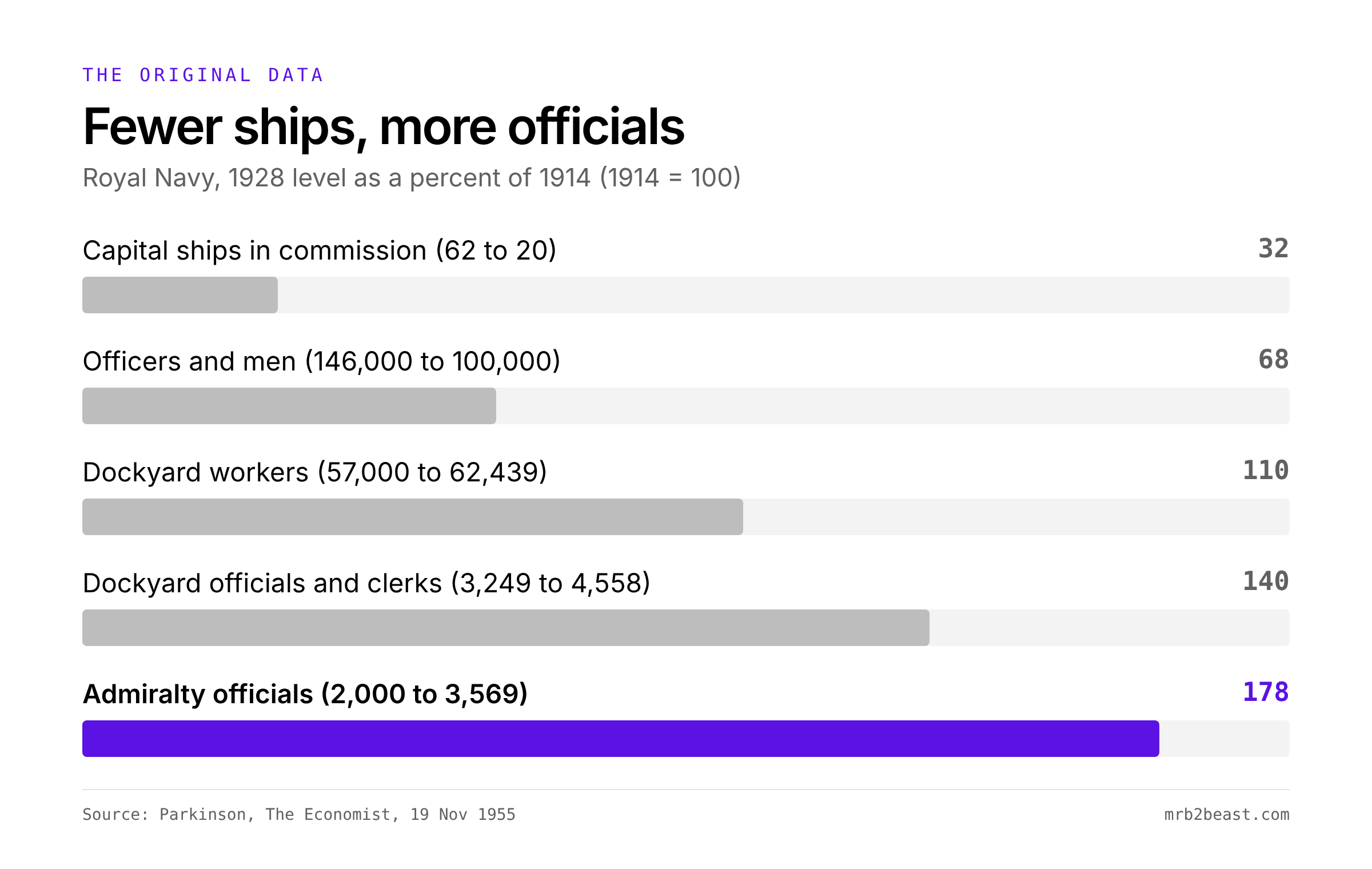
Capital ships fell by 67.74 percent. Officers and men fell by 31.5 percent. Dockyard workers rose by 9.54 percent. Dockyard officials and clerks rose by 40.28 percent. Admiralty officials rose by 78.45 percent.
Parkinson then derived a fake formula. It "proved" that staff would grow by between 5.17 and 6.56 percent a year, regardless of the work to be done. He closed by comparing himself to a botanist who only measures how fast the weeds grow.
That is satire, and the decimal-point precision is part of the joke.
The number nobody quotes
In 1994, the naval historian Jon Sumida checked the figures in Naval History magazine, and his finding cuts both ways.
The 1928 Admiralty figure was close to official records. The 1914 figure was about a quarter too high. Using the Navy Lists, Sumida counted 1,469 administrative staff in January 1914 and 3,223 in January 1928. That is an increase of about 120 percent, not 78.
So the real growth was even larger than the joke claimed, but Sumida also found a real reason for it. World War I turned naval war into a contest of industrial economies. The Admiralty built up staff to keep control of its supply chain, so the cause was a new kind of work, not work inventing itself.
In short: the line you know is the opening of a joke. The joke was about staff growth. And even its data had a better explanation.
What the research actually shows
The common belief goes like this. Give yourself less time and you will get the same work done faster. Give yourself more and the work will swell.
That is partly true, but the evidence is narrower than the slogan.
What is Parkinson's law? Parkinson's law is the claim that "work expands so as to fill the time available for its completion." It comes from a 1955 satirical essay in The Economist by C. Northcote Parkinson. In productivity writing, it is used to argue for short deadlines and timeboxing. In the original, it introduced a joke about the growth of government staff.
Tight deadlines do speed people up
In 1967, Judith Bryan and Edwin Locke published a paper titled "Parkinson's Law as a goal-setting phenomenon." Their idea was that a time limit works like a goal, so people set their pace to the time they are given.
Locke and Gary Latham later summarized the evidence in a 2002 review in American Psychologist. Tight deadlines led to a faster work pace than loose deadlines in the laboratory. A 1975 field study with the title "Increasing productivity with decreasing time limits" found the same pattern at work.
Other lab studies point the same way. In the 1960s, Elliot Aronson and colleagues reported an "excess time effect": people given more time than needed took longer on the next task too. In 1999, Laura Brannon and colleagues ran four experiments. When students learned that a later task was cancelled, they slowed down on the current one.
So the core effect is real, but it is conditional: time limits work when they act as a clear goal.
Longer limits make tasks look bigger
A 2020 paper by Indranil Goswami and Oleg Urminsky adds a twist. They noted that Parkinson's law has been influential "despite limited empirical evidence."
In their first study, 116 lab workers solved the same jigsaw puzzle. They had 5 minutes, 15 minutes or no limit, and a flat fee either way. Average times were 2.24, 2.75 and 2.23 minutes, a difference that was not statistically significant.
Then outside judges estimated how long the workers took. With the 5-minute limit, they guessed 3.49 minutes. With the 15-minute limit, they guessed 6.89 minutes.
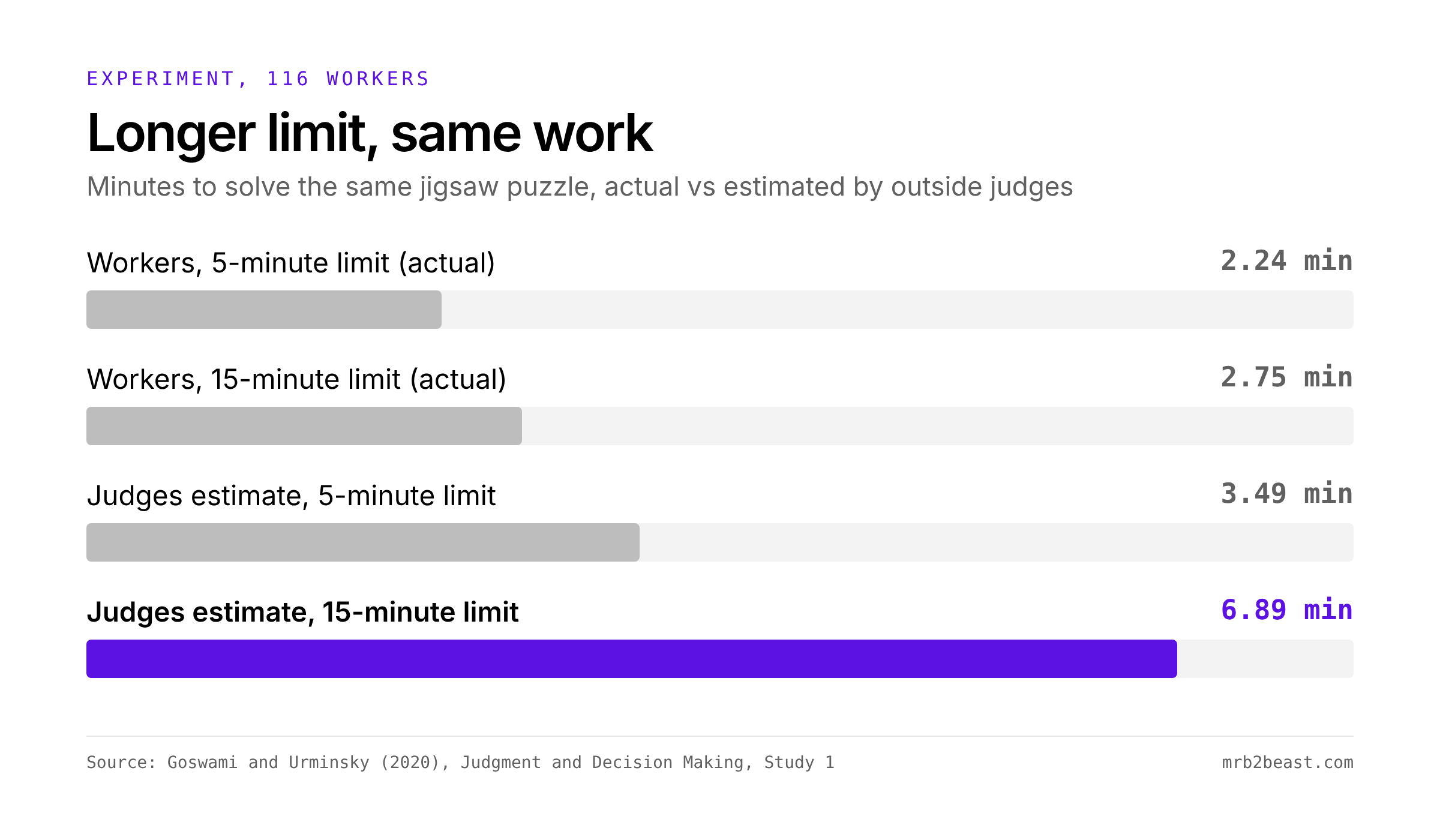
The work did not expand much, but the perceived size of the work did. The authors call it a "Parkinson's Law of the Mind." A longer time limit makes a task look bigger, even when it is not.
The deadline study that fell
For two decades, one study anchored the advice on deadlines. In 2002, Dan Ariely and Klaus Wertenbroch published "Procrastination, Deadlines, and Performance" in Psychological Science.
Its second study had 60 people proofread three texts over three weeks for small cash rewards. Those with evenly spaced deadlines found nearly twice as many errors as those with one final deadline. Self-set deadlines landed in between.
In 2026, Kyle Hyndman and Alberto Bisin published a replication in the same journal. With 124 participants, changing the deadlines had a negligible effect on all three performance measures. On 31 August 2026, the Data Colada researchers reported anomalies they could not explain in a benign way. On 2 September 2026, the journal retracted the whole article. Both authors agreed with the retraction.
In short: tight time limits can raise pace, and generous limits inflate how big a task feels. The famous proof that evenly spaced deadlines work is no longer evidence of anything.
The three mistakes almost everyone makes with deadlines
Once you see the research, the common mistakes with deadlines are easy to spot.
Mistake 1: Treating a joke as a law of nature
Parkinson's law is quoted as if work always expands, but the experiments show something smaller. Pace adjusts to the goal a time limit implies, which is useful, but it is a lever, not a law.
If you believe work always expands, you cut time everywhere. Some tasks get faster, and others just get worse.
Mistake 2: Cutting time without defining the output
Bryan and Locke framed the effect as goal setting, and a goal needs content. "Work on the deck until noon" names a time, not a result.
Here is an example. A solo founder blocks two hours for "landing page copy." At the end, there is a half-edited draft and three new ideas. The box was short, but the output was never defined, so the box measured effort, not progress.
Mistake 3: Letting the calendar set the size of the task
This is the Goswami and Urminsky trap. A free afternoon makes a task feel like an afternoon task, and a week until the deadline makes it feel like a week of work.
The same founder sees "launch by Friday" and plans five days of copy work. The real job might be four hours, but the scope grew to match the deadline before any work started.
Beating Parkinson's law: the Output-First Timebox
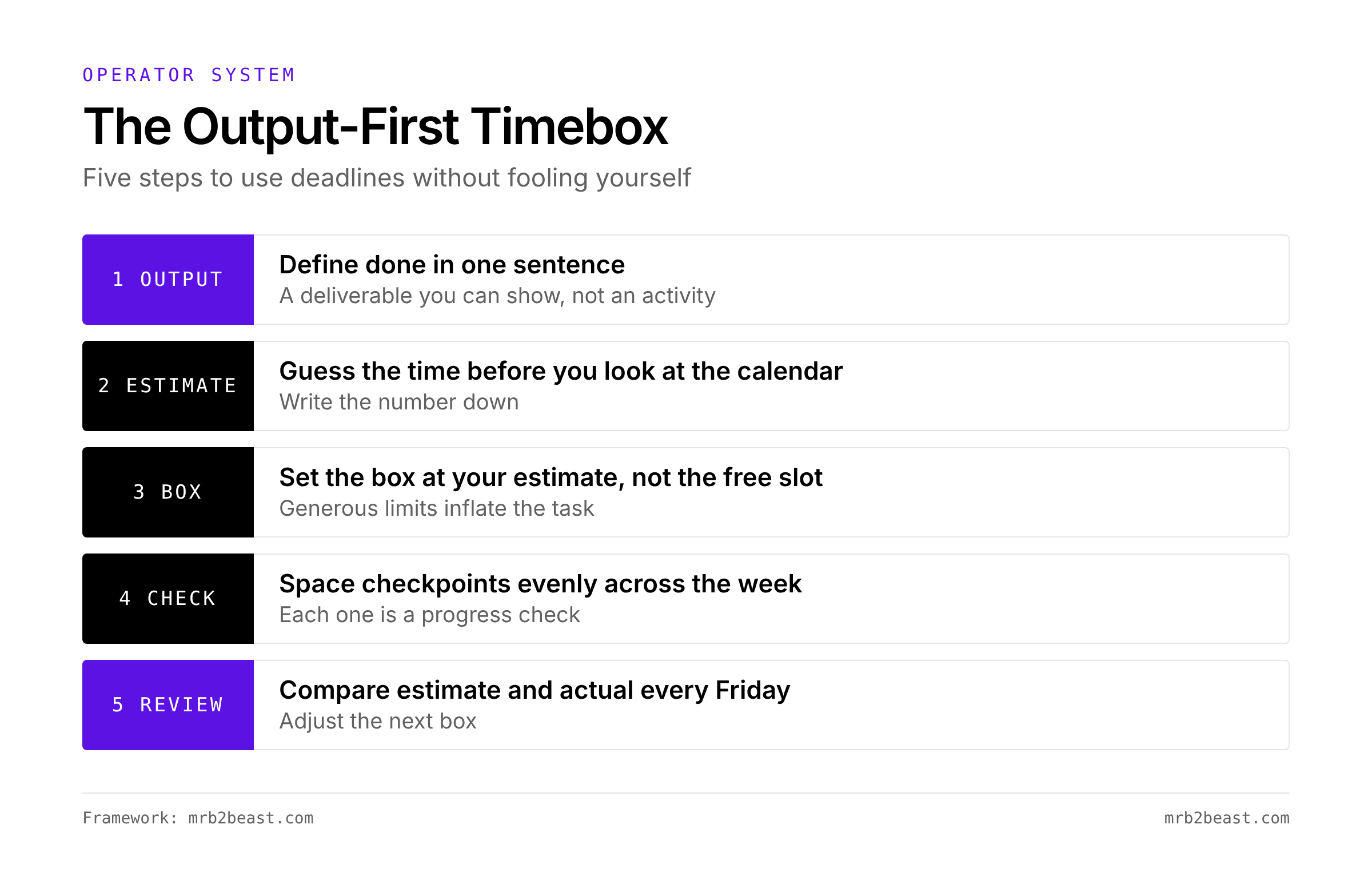
I am not saying deadlines are useless. I am saying that a deadline without a defined output is just a timer with a nicer name. Here is a system that uses the parts of the evidence that hold up.
Step 1: Define the output in one sentence. Write down what will exist when you are done. "Landing page hero and three benefit blocks, ready to paste." Not "work on the landing page."
Step 2: Estimate before you look at the calendar. Write down how long the output should take before you see the free slot. A visible free afternoon inflates the estimate.
Step 3: Set the box at your estimate, not the slot. If the estimate is 90 minutes, the box is 90 minutes, even if you have four hours. Tight limits work because they act as a goal, so give the goal a number.
Step 4: Space checkpoints evenly across the week. Be honest about the evidence here: the study that made this popular was retracted. Use spacing as a practical choice, not a proven effect. Its value is that each checkpoint is a progress check, and progress monitoring has strong evidence of its own, as covered in how to achieve goals.
Step 5: Review estimate against actual every Friday. Compare what you planned with how long it really took. Shrink the next box if you finished early, and split the output if you ran over.
This weekly loop is the idea behind Gaapp.io, an app to set weekly goals that connect to your yearly goals and show what is due today. Disclosure: I am building it. A paper notebook works too. The system matters more than the tool.
Ask yourself this week:
- Can I describe today's most important output in one sentence?
- Did I estimate that task before I looked at my free time?
- Which deadline this week is longer than the work needs?
Conclusion: deadlines are a lever, not a law
Parkinson wrote a joke about clerks. We turned it into a rule for our calendars.
The kernel is real. Tight time limits can raise your pace, and loose ones make tasks feel bigger than they are. But the effect depends on a clear output, and the most famous proof for spaced deadlines is gone.
The fix is simple: define the output, estimate first, box it tight, and check the numbers every week.
What you learned today
- Parkinson's law began as a 1955 satire in The Economist. Its data: capital ships fell from 62 to 20 while Admiralty officials rose from 2,000 to 3,569.
- Tight deadlines speed up work in lab and field studies, and longer limits make tasks look bigger even when the work stays the same.
- The 2002 Ariely and Wertenbroch deadline study was retracted in 2026, so evenly spaced deadlines are a practical habit, not a proven effect.
FAQ
What is Parkinson's law? Parkinson's law says that "work expands so as to fill the time available for its completion." It comes from a satirical essay by C. Northcote Parkinson in The Economist in November 1955. The essay was mainly about the growth of government staff. Today the line is used to argue for short deadlines and timeboxing.
Is Parkinson's law real? Partly. Lab and field studies since the 1960s show that tight time limits lead to a faster work pace, because the limit works as a goal. But the effect is conditional. A 2020 study found that workers took similar time under 5 and 15 minute limits, while observers assumed the longer limit meant a bigger task.
What are some Parkinson's law examples? Parkinson's own example was an elderly lady who spends a whole day sending one postcard. His data example was the Royal Navy: from 1914 to 1928, capital ships fell from 62 to 20 while Admiralty officials rose from 2,000 to 3,569. Everyday examples include meetings that fill their slot and projects that grow to match the deadline.
How do you beat Parkinson's law? Define the output in one sentence before you start. Estimate the time before you look at your calendar, then set the timebox to that estimate rather than the free slot. Review estimates against actual time every week. A short deadline without a clear output only measures effort, not progress.
Do deadlines improve productivity? Tight deadlines can raise work pace, according to goal-setting research by Locke and Latham. But the best-known study on evenly spaced deadlines, by Ariely and Wertenbroch in 2002, was retracted in 2026 after a failed replication and data anomalies. Deadlines help most when they come with a clearly defined output.
About the author
Tristan Eilenburg. One person. AI systems. Global reach. I write about building systems that work, with evidence instead of hype.
- X: @MrB2Beast
- LinkedIn: Tristan Eilenburg
- Instagram: @mrb2beast
- Building Gaapp.io (Instagram: @gaapp.io)
I write one of these every week. If this one taught you something, the newsletter is where the next one lands first.
Sources
- Parkinson, C. N. (1955, November 19). Parkinson's Law. The Economist. https://www.economist.com/news/1955/11/19/parkinsons-law and full-text reprint: https://doc.cat-v.org/economics/parkinsons-law/the-economist-article.pdf
- Sumida, J. (1994, December). Challenging Parkinson's Law. Naval History, U.S. Naval Institute. https://www.usni.org/magazines/naval-history-magazine/1994/december-1/challenging-parkinsons-law
- Bryan, J. F., and Locke, E. A. (1967). Parkinson's Law as a goal-setting phenomenon. Organizational Behavior and Human Performance, 2(3), 258-275. https://doi.org/10.1016/0030-5073(67)90021-9
- Locke, E. A., and Latham, G. P. (2002). Building a practically useful theory of goal setting and task motivation: A 35-year odyssey. American Psychologist, 57(9), 705-717. https://www-2.rotman.utoronto.ca/facbios/file/09%20-%20Locke%20&%20Latham%202002%20AP.pdf
- Latham, G. P., and Locke, E. A. (1975). Increasing productivity with decreasing time limits: A field replication of Parkinson's law. Journal of Applied Psychology, 60(4), 524-526. https://doi.org/10.1037/h0076916
- Aronson, E., and Gerard, E. (1966). Beyond Parkinson's law: The effect of excess time on subsequent performance. Journal of Personality and Social Psychology, 3(3), 336-339. https://doi.org/10.1037/h0023000 and Aronson, E., and Landy, D. (1967). Further steps beyond Parkinson's Law: A replication and extension of the excess time effect. Journal of Experimental Social Psychology, 3(3), 274-285. https://doi.org/10.1016/0022-1031(67)90029-7
- Brannon, L. A., Hershberger, P. J., and Brock, T. C. (1999). Timeless demonstrations of Parkinson's first law. Psychonomic Bulletin and Review, 6(1), 148-156. https://doi.org/10.3758/BF03210823
- Goswami, I., and Urminsky, O. (2020). More time, more work: How time limits bias estimates of task scope and project duration. Judgment and Decision Making, 15(6), 994-1008. https://doi.org/10.1017/S1930297500008196
- Ariely, D., and Wertenbroch, K. (2002). Procrastination, deadlines, and performance: Self-control by precommitment. Psychological Science, 13(3), 219-224. Retracted 2026. Retraction notice: https://journals.sagepub.com/doi/full/10.1177/09567976261488042
- Hyndman, K., and Bisin, A. (2026). Replication of "Procrastination, Deadlines, and Performance: Self-Control by Precommitment." Psychological Science. https://journals.sagepub.com/doi/full/10.1177/09567976261460772
- Simonsohn, U., Simmons, J., and Nelson, L. (2026, August 31). [138] Artificial Deadlines (Part 1): Evidence of Fraud in an Influential Study About Procrastination. Data Colada. https://datacolada.org/138
- Retraction Watch (2026, September 3). Procrastination study by Duke's Dan Ariely retracted after sleuths find signs of data tampering. https://retractionwatch.com/2026/09/03/procrastination-study-duke-dan-ariely-psychological-science-data-colada-tampering-retraction/