Micro SaaS in One Hour a Day: What It Takes
Not a list of 50 ideas and not a promise of passive income. What a small software product needs when you only have one hour a day.

Search for micro SaaS and you get two kinds of pages. Long lists of ideas. And stories about someone who built a tool over a weekend and now earns more than their old salary.
Both skip the part that decides everything. Not the idea, not the weekend. The months after launch, when nobody is visiting and you have a full calendar and maybe one free hour.
I am building a micro SaaS in exactly that hour. It is called Gaapp. It breaks one yearly goal down to quarter, month, week and the step for today. I started it on September 8, 2026, it was live on September 11, and it gets about one hour of my day.
This article is the honest version. What micro SaaS actually means, what the data on small software founders says, what one hour a day can and cannot do, and the five-step system I use. No money numbers, no promises. Just the parts most guides leave out.
Key takeaways
- Micro SaaS is defined by the size of the problem, not the size of the company: a problem one person or a very small team can truly solve.
- Most independent SaaS products are small. In MicroConf's 2024 survey, 28 percent were under $1,000 in monthly revenue and 65 percent had 1 to 10 paying customers.
- One hour a day is enough to build and ship. It is not enough to skip distribution. Plan the hour around both.
What is micro SaaS?
Micro SaaS is a small software product, sold as a subscription, that solves one narrow problem for one clear group of people. It is usually built and run by one founder or a very small team, without outside funding.
The most useful definition comes from Tyler Tringas. In a 2021 post he wrote that "micro" refers to the scope of the problem, not the size of the company. A micro SaaS tackles a problem that a solo founder or a very small team can truly solve. He added a line I like: "everything is a Micro-SaaS now."
That definition matters, because it changes the question you ask. Not "how big can this get?" but "can one person solve this problem completely?" A store locator for small shops passes that test. A new accounting suite for global companies does not.
Typical traits of a micro SaaS:
- One narrow problem. It does one job well instead of ten jobs halfway.
- One clear audience. You can name who uses it in one sentence.
- Often inside an ecosystem. Many micro SaaS products are add-ons to a bigger platform, like a Shopify app or a browser extension.
- Low running costs. No office, no sales team, small infrastructure bills.
- Founder time as the main resource. The bottleneck is hours, not money.
Micro SaaS vs SaaS: what is the difference?
The difference between SaaS and micro SaaS is ambition and structure, not technology. Both are software sold as a subscription. A classic SaaS company aims at a large market, raises money, hires and tries to grow fast. A micro SaaS aims at a small, specific market and stays small on purpose.
| Micro SaaS | Classic SaaS | |
|---|---|---|
| Team | One founder or a handful of people | Departments, often dozens or more |
| Market | One niche, one problem | Broad, many use cases |
| Funding | Usually self-funded | Often venture capital |
| Growth goal | Sustainable, fits the founder's life | Fast, to justify the funding |
| Main risk | Nobody finds it | Running out of money before growth |
Neither is better. They are different bets. If you have one hour a day, only one of them is realistic.
What the numbers on small software founders say
Most micro SaaS content tells you what is possible. The data tells you what is typical. Those are not the same.
MicroConf runs the State of Independent SaaS survey for bootstrapped software founders. Its 2024 report, based on 469 founders with data collected in late 2023, shows a sober picture:
- 28 percent of independent SaaS companies were under $1,000 in monthly revenue, the largest single group in the survey.
- 65 percent had just 1 to 10 paying customers.
- Companies with full-time founders grew 30 percent faster than those with part-time founders.
Read the last line again if you plan to build in one hour a day. Part-time founders grow slower. That is not a reason to stop. It is a reason to plan for slow and to cut everything that does not move the product.
This is the same pattern I found in the official data on solo businesses. Most of them stay small, and the famous outliers are a bad planning baseline. If you want the full numbers, I broke them down in what a one person business really earns.
The realistic case is not failure. It is a small product with a few users who care, run by someone with limited time. Plan for that case. Celebrate if you beat it.
The case: Gaapp, built in one hour a day
Here is my own build, with the numbers I can share.
The product. Gaapp starts with one yearly goal and breaks it down to quarter, month, week and the step for today. My claim for everything I build is "Build leverage, not to-do lists." Gaapp is that claim as software.
The timeline. I started building on September 8, 2026, in Lovable, an AI app builder. The app was live on September 11. By October 2 the project had 781 commits. All of that happened in about one hour a day.
The borrowed parts. Payment and Google login ran through Lovable's own services. For a one-hour founder that was the most important decision, because login and payments are where small projects usually stall.
The first numbers. In September 2026, Gaapp had 74 visitors. In its first 18 days, from September 11 to 28, Google Search Console showed 12 impressions, 0 clicks and an average position of 6.7. Eight of those 12 impressions came from one English page about daily goals. One came from the German pages.
That is what a fresh micro SaaS looks like from the inside. Not a launch spike. A few visitors, a handful of impressions and zero clicks. Every guide that starts with revenue skips this phase. It is the phase you will spend the most time in.
What is not here. No money numbers. Out of context, a figure like that reads like a promise, and this is not one.
The One-Hour Build: five steps for a micro SaaS
Here is the system. It is built for one constraint: you have one hour a day, and some days not even that.
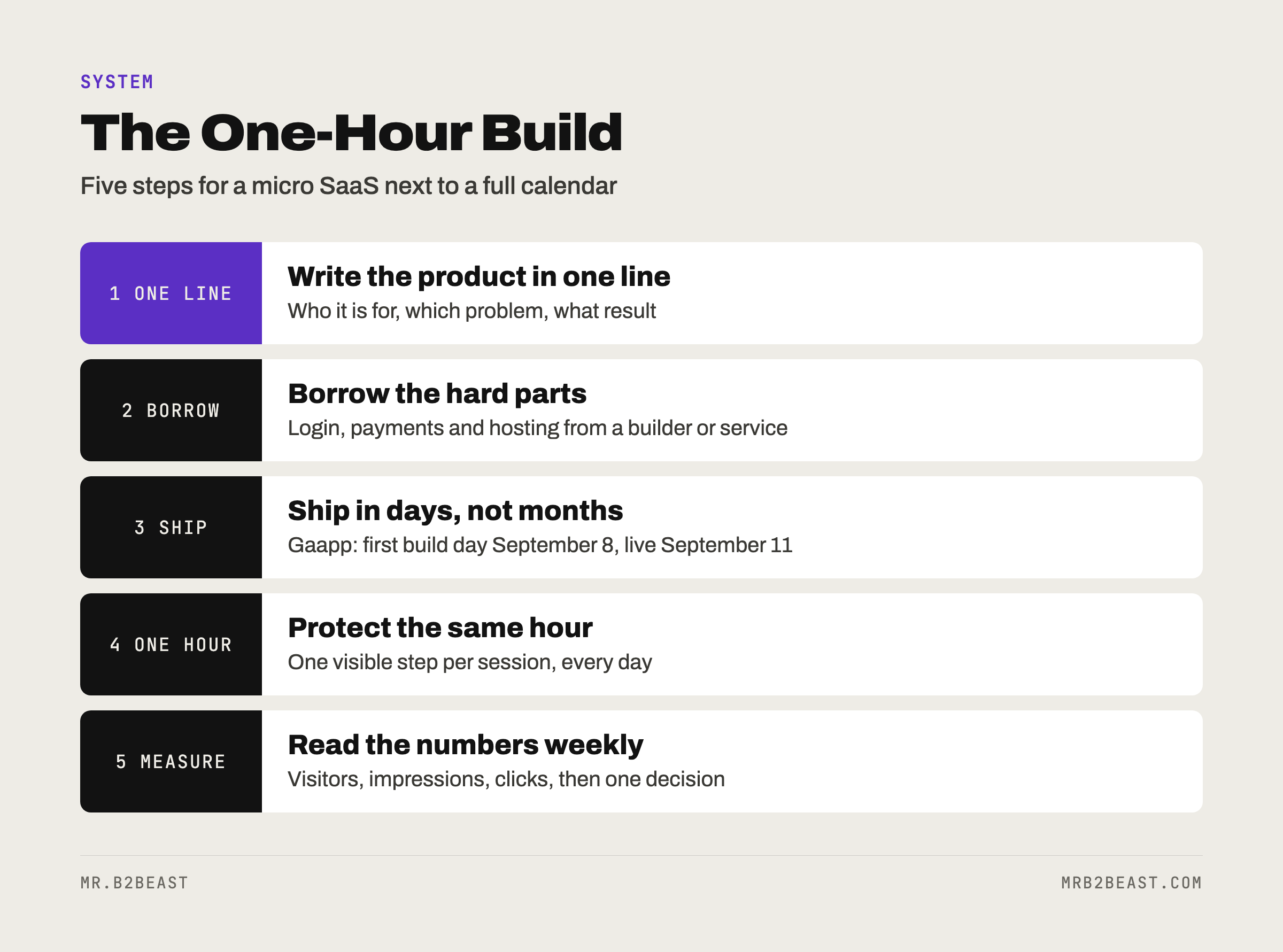
Step 1: Write the product in one line
Before you build anything, write one sentence: who it is for, which problem it solves and what result they get. For Gaapp: one yearly goal, broken down to the step for today.
If you cannot write that sentence, an hour a day will be spent arguing with yourself about scope. The sentence is your filter for every feature request, including your own.
Step 2: Borrow the hard parts
Login, payments, hosting, email. None of these make your product special, and all of them take time. Borrow them from a builder or a service. For Gaapp, payment and Google login ran through Lovable's own services. I did not have to build either.
The trade is control. Borrowed parts tie you to the platform that lends them. That is fine for a first version. If you want to know when it stops being fine, I wrote about moving my own site in Lovable vs Claude Code.
Step 3: Ship in days, not months
Gaapp went live three days after the first build day.
The reason to ship this early is not hustle. It is that every day before launch is a day without data. With one hour a day, you cannot afford months of guessing. A live product with zero users still teaches you more than a perfect plan, because Search Console, the first visitors and the first questions start talking.
Step 4: Protect the same hour every day
One hour a day only works if it is the same hour, with one visible step per session. Not "work on Gaapp." Something like "the weekly view shows the right step for today."
The research on estimation is clear about why this matters: people underestimate how long their own tasks take, even when they know their past projects ran late. I wrote about it in the planning fallacy. Small steps are the defense. A one-hour step that overruns costs you a day. A one-month feature that overruns costs you a quarter.
Step 5: Read the numbers weekly, then decide
Once a week, look at three things: visitors, search impressions and clicks. Then make one decision for the next week. Write the next page, fix the thing people get stuck on, or cut a feature nobody uses.
My first 18 days showed 12 impressions and 0 clicks. That told me something concrete: one English page about daily goals was doing most of the work. That is a direction, not a verdict. Weekly numbers keep you from either panicking or dreaming.
If you track numbers, track the ones tied to the goal, not just activity. I wrote about that trap in the goal tracker study.
Micro SaaS ideas: how to pick one without an idea list
Lists of micro SaaS ideas are popular because they feel like progress. Fifty ideas, sorted by niche. The problem is that an idea from a list is someone else's problem, and you will not know the people who have it.

Instead of a list, run every idea through five questions:
- Do I have this problem, or know ten people who do? If not, you will not know what to build or where to find users.
- Can one person solve it completely? That is the Tringas test. If the problem needs a sales team or a data center, it is not micro.
- Does it live inside something people already use? An add-on to an existing platform comes with an audience and a place to be found.
- Can I describe it in one sentence? If the sentence needs "and" twice, the scope is too big for one hour a day.
- Is there a way to reach the first 100 people? A search phrase, a community, a platform store. No channel, no product.
An idea that passes all five is worth a first version. An idea that passes three is worth a week of research. An idea that passes one belongs on a list, which is where you found it.
Where good micro SaaS ideas actually come from
The best ideas usually come from work you already do. A repeated manual step, a spreadsheet you rebuild every month, a question clients keep asking. These are boring problems, and boring is good: boring problems are real, and real problems have people searching for a fix.
Gaapp does one thing: one yearly goal, broken down to the step for today. Many articles on this site, from quarterly goals to the planning fallacy, circle the same topic. That overlap is useful. Your content, your product and your audience should point at the same thing.
Distribution: where most micro SaaS projects actually stall
You can build a micro SaaS in an hour a day. You cannot skip distribution in an hour a day. This is where most small products quietly stop.
My own numbers make the point. In its first 18 days live, Gaapp collected 12 impressions in Search Console, and none of them turned into a click. The product existed. Almost nobody saw it.
Three channels fit a one-hour founder:
- Search. Pages that answer the questions your users type. Slow to start, but they keep working while you sleep. For Gaapp, one English page about daily goals brought most of the early impressions.
- Building in public on X. Short posts about what you built, what broke and what you learned. On @MrB2Beast I went from about 100 followers in early October 2026 to 531 on October 21, 2026, according to the X API. Current numbers are on my stats page.
- A newsletter. The one channel you own. One email a week, double opt-in, no platform can switch it off.
If X is your channel, do not guess what works. I collected 148 X tips from 9 creator videos and marked the 22 that at least two creators back up, as of October 19, 2026. They are free in the X tips cheat sheet.
The rule: split your hour. On build days, most of it goes into the product. But every week, some of it goes into one channel. A product without a channel is a hobby with a hosting bill.
Building a micro SaaS with AI: what changed
AI builders and coding agents have made the first version dramatically cheaper. Gaapp went from first build day to live in three days, in an AI app builder, in about one hour a day.
That shifts the bottleneck. Building is no longer the hard part for many small products. Choosing the right problem, reaching people and keeping the product running are.
It also creates a new trap: because building is cheap, it is tempting to keep building. More features, more pages, more settings. Every hour spent on a feature nobody asked for is an hour not spent on the one channel that would bring the first users.
Two questions decide which tool to use. Do you want to validate the idea fast? Then a hosted builder is the shortest path. Do you want to run and change the product daily, on your own terms? Then a coding agent in your own repository fits better. I compared both from a real move in Lovable vs Claude Code.
Where to find micro SaaS businesses for sale
Building is not the only way in. Some people buy an existing micro SaaS instead of starting from zero.
The best-known marketplace is Acquire.com, which launched in 2020 as MicroAcquire and changed its name in 2023 as it expanded to businesses of all sizes. Microns.io is another marketplace for online startups. Both list products with their numbers and let buyers contact founders.
Buying trades build time for due diligence. You skip the empty months, but you have to check that the users, the traffic and the code are what the listing says. If you have one hour a day, that check is the hard part. Treat any listing as a claim until you have seen the data.
The honest limits of one hour a day
One hour a day is a real constraint, and pretending otherwise helps nobody.
- It is slower. MicroConf's survey found full-time founders grow 30 percent faster than part-time founders. One hour a day is part-time by any definition.
- Some days it is zero. Plan for missed days. A system that only works on perfect days does not work.
- Support competes with building. Once users arrive, their questions take hours you used for features.
- No outcome is guaranteed. Most independent SaaS products stay small. Build because the problem matters to you, and set a date to review honestly whether it is working.
A quarter is a good review rhythm. Long enough to see a trend, short enough to change course. I explained why quarters work better than year-long plans in quarterly goals.
What one hour a day gives you is not speed. It is consistency. A small step every day, a weekly look at the numbers and a quarterly decision. That compounds, slowly.
FAQ
What is the difference between SaaS and micro SaaS? Both are software sold as a subscription. A classic SaaS company targets a large market, often raises funding and builds a big team. A micro SaaS solves one narrow problem for a specific audience and is run by one founder or a very small team, usually without outside money.
Can you build a micro SaaS in one hour a day? Yes, building is possible: Gaapp went live three days after the first build day in about one hour a day. Growth is slower, though. MicroConf found full-time founders grow 30 percent faster than part-time ones, so plan the hour around both building and distribution.
How do I find good micro SaaS ideas? Start with problems you or ten people you know have every week, then test each idea: can one person solve it completely, does it fit into a tool people already use, can you describe it in one sentence, and can you reach the first 100 users. Ideas from lists rarely pass all five.
Where can I find micro SaaS businesses for sale? The best-known marketplace is Acquire.com, formerly MicroAcquire. Microns.io is another marketplace for online startups. Treat every listing as a claim until you have checked users, traffic and code yourself.
Do I need to code to build a micro SaaS? Not for a first version. AI app builders can produce a working product with login and payments from plain language. You still need to decide scope, test the product and read the results, and once you change it daily, owning the code starts to matter.
About the author
Tristan Eilenburg. One person. AI systems. Global reach. I write about building systems that work, with evidence instead of hype.
- X: @MrB2Beast
- LinkedIn: Tristan Eilenburg
- Instagram: @mrb2beast
The newsletter goes out once a week. If this one taught you something, the newsletter is where the next one lands first.
Sources
- Tringas, T. (2021, January 7). 2021 SaaS Market Predictions. https://tylertringas.com/micro-saas/
- MicroConf (2024). State of Independent SaaS 2024 Report. https://microconf.com/state-of-indie-saas
- MicroConf (2026). Resources for founders from $0 to $10K ARR, with figures from the 2024 State of Indie SaaS report. https://microconf.com/founders/0-10k-arr
- Acquire.com (2026). The largest marketplace to buy and sell profitable online businesses. https://acquire.com/
- Microns.io (2026). Microns vs MicroAcquire: best online startup marketplace. https://www.microns.io/blog/microns-vs-microacquire-best-online-startup-marketplace