The One-Person Unicorn Is a Bet. What a One Person Business Really Earns
Why the median solo business is far smaller than the headlines suggest, and what the rare outliers actually do differently.

The United States has 29.8 million businesses with no paid employees. In 2022, together they took in 1.7 trillion dollars. That sounds like a boom.
Then you open the Census table behind it. 60.7 percent of these businesses took in less than 25,000 dollars that year. The typical one person business is not a startup. It is a side income.
Meanwhile, the story everyone shares is the one-person unicorn: a single founder, a stack of AI tools, a billion-dollar valuation.
The idea is not stupid. AI really does let one person do more than before. It is just the wrong reference point for planning your own business.
I want to show you what the official data says about solo businesses. I want to show you what the most cited AI solo exit really looked like up close. And I want to give you an operating model built for the realistic case, one you can set up this week.
Key takeaways
- Of 29.8 million US nonemployer businesses in 2022, 60.7 percent took in under $25,000. Only 0.4 percent reached $1 million or more.
- Base44, the best-known AI solo exit, sold to Wix for about $80 million. By the sale it had a small team, and it had one product and strong distribution.
- A realistic one person business runs one product through one channel, automates delivery, and checks a few numbers every week.
What the data on one person businesses actually shows
The common belief: AI has made the solo founder the new default, and the billion-dollar solo company is a matter of time.
The second half comes from a specific quote. Fortune reported in February 2024 that Sam Altman, speaking with Reddit cofounder Alexis Ohanian, said his group chat of tech CEO friends had "this betting pool for the first year that there is a one-person billion-dollar company."
Note the wording. A betting pool is a forecast, not a measurement. So let us look at the measurement.
What is a nonemployer business? The US Census Bureau defines a nonemployer business as one that has no paid employees, is subject to federal income tax, and has receipts of $1,000 or more ($1 or more in construction). Most are self-employed individuals. It is the closest official count of one person businesses in the United States.
The Census numbers nobody puts in the headline
The Census Bureau counted 29.8 million nonemployer businesses in 2022. Their receipts added up to $1.7 trillion, which the Bureau describes as about 6.8 percent of the 2022 US economy. For comparison, there were 8.3 million employer businesses.
Divide the total receipts by the number of businesses and you get an average of about $57,900. That number is misleading. A small group at the top pulls it up.
The receipts size table shows the real shape. 23.3 percent took in less than $5,000. Another 14.6 percent took in $5,000 to $9,999. Together, 37.9 percent stayed below $10,000 for the whole year.
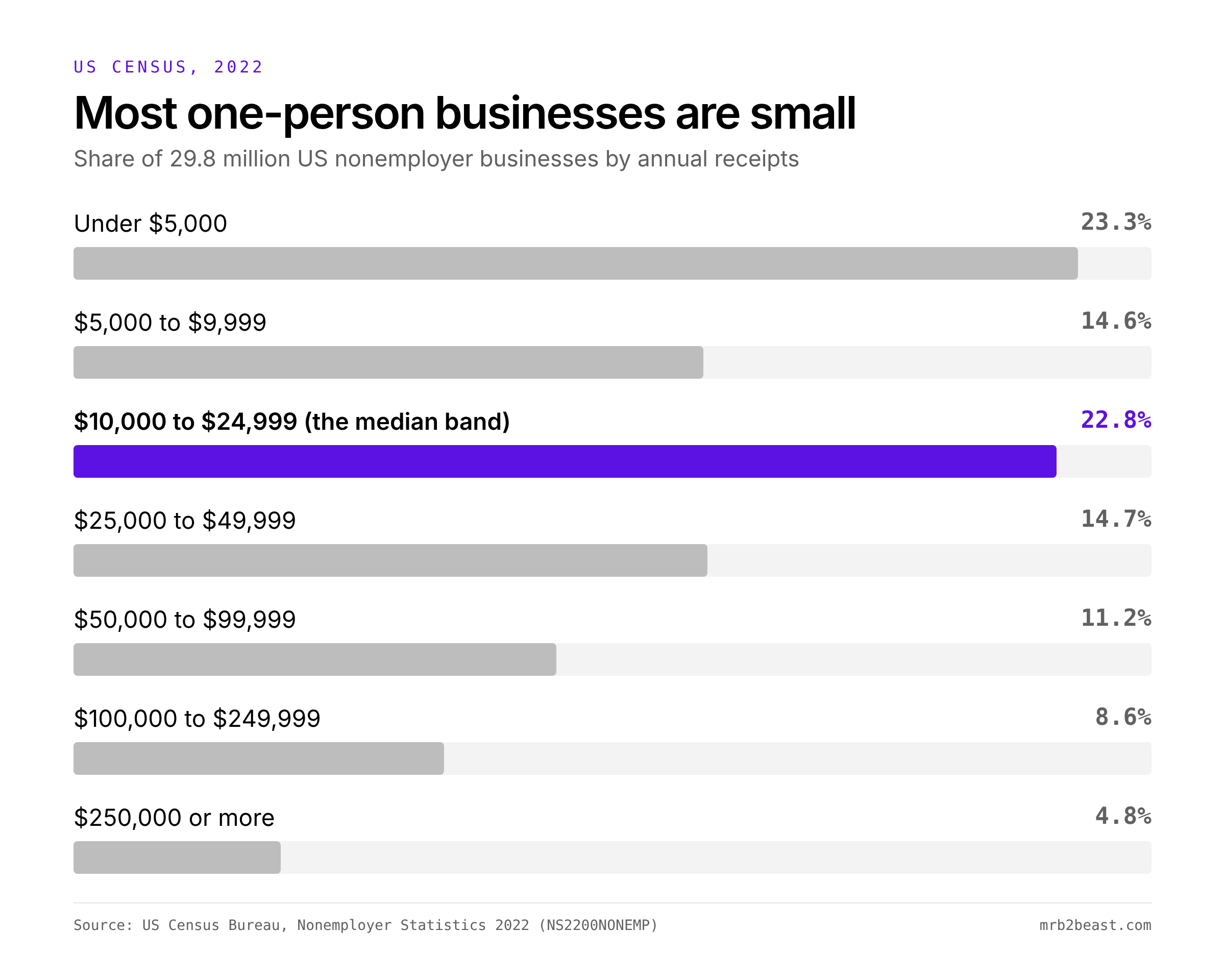
The middle business, the median, falls in the $10,000 to $24,999 band. Only 13.4 percent took in $100,000 or more. And 116,803 businesses, about 0.4 percent, reached $1 million or more.
Two limits matter here. Receipts are revenue, not profit. And the data does not show which businesses are a full-time job and which are side income. It also covers 2022, before AI tools were widely used for business.
Solo founders: more starts, less capital
The startup side shows a similar split. According to Carta, 35 percent of startups incorporated on its platform in 2024 had a solo founder. That share has more than doubled over the past decade.
But among 2024 startups that also closed a venture round that same year, only 17 percent had a solo founder.
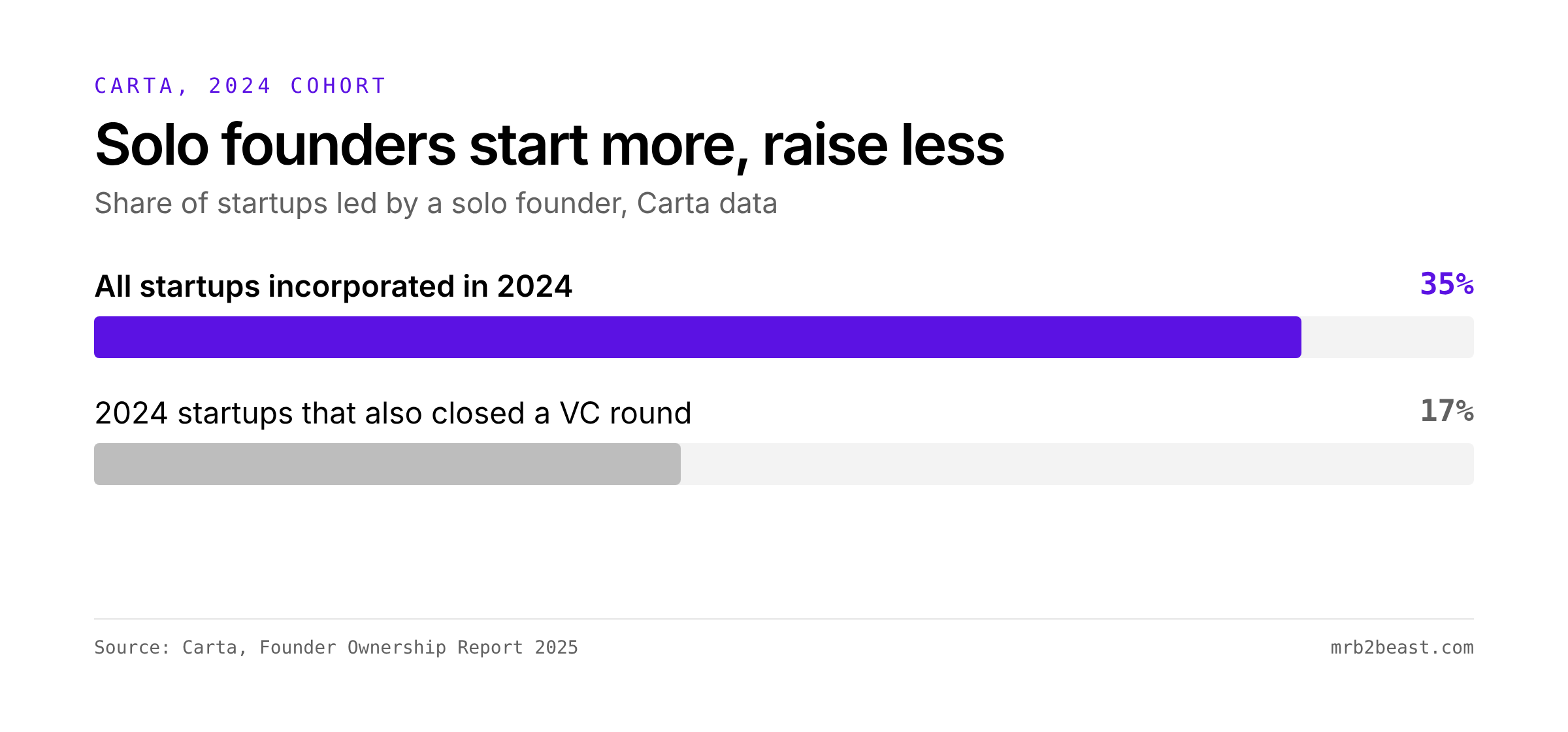
More people start alone. Fewer of them get funded. Neither number says that solo is wrong. Both say that solo is common, and that outsized results are rare.
The outlier, read closely
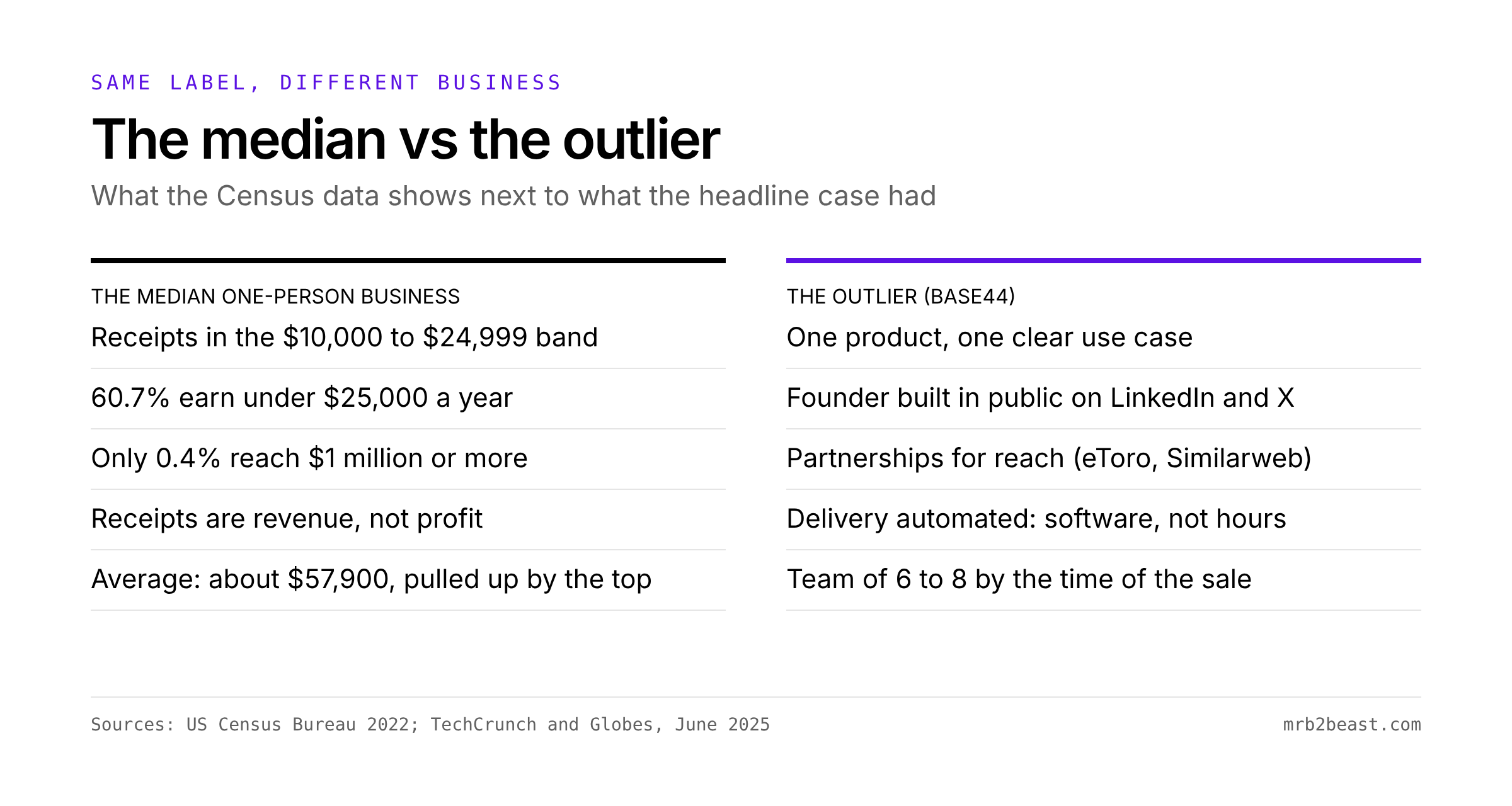
Base44 is the case most often used as proof for the one-person unicorn. Founder Maor Shlomo built an AI app builder that lets people create software with text prompts. In June 2025, Wix bought it for about $80 million in cash, plus earn-out payments through 2029.
TechCrunch called it a six-month-old, solo-owned company. It reported 250,000 users and a profit of $189,000 in May 2025. The company had raised no outside funding.
Here is the detail that travels less. At the time of the sale, Base44 had a team. TechCrunch reported 8 employees, a number Wix confirmed to the outlet. Globes reported 6, all hired in the month before the announcement. Wix also set aside $25 million in retention bonuses for those employees.
And look at how it grew. TechCrunch describes growth mostly through word of mouth, as Shlomo shared his building journey on LinkedIn and X. It also landed partnerships with Israeli tech companies such as eToro and Similarweb.
In short: the famous solo exit was one product, strong distribution and automated delivery, with a small team at the finish. It was not one person and a stack of tools.
The three mistakes that keep a solo business small
The gap between the median and the outlier is not talent. It is mostly structure. Three mistakes show up again and again.
Mistake 1: Copying the outcome instead of the inputs
The outcome of Base44 was a sale. The inputs were a single product, a founder who posted his progress publicly, and partners who brought users.
Copying the outcome means chasing a valuation. Copying the inputs means choosing one product and one way to reach people, then doing both every week.
Mistake 2: Running five offers and four channels
Here is an example. A solo founder runs a newsletter, a consulting offer, a template shop and two small AI tools. She posts on four platforms. Each offer gets a fifth of her week.
None of them gets enough attention to grow. Every new customer adds work in a different place. The business stays busy and small.
Mistake 3: Automating before there is demand
AI tools make it easy to build systems before there is anything to run through them. A fully automated onboarding flow for zero customers is a hobby.
There is also a measurement problem. The article on the AI productivity study shows that developers in a 2025 trial felt faster with AI while they were actually slower. If you do not measure, the feeling of leverage replaces the fact of it.
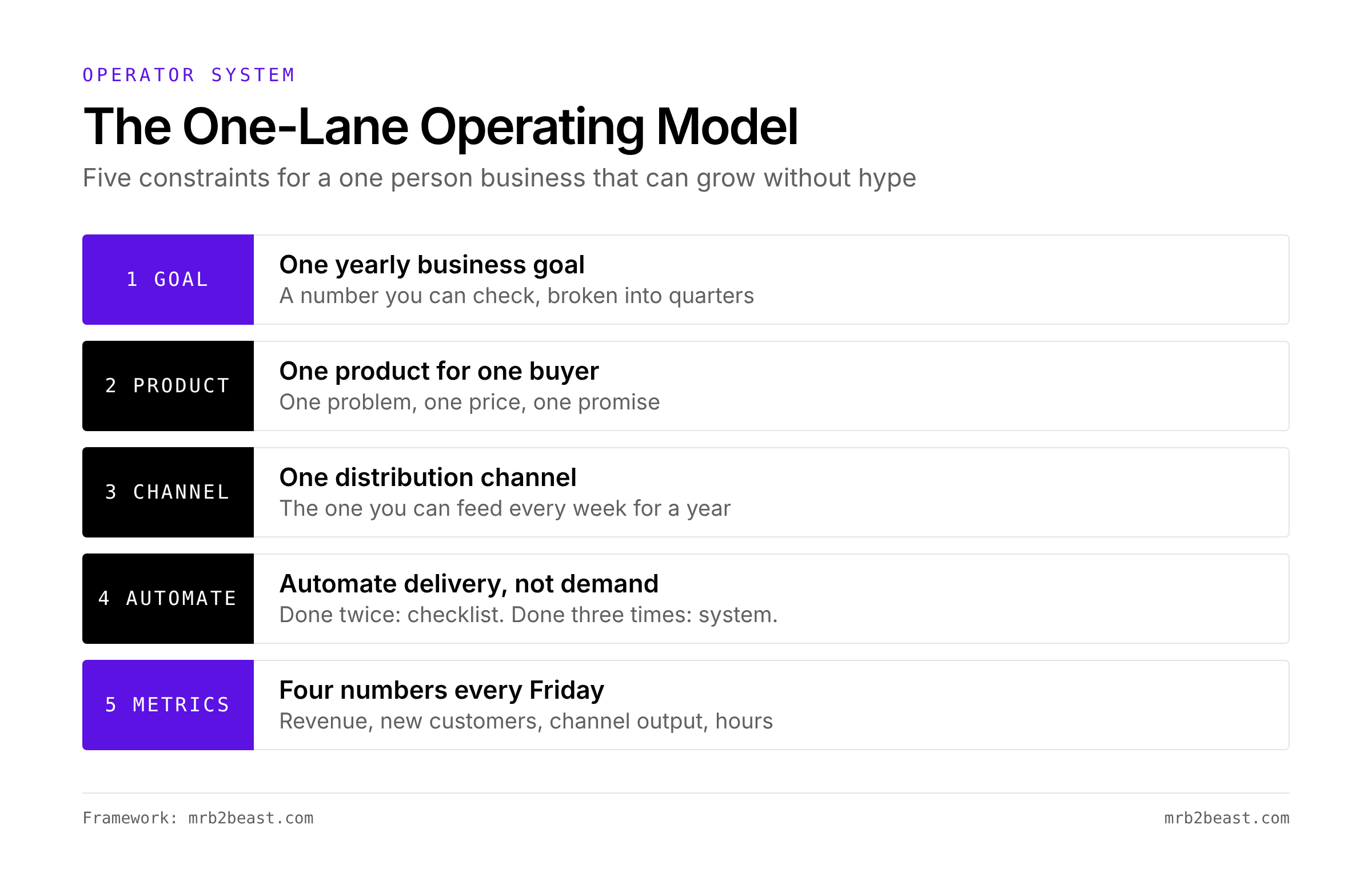
The one person business system: the One-Lane Operating Model
I am not saying a solo business cannot grow. I am saying it grows through constraints, not through more tools. Here is a model built for that.
Step 1: Set one yearly business goal. Make it a number you can check: revenue, customers or retained clients. Break it into four quarterly targets. If you want the full chain from year to day, the article on how to achieve goals covers it.
Step 2: One product for one buyer. Pick one problem, one type of customer and one price. Base44 did one thing: turn a text prompt into a working app. Everything else waits until this product sells without you explaining it twice.
Step 3: One distribution channel. Choose the channel you can feed every week for a full year. That can be LinkedIn, a newsletter, partnerships or search. Shlomo posted his progress publicly. The channel matters less than the consistency.
Step 4: Automate delivery, not demand. Use a simple rule. A task you do twice gets a checklist. A task you do three times gets a system or an AI workflow. Do not automate sales conversations you have not had yet.
Step 5: Check four numbers every Friday. Revenue, new customers, output in your one channel, and hours worked. Compare them with your quarterly target. If hours rise and revenue does not, the model is broken somewhere.
This loop is the idea behind Gaapp.io, a yearly business goals app that connects each goal to the steps due today and shows which bigger goal they serve. Disclosure: I am building it. A paper notebook works too. What matters is that the yearly goal and the Friday numbers live in the same place.
Ask yourself this week:
- Can I name my one product and my one buyer in a single sentence?
- Which channel would I still feed every week if I dropped all others?
- Do I know my revenue, new customers and hours from last week, as numbers?
Conclusion: plan for the median, build like the outlier
The one-person unicorn is a bet. The one person business is a structure.
Most solo businesses in the official data are small, and that is not a failure. It is the base rate. Planning from the base rate is how you avoid building on a headline.
The outliers did not have better tools than everyone else. They had fewer products, one strong channel and delivery that did not depend on their hours. That part is available to anyone.
What you learned today
- Of 29.8 million US nonemployer businesses in 2022, 60.7 percent took in under $25,000 and only about 0.4 percent reached $1 million.
- Base44, the most cited solo AI exit, sold for about $80 million with a team of 6 to 8 by the time of the deal, and grew through public building and partnerships.
- A realistic one person business runs one product, one channel, automated delivery and a weekly review of a few hard numbers.
FAQ
What is a one person business? A one person business is a company run by its owner without employees. In US statistics, these are called nonemployer businesses: no paid employees, subject to federal income tax and at least $1,000 in receipts. The Census Bureau counted 29.8 million of them in 2022, compared with 8.3 million employer businesses.
How much does a one person business make? Most make little. In 2022 Census data, 60.7 percent of US nonemployer businesses took in under $25,000, and the median falls in the $10,000 to $24,999 band. The average is about $57,900, pulled up by a small group at the top. Only about 0.4 percent took in $1 million or more.
Has there been a one-person unicorn yet? No one-person company has been clearly documented at a billion-dollar valuation. Sam Altman described a betting pool on when it would happen. The most cited case, Base44, sold to Wix for about $80 million in 2025. By the sale it had 6 to 8 employees, depending on the report.
Can AI help a solopreneur run a business alone? Yes, mostly on the delivery side: drafting, support, onboarding and reporting can be partly automated. AI does not replace demand. An AI solopreneur still needs one clear product and one channel that reaches buyers. Measure the gain in hours and revenue, because the feeling of speed can differ from the result.
Is it better to be a solo founder or have a cofounder? Both can work. Carta data shows that 35 percent of startups incorporated in 2024 had a solo founder, but only 17 percent of 2024 startups that closed a VC round did. Solo founders raise less often. For a bootstrapped, profitable business, outside funding may matter less.
About the author
Tristan Eilenburg. One person. AI systems. Global reach. I write about building systems that work, with evidence instead of hype.
- X: @MrB2Beast
- LinkedIn: Tristan Eilenburg
- Instagram: @mrb2beast
- Building Gaapp.io (Instagram: @gaapp.io)
I write one of these every week. If this one taught you something, the newsletter is where the next one lands first.
Sources
- US Census Bureau. (2024, December 12). Nonemployer Statistics: 2022 (press release, including definition of nonemployer businesses). https://www.census.gov/newsroom/press-releases/2024/2022-nonemployer-statistics.html
- US Census Bureau. All Sectors: Nonemployer Statistics by Legal Form of Organization and Receipts Size Class for the U.S., States, and Selected Geographies: 2022 (table NS2200NONEMP). https://data.census.gov/table/NONEMP2022.NS2200NONEMP (shares, median band and average calculated from this table)
- Shoemaker, T. (2025, May 6). Census Bureau Statistics Shed Light on Self-Employment by Sector and State During Small Business Week. US Census Bureau. https://www.census.gov/library/stories/2025/05/smallest-businesses.html
- Confino, P. (2024, February 4). Sam Altman wants AI to create a one-person unicorn with a billion-dollar valuation. Fortune. https://fortune.com/2024/02/04/sam-altman-one-person-unicorn-silicon-valley-founder-myth/
- Bort, J. (2025, June 18). 6-month-old, solo-owned vibe coder Base44 sells to Wix for $80M cash. TechCrunch. https://techcrunch.com/2025/06/18/6-month-old-solo-owned-vibe-coder-base44-sells-to-wix-for-80m-cash
- Globes. (2025, June). Wix acquires Israeli vibe coding co Base44. https://en.globes.co.il/en/article-wix-acquires-israeli-vibe-coding-co-base44-1001513267
- Wix.com Ltd. (2025, June 18). Wix Further Expands into Vibe Coding with Acquisition of Base44, a Hyper-Growth Startup that Simplifies Web and App Creation with AI (press release). https://www.nasdaq.com/press-release/wix-further-expands-vibe-coding-acquisition-base44-hyper-growth-startup-simplifies
- Carta. (2025, January 21). Founder Ownership Report 2025. https://carta.com/data/founder-ownership/