Lovable vs Claude Code: Why I Moved My Site
One tool got my products live in days. The other runs them now. What I learned from moving a real site between the two.

Most Lovable vs Claude Code comparisons build the same toy app twice and pick a winner. That tells you how each tool feels for an afternoon. It does not tell you what happens when you have to live with the result.
I have used both on real projects. Gaapp, my goal app, was built in Lovable and went live three days after the first build day. My personal site, mrb2beast.com, also started in Lovable. In October 2026 I moved it to my own server, and I build it with Claude Code now.
This is not a story about a bad tool. Lovable did exactly what it promised. The question is which layer of the work you want to own, and when it is time to switch.
Key takeaways
- Lovable is a hosted app builder: you chat, it builds, it hosts. Claude Code is a coding agent that works inside your own files, terminal and server.
- Lovable is the fastest way from idea to a live product. Claude Code wins once you need control over hosting, cost or code you understand.
- Moving is a project, not a click. My move took five steps, and the worst bug only appeared after the switch.
Lovable vs Claude Code: two different layers
The short answer: they are not the same category of tool.
Lovable describes itself as a full-stack AI development platform for building, iterating on and deploying web apps from plain language. You describe the app in a chat, watch a live preview, and publish to a Lovable URL. Lovable runs the servers for you. Its built-in backend includes a managed PostgreSQL database, login and file storage, and you can connect your own Supabase project instead. Usage is measured in credits; the free plan includes 5 daily build credits, up to 30 a month.
Claude Code is Anthropic's agentic coding tool. It reads your codebase, edits files, runs commands and works with git. It runs in the terminal, in VS Code and JetBrains, in a desktop app and in the browser. Claude Code is included in Anthropic's paid plans, Pro and Max. It does not host anything. Where your code runs is your decision.
So the honest comparison is not "which AI codes better." It is "do I want a builder that hides the stack, or an agent that works inside a stack I own?"
Is Lovable based on Claude Code?
No. Lovable is its own product with its own agent. According to Anthropic's customer case study, Lovable runs on Claude models, with a main agent that hands smaller tasks to subagents and picks a fitting model for each step. Same model family, different products. Claude Code is the tool you run yourself.
Claude Code vs Lovable at a glance
| Lovable | Claude Code | |
|---|---|---|
| How you work | Chat and live preview in the browser | Terminal, IDE, desktop app or browser, inside your repo |
| Hosting | Included, on a Lovable URL; custom domains on paid plans | None; you pick the server |
| Backend | Built in (database, login, storage) or your own Supabase | Whatever you build or connect |
| Cost model | Credits per workspace | Included in Claude Pro and Max |
| Code access | Git sync to a new repository; zip download on paid plans | Your files from the start |
| Best for | First version, fast validation | Long-term running, custom setups |
The table hides the real difference. In Lovable, the builder decides most of the stack and you steer. In Claude Code, you decide the stack and the agent does the typing.
Lovable vibe coding: where it shines
Gaapp is the best argument for Lovable I have. It is an app that breaks one yearly goal down to quarter, month, week and the step for today. I started building it in Lovable on September 8, 2026. It was live on September 11. By October 2 the project had 781 commits, with about one hour of work a day.
Payment and Google login ran through Lovable's own services. That is the part people underestimate. Login and payments are where a weekend project usually stalls, and Lovable simply handled them.
If you are testing whether anyone wants your idea, that speed matters more than anything else on the table. I wrote about the business side of that build in micro SaaS in one hour a day.
Why I moved my site anyway
My site is different from Gaapp. It is a hub for articles and a newsletter, it changes often, and I wanted to automate a lot around it. Three reasons pushed me out:
- Cost. Lovable bills by credits, and a site you keep changing keeps spending them.
- Used-up build credits. I had run through mine, and the site still needed work.
- Claude Code was already paid for. It came with my Max plan anyway.
None of that is a flaw in Lovable. It is a mismatch between a builder priced for building and a site that needed daily operating.
The move from Lovable to Claude Code in five steps
I started on October 6, 2026. The new site was live on October 7. This is the order I used, and I would use it again.
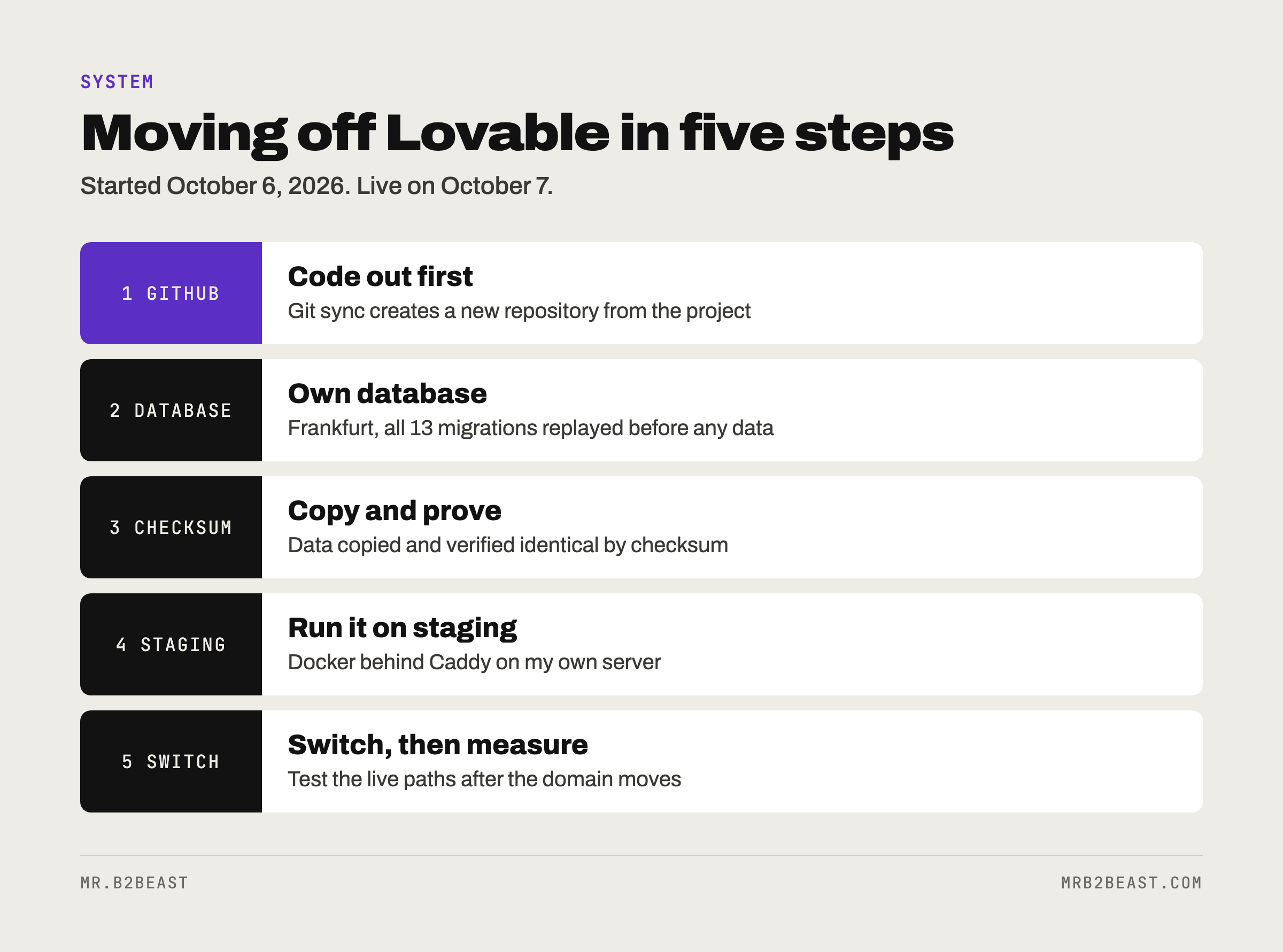
- Get the code onto GitHub. Lovable's Git sync creates a new repository from your project. It cannot import an existing one, so do this first.
- Build your own database. Mine runs in Frankfurt, and I replayed all 13 migrations against it before touching any data.
- Copy the data and prove it. I compared checksums so I knew the copy was identical, not just similar. Lovable keeps the database separate from the code, so it needs its own export.
- Run it on staging. Docker containers behind Caddy on my own server, first on a staging address.
- Switch, then measure. Only after staging held up did I point the domain at the new server.
The order matters more than the tool. Put staging before the switch into your instructions, because an agent will not insist on it for you.
The bug that only showed up after the move
Here is what broke. A CSRF check in the code I took over from Lovable blocked every request with a 403 once the site ran behind my own server. The homepage loaded and then fell apart.
It did not show up right away. I only found it because PageSpeed returned no value for desktop at all, which made me look closer.
The lesson is not "AI code is bad." The code worked where it was born. Code that runs fine inside one platform is a guess on another server. Test the paths a visitor actually uses, on the real domain, after the switch. A green build tells you nothing about that.
Lovable SEO vs your own server
Search was one reason I cared about owning the stack. To be fair to Lovable, its current docs say newer apps render pages on the server, and older apps that render in the browser get pre-rendered copies served to verified search engines and other verified crawlers. There is also a free SEO review inside the editor.
So Lovable SEO is not broken by default. My point is a different one: on my own server I can change anything, and fast.
After the move I spent one night with Claude Code on performance. In local Lighthouse runs on October 20, 2026, three runs each, the homepage scored 99 on mobile, up from 77, and 100 on desktop. Accessibility, Best Practices and SEO scored 100 each. Article pages reached 99 on mobile, up from 95. PageSpeed Insights had shown 73 on mobile before; the official re-measurement there is still open.
Those numbers say more about one focused night than about either platform. But I could only have that night because every file was mine.
What Claude Code adds after the move
Owning the repo means the agent can work with everything around the site, not just inside it. Claude Code loads a CLAUDE.md file at the start of each session, so rules and context live in the repo instead of in your head. On top of that, my setup today:
- MCP connections. Postiz on my own server schedules the X posts, Composio reaches other apps, Chrome control handles browser jobs and Context Mode keeps large tool output out of the context. More in Claude MCP explained.
- Skills. gstack for
/browseon pages and screenshots, Superpowers for test-driven building and systematic debugging, and my own design skill for every graphic. See Claude skills.
None of this is possible inside a hosted builder in the same way. That is the trade: more power, more responsibility. My rules for running it day to day are in Claude Code best practices.
When to pick Lovable, when to pick Claude Code
Pick Lovable when:
- You want to know within days whether anyone wants the product.
- You do not want to think about servers, login or payments yet.
- The app is small and changes in bursts, not daily.
Pick Claude Code when:
- You change the product every day and credits become a real cost.
- You need your own server, your own database location or your own automation.
- You want to understand the code you run, not just the preview.
Or do both. Start in Lovable, sync the code to GitHub once the idea holds, and move when the builder starts costing you more than it saves. That is what I did. The switch is easier the earlier you do it, because there is less data and fewer surprises.
If you want to know how far automation around a site like this goes, start with AI workflow automation. The rule from that article applies here too: write the process before you hand it to a tool.
FAQ
Is Lovable based on Claude Code? No. Lovable is a separate product with its own agent. Anthropic's case study says Lovable runs on Claude models and uses a main agent with subagents, picking a model per step. Claude Code is Anthropic's own coding tool that you run in your terminal, IDE, desktop app or browser.
Is there something better than Lovable? It depends on the job. For a first version you want live fast, a hosted builder like Lovable is hard to beat. Once you change the product daily, need your own server or want full control of the code, a coding agent like Claude Code inside your own repository fits better.
Is Claude Code still the best for coding? "Best" depends on how you work. Claude Code works across terminal, IDE, desktop and browser, reads your whole codebase, runs commands and connects tools through MCP. It is my main tool today, but I would test any agent on one real task from your own project before deciding.
Can I move a project from Lovable to Claude Code? Yes. Sync the project to GitHub, set up your own database and copy the data, run it on staging, then switch the domain. Plan for the backend and data separately from the code, and test the live site after the switch.
Do I need to code to use Claude Code? You do not need to write code, but you need to read results and make decisions. Claude Code works in your files and terminal, so you choose hosting, review changes and decide the order of steps. If that sounds like too much, start in Lovable.
About the author
Tristan Eilenburg. One person. AI systems. Global reach. I write about building systems that work, with evidence instead of hype.
- X: @MrB2Beast
- LinkedIn: Tristan Eilenburg
- Instagram: @mrb2beast
The newsletter goes out once a week. If this one taught you something, the newsletter is where the next one lands first.
Sources
- Lovable (2026). Welcome to Lovable. https://docs.lovable.dev/introduction/welcome
- Lovable (2026). FAQ: tech stack, backend, Git sync, publishing, credits and SEO. https://docs.lovable.dev/introduction/faq
- Lovable (2026). Pricing and plan FAQ. https://lovable.dev/pricing
- Anthropic (2026). Claude Code overview. https://code.claude.com/docs/en/overview
- Anthropic (2026). Claude pricing. https://claude.com/pricing
- Anthropic (2026). Lovable customer case study. https://claude.com/customers/lovable
- Anthropic (2026). How Claude remembers your project. Claude Code documentation. https://code.claude.com/docs/en/memory