Best Time to Post on X: What 9 Creator Videos Agree On
Two large studies give you two different clocks. Nine creator videos give you no clock at all. What they do agree on is more useful.

Search for the best time to post on X and you get a confident answer. Tuesday at 9 a.m. says one study. Tuesday to Thursday, noon to 6 p.m., says another. Both are built on millions of data points. Both are probably right for the accounts they measured.
Then I went through the X tips library I keep for my own account. It holds 148 tips from 9 creator videos, 22 of them backed by at least two creators (as of 2026-10-19). Not one of the nine transcripts names a clock time.
What the videos do agree on is how often to post and how far apart. That turns out to be the part you can control.
This article puts the studies and the creators side by side. Then it shows the posting grid I run on @MrB2Beast, and a five-step way to find your own best time without trusting anyone's chart, including mine.
Key takeaways
- Big studies disagree on the hour. Buffer's 2026 data peaks at 9 a.m. local time, Sprout Social's at noon to 6 p.m. Both put Saturday last.
- None of the 9 creator videos names a best hour. Six of them say post every day, one to four times.
- Fix frequency and spacing first. Then test slots against your own average, not against an industry chart.
The best time to post on X, according to the big studies
Two studies get quoted more than any other. Here is what each one measured, because the method explains the answer.
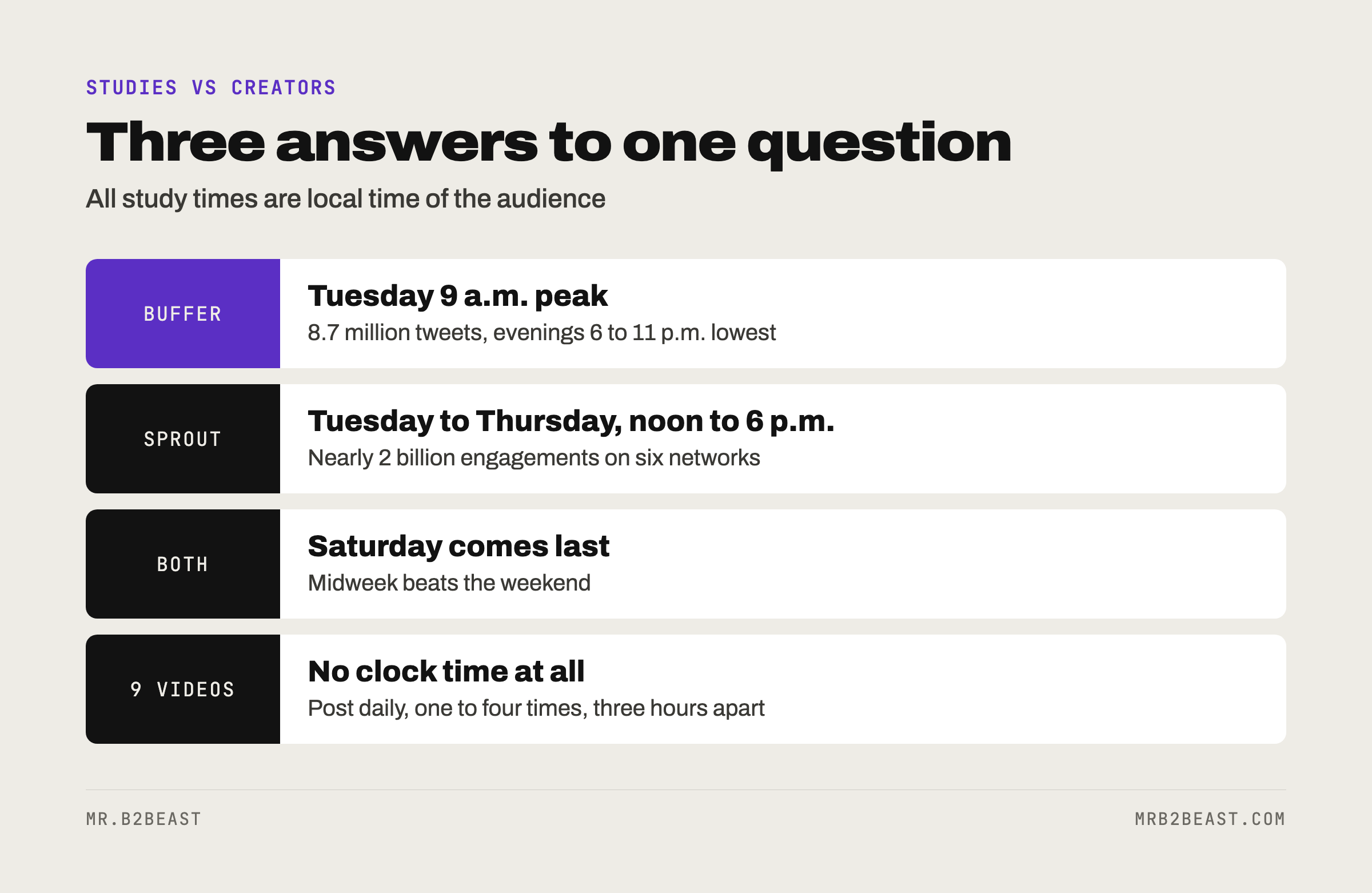
Buffer (published March 13, 2026). Buffer looked at the engagement rate of more than 8.7 million tweets sent through its own tool. Its single best slot is Tuesday at 9 a.m., followed by Wednesday at 10 a.m. and Wednesday at 9 a.m. The best days are Wednesday, Tuesday and Thursday. Saturday is the weakest day, Friday the second weakest. Evenings from 6 to 11 p.m. are the lowest hours on every day of the week. All times are local.
Sprout Social (published March 31, 2026). Sprout analyzed nearly 2 billion engagements between November 27, 2025 and February 27, 2026, across about 307,000 profiles on six networks and more than 30,000 customers. For X, its best window is Tuesday through Thursday, noon to 6 p.m. local time. Saturday is the day to avoid.
So the two agree on two things. Midweek beats the weekend, and Saturday is weak. On the hour, they point at different halves of the day.
Why the best time to post on Twitter charts disagree
This is not a scandal. It is what happens when you average very different accounts.
Different samples. Buffer measured tweets sent through Buffer. Sprout measured the profiles of its customers across six networks. A brand account posting product news and a solo creator posting build updates do not share an audience, so they do not share a best hour.
Different measures. Both use engagement. Engagement rate rewards a post that a small, loyal audience reacts to. Raw reach would reward something else. Neither study is a measure of new followers, and for a small account that is usually the number that matters.
Local time of whom? Both studies give local time. That sounds simple until your followers sit on two continents. A post at 9 a.m. in New York lands at 3 p.m. in Berlin and 6 a.m. in San Francisco. "Local" only helps once you know where most of your audience lives.
An average is not your audience. A best time across millions of posts tells you when the average account does best. It says nothing about the few hundred people who actually follow you.
That is the point where creator advice gets interesting, because creators only care about one account at a time.
What 9 creator videos say about timing
The library behind my X tips cheat sheet comes from 9 YouTube videos by 5 creators, all about growing on X. Every tip is stored with the timestamp it came from. Here is everything in it that touches timing, sorted by how many videos back it.
Post every day, one to four times (6 of 9 videos). This is the strongest point of agreement in the whole library. The advice ranges from "at least once a day" to three or four posts a day. Two videos treat more than about three a day as a brake on reach. One creator says he has not missed a day in three years. Another admits that three or four posts a day without losing quality is hard.
Ride trends while they run (3 videos). Timing here means reacting, not scheduling. A post that adds to a live conversation gets picked up because the conversation is already moving.
Content beats algorithm tricks (3 videos). Three videos argue that X now reads the post itself and rewards value and originality. If that is true, no posting hour rescues a weak post.
A post that takes off lifts the next one or two (2 videos). People who engaged with a strong post are more likely to see what you post right after. That is an argument for having the next post ready, not for a specific hour.
Leave three hours between posts (1 video). One creator leaves at least three hours between posts so each one reaches its full audience. Another video says the opposite for one case: when a post starts to take off, add a quote or a reply to it right away. The library marks the two as a contradiction.
A post lives about two days (1 video). After that, one creator says, it mostly stops spreading.
Do not judge a post too early (1 video). One video argues that the recommendation system now takes longer to deliver a post to its full audience.
Post when another platform goes down (1 video). When Instagram or Snapchat fails, one creator says, users move to X and small accounts get unusual reach.
The library also covers how far ahead to plan. That is a scheduling question, and it sits in how to schedule tweets.
No clock time anywhere. The creators who grew large accounts talk about frequency, spacing, consistency and content. They do not talk about 9 a.m.
How often should you post on X?
Short answer from the library: every day, one to four posts. If you start near zero, the lower end done well beats the upper end done badly.
The more useful question is how far apart. Here the only number in the library is three hours. One video, so treat it as a starting rule rather than a law. It fits the other advice, though. If a post needs time to reach its audience, a second post an hour later competes with the first.
So frequency and spacing work as a pair. Four posts a day at three-hour gaps already cover twelve hours. You do not need a perfect hour if your posts are spread across the hours your audience is awake.
Hard limits help more than good intentions. My own limits are below.
Best day to post on X
The studies say midweek, with Saturday last. The creators say every day, weekends included.
Both can be true. A study measures engagement per post. A creator cares about the account over months. A weaker Saturday post still keeps the daily habit, and the habit is what six of the nine videos push hardest.
My take: post every day, but put your best post of the week on a weekday. If you only manage three days a week, choose Tuesday, Wednesday and Thursday. Both studies would back you on that.
My X posting schedule: four slots, three hours apart
Here is the grid @MrB2Beast runs on. Times are German time.

| Slot | Days | New York (most of the year) |
|---|---|---|
| 12:00 | Every day | 6:00 |
| 15:30 | Weekdays only | 9:30 |
| 19:00 | Every day | 13:00 |
| 23:00 | Every day | 17:00 |
The rules behind it are fixed:
- At most 5 posts per day. Four slots are the normal case.
- At least 180 minutes between two posts. The real gaps are 210, 210 and 240 minutes.
- Three posts on weekend days, four on weekdays.
Two things stand out when you put the grid next to the studies. The 15:30 slot lands at 9:30 in New York, close to Buffer's peak. The 19:00 and 23:00 slots land at 1 p.m. and 5 p.m. in New York, inside Sprout's window. For a reader in Berlin, though, 23:00 sits in exactly the evening hours that Buffer ranks lowest.
That is the "local time of whom" problem in one table. A time is only good or bad relative to where your followers are.
I am not going to tell you this grid is the answer. My account is small. It had about 100 followers at the start of October 2026 and 531 on 2026-10-21, according to the X API. Posts and reach are public on the stats page. A sample that size cannot prove which hour wins. The grid encodes what the library agrees on, frequency and spacing, and I treat the clock times as a hypothesis to test.
The mechanics of filling a grid like this automatically are in the scheduling article linked above. This article is about when. That one is about how.
How to find your own best time to post on X
Here is the method I would give anyone who starts out. It needs no paid tool. Call it frequency, spacing, slots, hold, judge.
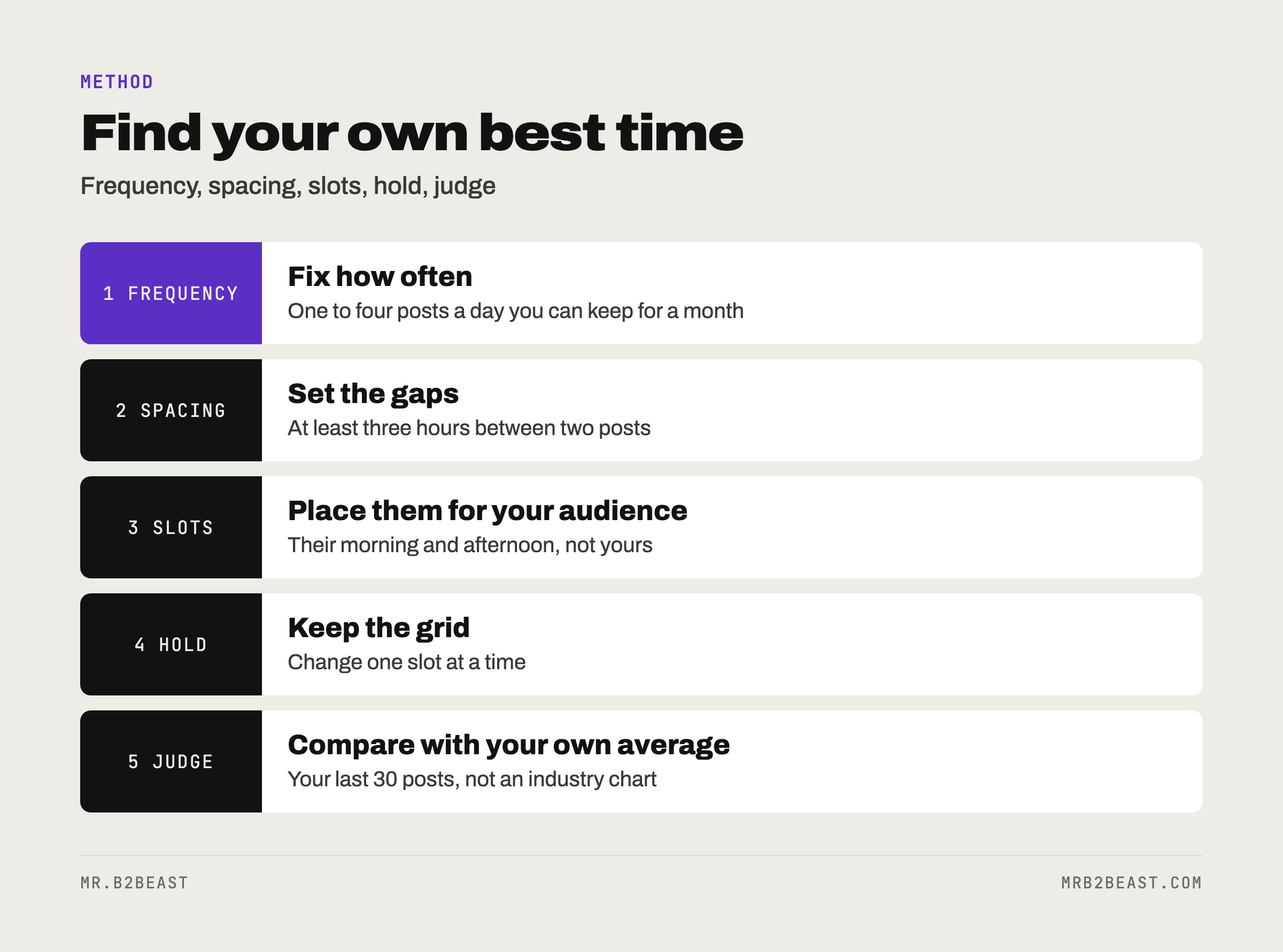
Step 1: Fix the frequency. Pick a number between one and four posts per day that you can keep for a month. Write it down. Consistency is the one thing six of the nine videos agree on.
Step 2: Set the spacing. Leave at least three hours between posts. If your number is one post a day, this step is free.
Step 3: Pick slots in your audience's time zone. Find out where your followers live. A rough picture is enough: open the profiles of the people who reply and engage most. X analytics explains which numbers are worth reading after that. Then place your slots in their morning and afternoon, not yours. If they are split across continents, spread the slots so each region gets one.
Step 4: Hold the grid. Keep the same slots long enough to collect a few dozen posts per slot. Change one slot at a time, not the whole grid. Otherwise you will never know what made the difference.
Step 5: Judge against your own average. Look at your last 30 posts, as three of the videos suggest. Compare each post with your usual result, not with somebody else's numbers. One video defines an outlier exactly that way: a post that does clearly better than the account's normal level, whatever the follower count. If the outliers keep landing in one slot, that is your best time. If they land everywhere, the hour was never the issue. The post was.
One warning for step 5. A single viral post can make any slot look brilliant. One creator in the library had his first lead magnet post pass 2.4 million views while his normal posts got 50 to 100. Do not move your whole grid because of one hit.
What timing cannot fix
The honest conclusion from the library is that timing is a small lever. Spacing and frequency are bigger. Content is the biggest.
If a post does badly at the "right" time, look at the hook first, then the topic. The how to get followers on X guide covers what moves an account from zero, and most of it has nothing to do with the clock.
What is the 4-1-1 rule on Twitter?
The 4-1-1 rule is an old content mix rule of thumb, credited to Tippingpoint Labs. For every self-promoting post, share four useful pieces of content from others and one relevant repost of someone else's post.
It is about what you post, not when. None of the 9 videos in my library mentions it. It also predates the current X, where three of the videos argue the system reads the content itself. Use it as a reminder not to make every post about yourself. Do not treat it as a schedule.
Conclusion: spacing beats the clock
There is no universal best time to post on X. There is a best rhythm for your audience, and you find it by holding a grid long enough to see it.
The big studies tell you when the average account does well. The creators tell you to post daily, space your posts and stop chasing tricks. Your own last 30 posts tell you the rest.
Start with frequency and spacing. Put your slots where your followers are awake. Then let your own average decide.
FAQ
What is the best time to post on X? Large studies disagree. Buffer's 2026 analysis of more than 8.7 million tweets puts the peak at Tuesday 9 a.m. local time. Sprout Social's 2026 data recommends Tuesday to Thursday, noon to 6 p.m. Both rank Saturday lowest. For your account, test slots in your audience's time zone and compare against your own average.
How often should I post on X? Six of the nine creator videos in my library say every day, one to four posts. Two of them see more than about three a day as a brake on reach. Leave at least three hours between posts so each one has time to reach its audience.
What is the best day to post on X? Buffer ranks Wednesday, Tuesday and Thursday highest, and Sprout Social also points to Tuesday through Thursday. Both put Saturday last. Creators still post on weekends to keep the daily habit, so put your strongest post of the week on a weekday.
How do I get more views on X? Fix the basics before the clock: a clear topic, a strong first line and daily posting. Replies under bigger accounts in your niche and posts on live trends get you in front of new people. The X tips cheat sheet lists the 22 tips backed by at least two creators.
Does posting time still matter on X? Less than most guides suggest. Several creator videos argue that X now reads the post itself and rewards value and originality. Timing helps a good post reach more of your audience while they are awake. It does not rescue a weak post.
About the author
Tristan Eilenburg. One person. AI systems. Global reach. I write about building systems that work, with evidence instead of hype.
- X: @MrB2Beast
- LinkedIn: Tristan Eilenburg
- Instagram: @mrb2beast
The newsletter goes out once a week. If this one taught you something, the newsletter is where the next one lands first. The X tips behind this article are free in the X tips cheat sheet.
Sources
- Buffer (2026, March 13). The Best Time to Post on Twitter/X in 2026. https://buffer.com/resources/best-time-to-post-on-twitter-x/
- Sprout Social (2026, March 31). Best times to post on Twitter (X). https://sproutsocial.com/insights/best-times-to-post-on-twitter/
- Kleber & Associates. Be more social: the 4-1-1 rule. https://kleberandassociates.com/be-more-social-the-4-1-1-rule/
- The AI Architects, Tom Crawshaw. How I Got 15,500 Twitter Followers in 4 Months Using AI. https://www.youtube.com/watch?v=oTa2RccMkJU
- Oleg Melnikov. I Built an X/Twitter Content Machine With Claude Code. https://www.youtube.com/watch?v=JQQhT0edXXw
- Marcos Ruiz. How to Dominate the New X Algorithm in 14 Minutes. https://www.youtube.com/watch?v=Z-sAmX7zeJc
- Marcos Ruiz (2026). X/Twitter Is STILL on 'Easy Mode'. https://www.youtube.com/watch?v=ujj-gTRXpWc
- Marcos Ruiz (2025). I Studied 1,000 Twitter/X Hooks, Here's How to ACTUALLY Go Viral. https://www.youtube.com/watch?v=5EUYQiFF6jk
- Jacob C. Edmunds. 7 Things The X Algorithm Hates. https://www.youtube.com/watch?v=qNHCNQ_t-V8
- Jacob C. Edmunds (2026). How To Grow From 0 to 5,000 Followers On X/Twitter. https://www.youtube.com/watch?v=gSgvnr4HtZg
- Jacob C. Edmunds (2026). How To Beat The New X Algorithm In 9 Minutes. https://www.youtube.com/watch?v=ZYiEId25OnA
- Matt Gray (2026). Copy this X posting strategy. https://www.youtube.com/watch?v=Tk-qgosjoYM