Willpower Is Not a Battery. Here Is What Self-Control Really Runs On
Why the "limited willpower" idea failed its biggest tests, and what people with strong self-control do instead.
In 1998, hungry students sat next to a plate of fresh chocolate chip cookies and were told to eat radishes instead. Afterwards, they gave up on impossible puzzles in 8.35 minutes. Students who could eat the chocolate lasted 18.90 minutes.
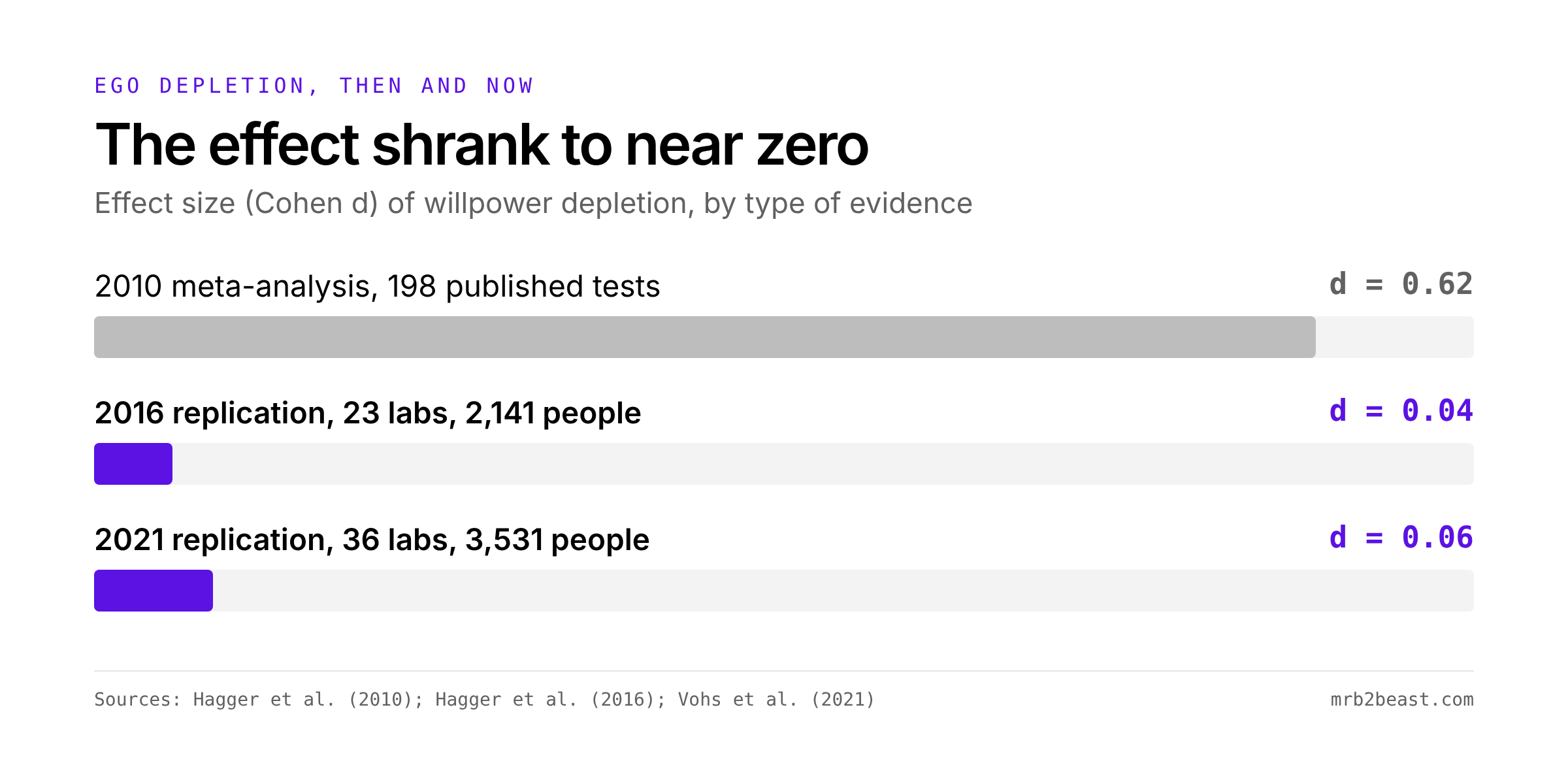
That study made willpower famous as a limited resource. In 2016, 23 labs with 2,141 participants ran a careful replication. The effect was d = 0.04. Practically zero.
The idea is not stupid. Everyone knows the feeling of a long day wearing them down. It is just a weak base for a system. If your plan depends on willpower lasting until 9 pm, it depends on something the research cannot pin down.
I want to show you how the battery idea rose and then failed its largest tests. I want to show you what people with high self-control actually do, which is less resisting, not more. And I want to give you a setup you can build this week that needs almost no willpower at all.
Key takeaways
- The famous ego depletion effect shrank to near zero in two large replications: d = 0.04 across 23 labs and d = 0.06 across 36 labs.
- Even the popular rescue, "it only runs out if you believe it does," failed a preregistered replication in 2023.
- People with high self-control report fewer temptations and rely on habits. They resist less, because their setup does the work.
What the research actually shows about willpower
The common belief goes like this. Willpower is a muscle, or a fuel tank. Every act of self-control drains it. When it is empty, you cave.
For about 15 years, that belief had strong support in the published literature.
The study that started it
Roy Baumeister and colleagues published the radish study in the Journal of Personality and Social Psychology. Participants were asked to skip a meal and not eat for at least 3 hours. Cookies were baked in the lab, so the room smelled of fresh chocolate.
Then 67 students were split into three groups. One group had to eat radishes and leave the sweets alone. One group could eat the chocolate. One group got no food at all. Afterwards, everyone worked on geometric tracing puzzles that were designed to be impossible to solve.
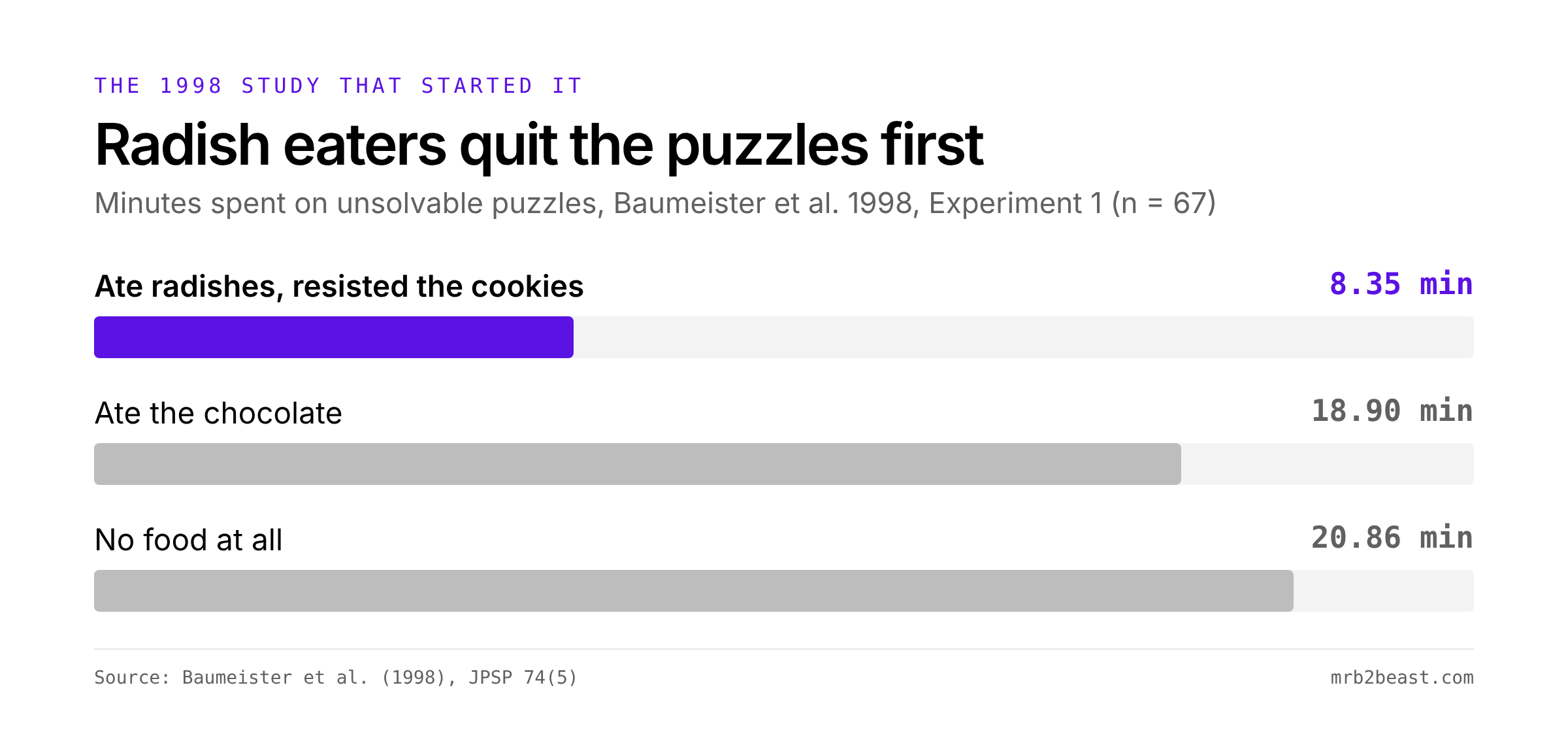
The radish group quit after 8.35 minutes on average. The chocolate group lasted 18.90 minutes, the no-food group 20.86 minutes. The conclusion: resisting cookies used up something, and that something was then missing.
What is ego depletion? Ego depletion is the idea that self-control draws on a limited resource. Using it on one task leaves less for the next one, so performance drops. The term comes from the 1998 paper by Baumeister and colleagues. It is also the root of popular phrases like "willpower muscle" and "decision fatigue."
Hundreds of studies, then a stress test
By 2010, a meta-analysis by Martin Hagger and colleagues in Psychological Bulletin combined 198 tests of the effect. The average was d = 0.62, a medium effect.
Then psychology hit its replication crisis. Meta-analyses of published studies can look strong when null results stay in the drawer. So researchers tried a different design: decide everything in advance, then run the same study in many labs at once.
In 2016, the journal Perspectives on Psychological Science published exactly that. 23 labs, 2,141 participants, one preregistered protocol. The depletion task was a computer letter-detection task, the outcome a response inhibition test. The effect was d = 0.04, with a 95 percent confidence interval from -0.07 to 0.15. That range includes zero.
Critics said the tasks were too weak. Fair point. So in 2021, Kathleen Vohs, one of the best-known ego depletion researchers, led a second test with 36 labs and 3,531 participants. Each lab used one of two procedures designed to drain self-control. The confirmatory result was d = 0.06 and not significant. A Bayesian analysis found the data 4 times more likely under no effect than under the predicted one.
To be fair, an exploratory analysis on the full sample did find a small effect, d = 0.08. That is a long way from 0.62.
What is a registered replication? A registered replication repeats a known study with a design, sample size and analysis that are fixed and published before any data is collected. Many labs run the same protocol. Because the plan cannot be adjusted after seeing the results, it is one of the strictest tests psychology has.
The rescue that did not hold either
When the battery model started to wobble, a softer version became popular. In 2010, Veronika Job, Carol Dweck and Gregory Walton reported that depletion depends on what you believe. People who saw willpower as limited showed the drop. People who saw it as unlimited did not.
It is an appealing idea, and it is widely quoted. Here is the part that rarely travels with it. In 2023, Nicholas Carruth, Jairo Ramos and Akira Miyake ran a preregistered replication with 187 participants. The original study had 60. They found no depletion effect and no moderation by willpower mindset. The 36-lab study of 2021 also tested willpower beliefs as a moderator. They made no difference there either.
That does not prove beliefs never matter. It does mean that "just believe your willpower is unlimited" is not a plan either.
In short: the evidence that willpower runs out like a battery is weak. The evidence that it is a reliable daily tool is not much better. Either way, you should not build your goals on it.
What people with high self-control actually do
If willpower is not the engine, what is? Two studies point in the same direction.
In 2012, Wilhelm Hofmann, Roy Baumeister, Georg Forster and Kathleen Vohs gave 205 adults smartphones. Over a week, the phones asked them about their desires at random moments. That produced 7,827 reports. About 46.8 percent of desires conflicted at least somewhat with a goal.
The surprise was in the personality data. People high in trait self-control reported weaker desires and less conflict. They did not seem to win more battles. They seemed to have fewer battles to fight.
In 2015, Brian Galla and Angela Duckworth ran six studies with a total of 2,274 participants. Self-control was linked to less effortful inhibition in daily life, not more. What explained the good outcomes was habits: for exercise, sleep, healthy snacks, homework and studying. The habits did the work that people imagine willpower doing.
In short: the people who look disciplined are mostly people who rarely need discipline. They built the setup first.
The three willpower mistakes almost everyone makes
Once you see the research, the common self-control mistakes look different.
Mistake 1: Planning to resist instead of planning to avoid
Most plans for self-control describe a fight. "I will not check my phone while I work." That sentence assumes the phone is there and you will win anyway.
Angela Duckworth, Tamar Gendler and James Gross reviewed the research on self-control strategies in 2016. Their point: strategies that change the situation early tend to beat strategies that fight an impulse in the moment. Impulses tend to grow stronger the longer you face them. The earlier you act, the less force you need.
Mistake 2: Blaming an empty tank
Here is an example. A solo founder plans deep work every evening after client calls. By 8 pm, she opens a streaming app instead. She concludes her willpower is used up and tries to "save energy" earlier in the day.
The battery story gives her a clean explanation. It also gives her the wrong fix. The evening problem is a setup problem: the laptop is on the couch, the streaming app is one tap away, and nothing decides what happens at 8 pm.
Mistake 3: Measuring discipline by how hard it feels
Many people judge their self-control by the struggle.
The Galla and Duckworth data points the other way. The people who did best reported less effortful inhibition, because habits had replaced the fight. If self-control feels like a constant fight, that is a design signal, not a character test.
How to improve self-control: the Zero-Willpower Setup
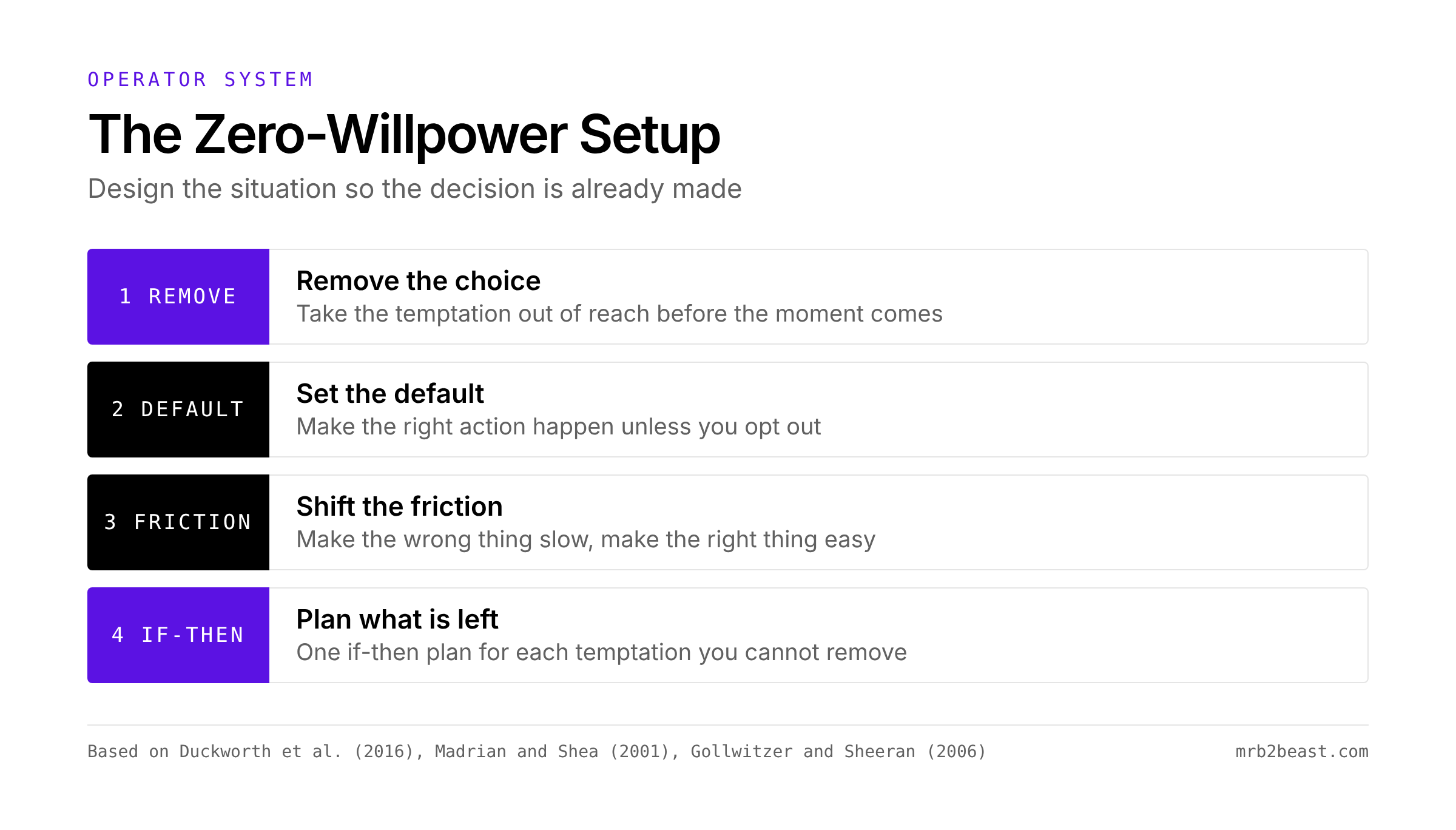
I am not saying willpower does not exist. I am saying it is the last line of defense, not the first. Here is a system that moves the decision out of the hard moment.
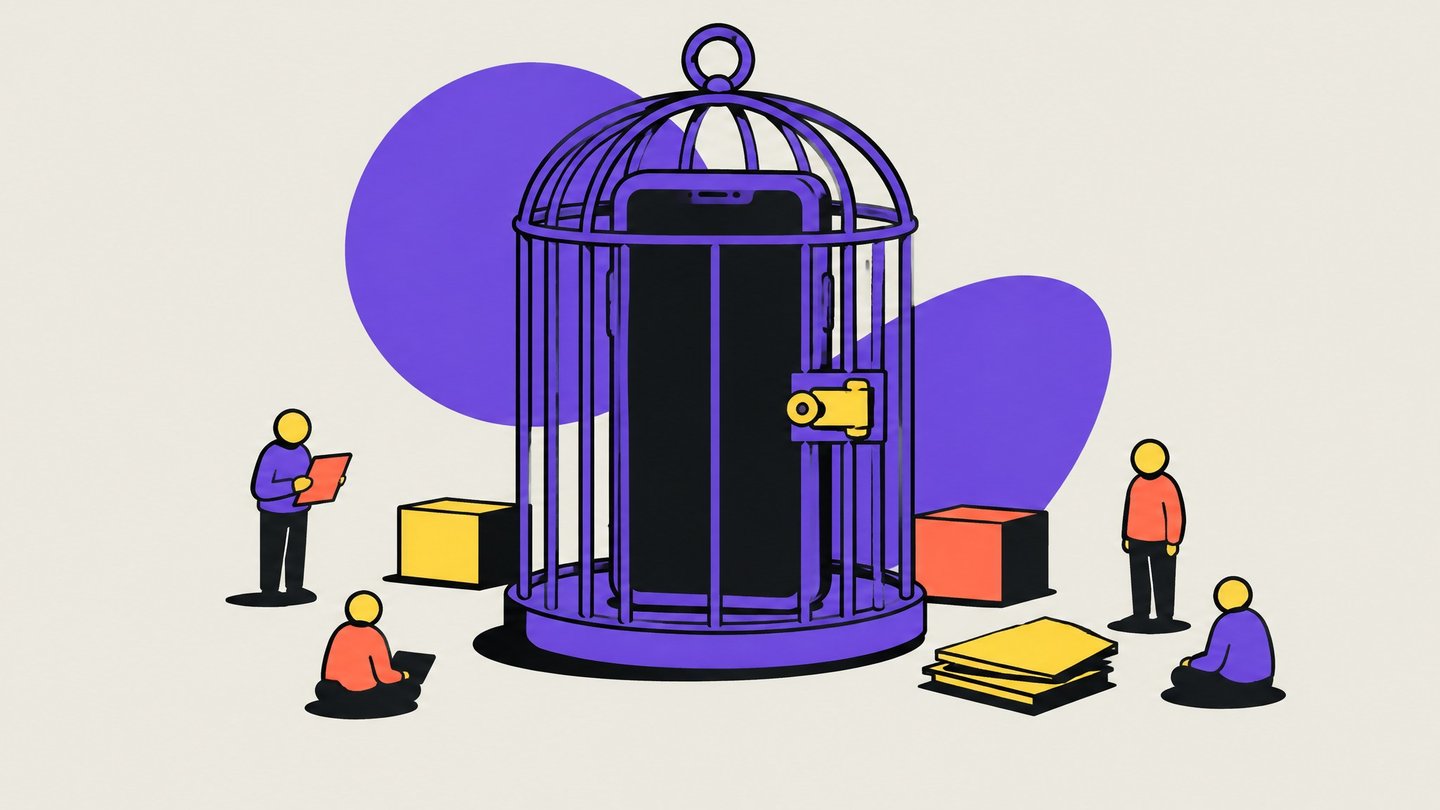
Step 1: Remove the choice. List the two or three temptations that most often beat your goals. For each one, decide how to take it out of reach before the moment comes. The phone goes in another room during deep work. No snacks in the desk drawer. A distraction you never see is a decision you never have to make.
Step 2: Set the default. Make the right action happen unless you actively opt out. The strongest evidence for defaults comes from economics. In a company studied by Brigitte Madrian and Dennis Shea, 37 percent of employees hired under opt-in joined the retirement plan at 3 to 15 months of tenure. Under automatic enrollment, it was 86 percent. Same people, same plan, different default. For you, that could mean a calendar block that repeats every morning, or a gym bag packed by the door.
Step 3: Shift the friction. Add steps to what you want to do less, and remove steps from what you want to do more. Log out of the apps that pull you away. Leave the work file open on the screen at night. Small delays change behavior more than big intentions.
Step 4: Plan what is left with if-then rules. Some temptations cannot be removed. For those, write one if-then plan each: "If I feel the urge to check messages during a work block, then I write it on a paper list and keep going." Across 94 tests, Peter Gollwitzer and Paschal Sheeran found an average effect of d = 0.65 for plans in this format.
Review the setup once a week. Every time you notice yourself fighting the same temptation twice, move it back to Step 1. Over a few weeks, these setups can turn into habits. The article on how long it takes to form a habit shows what to expect.
This is the idea behind Gaapp.io, an app to build systems for your goals that connects yearly goals to daily steps and shows what is due today. Disclosure: I am building it. A paper notebook works too. What matters is that the decision is made before the moment of temptation.
Ask yourself this week:
- Which temptation do I fight most often, and could it simply not be there?
- What happens by default at the time of day my plans usually fail?
- Do I have an if-then plan for the one temptation I cannot remove?
Conclusion: stop fighting, start designing
Disciplined people are not better at the fight. They set things up so the fight rarely starts.
The willpower battery was a good story with a memorable study behind it. Two large, preregistered tests could barely find it. The belief-based rescue did not hold up either.
What does hold up is less dramatic. People with strong self-control face fewer conflicts and lean on habits. Defaults and if-then plans have solid evidence. None of that needs a full tank.
What you learned today
- The ego depletion effect dropped from d = 0.62 in published studies to d = 0.04 and d = 0.06 in two multi-lab replications.
- The idea that depletion only hits people who believe in it failed a preregistered replication in 2023.
- High self-control is mostly a setup: fewer temptations, more habits. Remove the choice, set the default, shift the friction, then plan the rest.
FAQ
Is willpower a limited resource? The evidence is weak. The 1998 radish study suggested it is, and a 2010 meta-analysis found a medium effect. But two large preregistered replications, with 23 and 36 labs, found effects close to zero. Willpower may vary with mood and fatigue, but the "fuel tank" model is not well supported.
What is ego depletion? Ego depletion is the theory that self-control draws on a limited resource, so using it on one task weakens it for the next. Roy Baumeister and colleagues introduced it in 1998. Large replications in 2016 and 2021 found effect sizes of d = 0.04 and d = 0.06, which means little or no effect.
Is willpower a muscle? The muscle metaphor comes from the same strength model as ego depletion: willpower gets tired with use and stronger with training. The depletion part did not hold up in large replications. A more useful view is that self-control works best when habits and environment take over, so you need it less.
How do you improve self-control? Change the situation before the temptation shows up. Remove the trigger, set a default for the right action, add friction to the wrong one, and write an if-then plan for whatever remains. Research by Galla and Duckworth suggests that people with high self-control rely on habits, not constant resistance.
Discipline vs systems: which matters more? Systems do most of the work. People high in self-control report fewer temptations and less conflict in daily life, according to a 2012 experience sampling study. Discipline helps you build the system once. After that, the system makes the right action the easy one.
About the author
Tristan Eilenburg. One person. AI systems. Global reach. I write about building systems that work, with evidence instead of hype.
- X: @MrB2Beast
- LinkedIn: Tristan Eilenburg
- Instagram: @mrb2beast
- Building Gaapp.io (Instagram: @gaapp.io)
I write one of these every week. If this one taught you something, the newsletter is where the next one lands first.
Sources
- Baumeister, R. F., Bratslavsky, E., Muraven, M., and Tice, D. M. (1998). Ego depletion: Is the active self a limited resource? Journal of Personality and Social Psychology, 74(5), 1252-1265. https://faculty.washington.edu/jdb/345/345%20Articles/Baumeister%20et%20al.%20%281998%29.pdf
- Hagger, M. S., Wood, C., Stiff, C., and Chatzisarantis, N. L. D. (2010). Ego depletion and the strength model of self-control: A meta-analysis. Psychological Bulletin, 136(4), 495-525. https://doi.org/10.1037/a0019486
- Hagger, M. S., Chatzisarantis, N. L. D., et al. (2016). A multilab preregistered replication of the ego-depletion effect. Perspectives on Psychological Science, 11(4), 546-573. https://doi.org/10.1177/1745691616652873
- Vohs, K. D., Schmeichel, B. J., Lohmann, S., Gronau, Q. F., Finley, A. J., et al. (2021). A multisite preregistered paradigmatic test of the ego-depletion effect. Psychological Science, 32(10), 1566-1581. https://doi.org/10.1177/0956797621989733
- Job, V., Dweck, C. S., and Walton, G. M. (2010). Ego depletion: Is it all in your head? Implicit theories about willpower affect self-regulation. Psychological Science, 21(11), 1686-1693. https://doi.org/10.1177/0956797610384745
- Carruth, N. P., Ramos, J. A., and Miyake, A. (2023). Does willpower mindset really moderate the ego-depletion effect? A preregistered replication of Job, Dweck, and Walton (2010). PLOS ONE, 18(6), e0287911. https://doi.org/10.1371/journal.pone.0287911
- Hofmann, W., Baumeister, R. F., Forster, G., and Vohs, K. D. (2012). Everyday temptations: An experience sampling study of desire, conflict, and self-control. Journal of Personality and Social Psychology, 102(6), 1318-1335. https://carlsonschool-d8.prd.umn.edu/sites/carlsonschool.umn.edu/files/2019-04/hofmann_baumeister_forster_vohs_2012_jpsp.pdf
- Galla, B. M., and Duckworth, A. L. (2015). More than resisting temptation: Beneficial habits mediate the relationship between self-control and positive life outcomes. Journal of Personality and Social Psychology, 109(3), 508-525. https://pmc.ncbi.nlm.nih.gov/articles/PMC4731333/
- Duckworth, A. L., Gendler, T. S., and Gross, J. J. (2016). Situational strategies for self-control. Perspectives on Psychological Science, 11(1). https://doi.org/10.1177/1745691615623247
- Madrian, B. C., and Shea, D. F. (2001). The power of suggestion: Inertia in 401(k) participation and savings behavior. Quarterly Journal of Economics, 116(4), 1149-1187. https://www.nber.org/papers/w7682
- Gollwitzer, P. M., and Sheeran, P. (2006). Implementation intentions and goal achievement: A meta-analysis of effects and processes. Advances in Experimental Social Psychology, 38, 69-119. https://doi.org/10.1016/S0065-2601(06)38002-1