Grill Me Skill: 11 Questions That Built My Glossary
A template gives you blanks to fill. The grill me skill asks the questions you skipped, one round at a time.
The grill me skill does one thing: before Claude builds anything, it interviews you about the plan until nothing is left to guess. No template, no form. Just questions, each with a suggested answer, and you decide.
I ran its sibling, grill with docs, on my own repo on 2026-11-02. Claude asked me 11 questions in 3 rounds. I decided all 11 names. The glossary that came out of it has 52 terms.
The surprise was not the number. It was one word. Claude proposed "freier Slot" (free slot) for the spontaneous gaps I keep for myself. That term was already taken in the code for something else. So the gap now has its own name: "Spontan-Slot". One question caught a collision that would have confused every agent reading the repo.
This article covers both skills: what they do, how they run, when to use which, and what an interview catches that a template never will.
Key takeaways
- The grill me skill turns Claude into an interviewer: rounds of numbered questions, each with a recommended answer, until every open decision is settled.
- Grill with docs runs the same interview and writes the results into a glossary and, for hard-to-reverse decisions, into decision records.
- On my repo, 3 rounds and 11 questions produced a glossary of 52 terms and caught one name that already meant something else in the code.
What the grill me skill is
Grill me is a Claude skill from Matt Pocock's open source skills repo on GitHub, published under the MIT license. Its own description is short: "A relentless interview to sharpen a plan or design."
The skill file itself is tiny. It hands off to a shared skill in the same repo called grilling, which holds the actual method. Both grill me and grill with docs are set to manual invocation, which means Claude never starts them on its own. You call them by name with a slash command when you want to be questioned. If skills are new to you, the Claude skills article explains what they are and how they load.
The point of the skill is the opposite of a prompt template. A template assumes you already know which questions matter. An interview finds them.
How the grill me skill works
The grilling method treats your plan as a tree of decisions. Every decision opens the decisions that depend on it. You cannot pick a database schema before you know what you store, and you cannot name a thing before you know what it is.
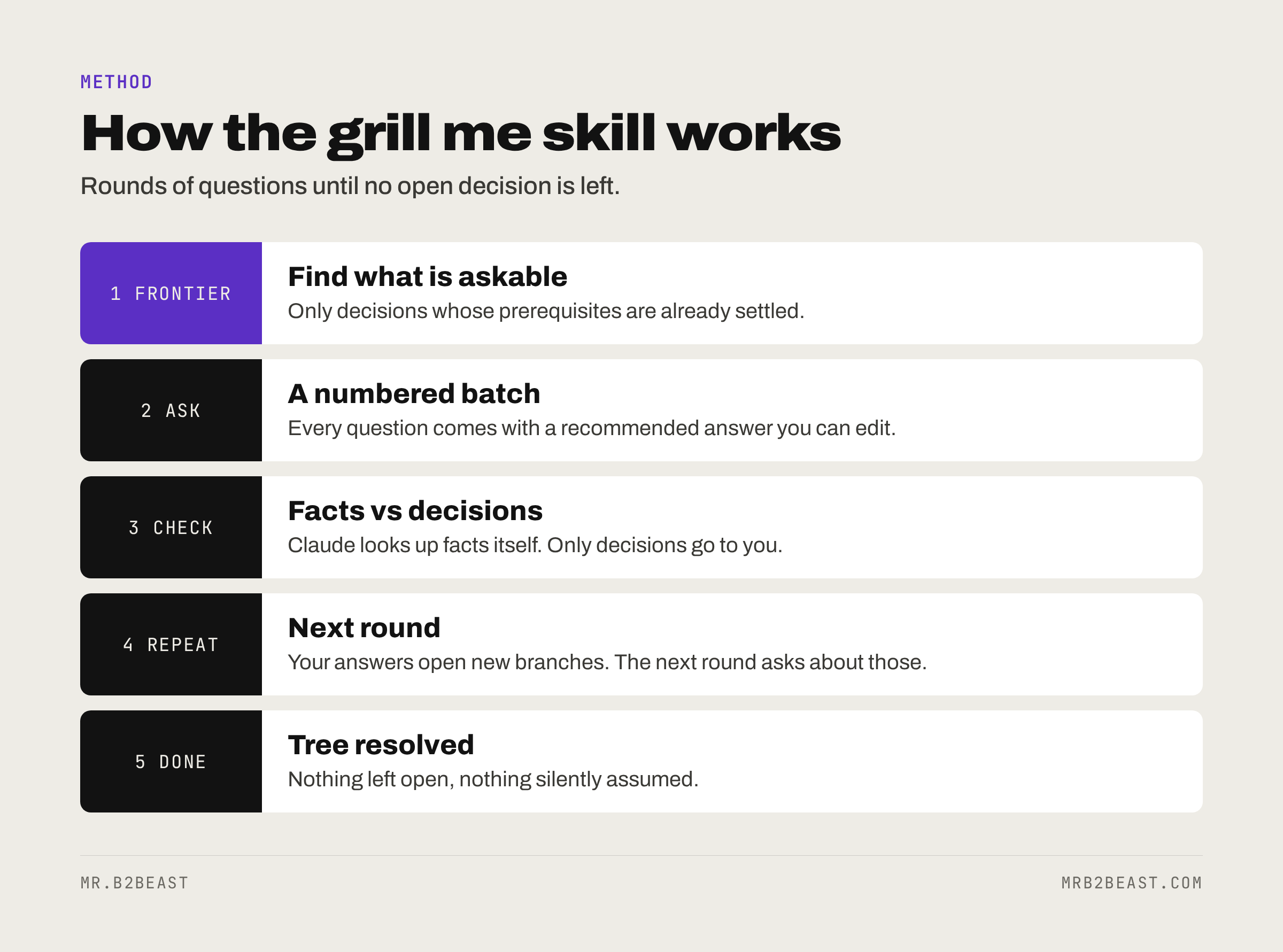
From there the skill works in rounds:
- Find the frontier. Claude looks for the decisions whose prerequisites are already settled. Those are the only ones it can ask about right now.
- Ask a numbered batch. Each question comes with a recommended answer. You can accept it, change it or throw it out.
- Look up facts, ask for decisions. If the answer is a fact about the environment, like what the code already does, Claude checks it itself instead of asking you. Only real decisions go to you.
- Wait, then go again. Your answers settle some branches and open new ones. The next round asks about those.
- Stop when the tree is done. The session ends when no open decision is left and nothing is silently assumed. Claude confirms the shared understanding before it acts.
The recommended answers matter more than they look. They turn every question into a quick yes, no or edit, instead of a blank page. In my session, all 11 answers were my decisions. The method still puts a suggestion on every question, so I was reacting, not inventing from zero.
Grill me vs grill with docs
The two skills share the interview. They differ in what is left when it ends.
| Grill me | Grill with docs | |
|---|---|---|
| Best for | Plans and designs, including non-code work | Code work in a repo |
| Output | A shared understanding in the conversation | The same, plus a glossary and decision records in the repo |
| Glossary | No | Yes, a GLOSSARY.md at the repo root, updated as terms are settled |
| Decision records | No | Only for decisions that are hard to reverse, surprising without context and the result of a real trade-off |
| Checks against the code | Facts are looked up when needed | Flags it when the code contradicts what you describe |
Use grill me when the thing you are planning lives in your head: a launch, an article series, a weekly routine. Use grill with docs when the plan touches a codebase, and especially when more than one person or agent works in it.
A note on the glossary: it holds vocabulary only. No implementation details, no specs. That keeps it short enough that an agent can read it at the start of every session.
How to install and run it
The repo README gives one command for Claude Code, which installs the whole collection as a plugin:
claude plugin install mattpocock-skills@claude-plugins-official
For other agents, the README lists npx skills@latest add mattpocock/skills. The engineering skills, including grill with docs, expect a one-time setup per repo with /setup-matt-pocock-skills, which asks where your docs should live.
Then the run is simple:
- Open the repo and describe what you want to plan or clean up, in one or two sentences.
- Call grill me or grill with docs by its slash command.
- Answer each round. Accept, edit or reject the suggestions. Say "I don't know yet" when that is the truth.
- Read what changed. With grill with docs, check the glossary diff before you commit it.
Plan for real attention. A round is fast to read but slow to answer well, because each answer is a decision someone will build on.
What 11 questions changed in my repo
My repo is not a typical codebase. It is the operating base for my account: several agents run headless on a schedule on my own server, and every one of them reads the same instructions. The AI operating system article shows the whole setup.
That makes words expensive. If two files use two names for one thing, or one name for two things, an agent will pick one meaning and act on it. No error, no warning. Just a quietly wrong result.
So I ran grill with docs with one goal: one word per thing.
- 3 rounds. Each round built on the last. Later questions only made sense once earlier names were fixed.
- 11 questions. Each was a naming decision, and I decided every one of them.
- 52 terms. That is what the glossary holds now, one word per thing.
The "Spontan-Slot" case is the one I keep coming back to. Claude's suggestion was reasonable. "Free slot" describes the gap well. But the code already used that name for something else. A template would have taken the reasonable name and moved on. The interview put the name next to what already existed, and the collision came up while it was still a question.
What this does not prove: that the glossary makes the agents better at their jobs. It removes one class of mistake, two meanings for one word. Whether that shows up in the output is something I can only judge over weeks, not from one session.
When an interview beats a template
Templates are good when the questions are known and stable: a bug report, a weekly review, a checklist that has worked fifty times. The Claude Code best practices piece covers where written instructions earn their place.
An interview wins in three situations:
- The plan is new. You do not know which questions matter yet. A template written by someone else knows even less about your case.
- The words are drifting. Several people, or several agents, use different names for the same thing. That is where grill with docs pays off fastest. If you run more than one agent in a repo, the Claude Code subagents article shows why shared terms matter there too.
- The cost of a wrong assumption is high. Every question is a chance to say "wait, no" before anything is built.
And where it is the wrong tool: small, clear tasks. If you know exactly what you want, an interview is overhead. Ask for the thing.
FAQ
What is the grill me skill? Grill me is a Claude skill from Matt Pocock's open source skills repo. It makes Claude interview you about a plan or design in rounds of numbered questions, each with a recommended answer, until every open decision is settled. It only runs when you call it.
What is the difference between grill me and grill with docs?
Both run the same interview. Grill me leaves the result in the conversation. Grill with docs also writes settled terms into a GLOSSARY.md and records hard-to-reverse decisions, which makes it the better fit for work inside a code repo.
Does grill me work outside Claude Code?
The skills repo lists install commands for other coding agents as well, via npx skills@latest add mattpocock/skills. The interview itself is plain text, so it works anywhere the skill can load. Check the repo README for the current list of supported agents.
How long does a grill me session take? It depends on the size of the plan. My glossary session took 3 rounds and 11 questions. Small plans may need one round, large designs several. Answering well takes longer than reading the questions.
About the author
Tristan Eilenburg. One person. AI systems. Global reach. I write about building systems that work, with evidence instead of hype.
- X: @MrB2Beast
- LinkedIn: Tristan Eilenburg
- Instagram: @mrb2beast
The newsletter goes out once a week. If this one taught you something, the newsletter is where the next one lands first.
Sources
- Pocock, M. Skills for Real Engineers (MIT license). GitHub. https://github.com/mattpocock/skills
- Pocock, M. grill-me skill file. GitHub. https://github.com/mattpocock/skills/blob/main/skills/productivity/grill-me/SKILL.md
- Pocock, M. grill-with-docs skill file. GitHub. https://github.com/mattpocock/skills/blob/main/skills/engineering/grill-with-docs/SKILL.md
- Pocock, M. grilling skill file. GitHub. https://github.com/mattpocock/skills/blob/main/skills/productivity/grilling/SKILL.md
- Pocock, M. domain-modeling skill file. GitHub. https://github.com/mattpocock/skills/blob/main/skills/engineering/domain-modeling/SKILL.md
- Anthropic. Extend Claude with skills. Claude Code documentation. https://code.claude.com/docs/en/skills