Claude Marketing Skills: The Three Behind My Graphics and Pages
A pack of fifty marketing skills gives Claude opinions. Three skills that hold your own rules give it a way of working.
Search for Claude marketing skills and you get lists. Twenty skills for launches. Fifty-three skills for SEO, copy and ads. Each one promises to turn Claude into a marketing team.
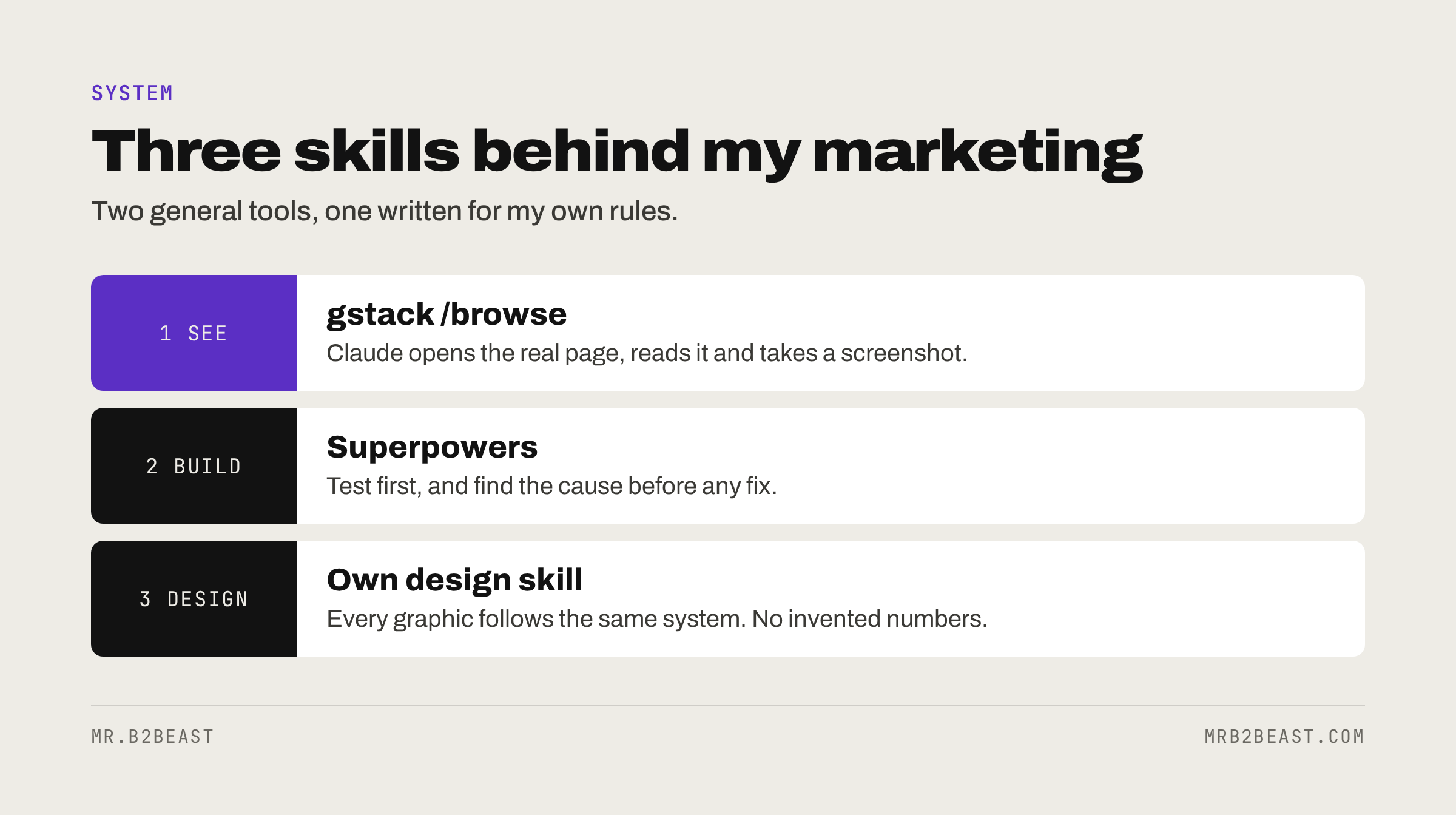
I run my site and the marketing around it mostly alone, and I use three skills. One lets Claude look at real pages in a browser. One makes Claude build and fix things in a disciplined way. One holds my design system, and every graphic I make goes through it.
None of the three came from a marketing pack. That is the point of this article.
If you want to know what a skill is in the first place, start with Claude skills explained. This piece is the next step: which skills actually do marketing work, what the popular packs are good for, and how to write the one skill no pack can give you.
Key takeaways
- The big marketing packs are good starting points for method: audits, copy frameworks, campaign plans. They cannot hold your brand, your numbers or your rules.
- My three skills: gstack for the browser, Superpowers for building and fixing, and my own design skill for every graphic. Two are general tools, one is mine.
- The highest value marketing skill is the one you write yourself: the rules you keep correcting, split into small files, with a hard rule against invented numbers.
What Claude marketing skills are, and what they are not
A skill is a folder with a SKILL.md file. The top of the file holds a name and a description. Claude reads every description at the start of a session and loads the full instructions only when a task matches. In Claude Code, personal skills live in ~/.claude/skills/ and project skills in .claude/skills/ inside the repository.
A marketing skill is the same thing pointed at marketing work: how to write a landing page, how to audit a page for search, how to keep a brand voice. Nothing about the format is special.
Two things a marketing skill is not:
- Not access. A skill cannot post, schedule or pull analytics on its own. That needs a connection to the tool, usually an MCP server or a script. My guide to Claude MCP covers that side, including the scheduler I connect to.
- Not taste. A skill makes Claude more consistent. It does not make Claude know your audience. If the rules inside the skill are generic, the output is generic, just more reliably so.
Keep those two limits in mind when you read any list of the best skills.
Claude skills for marketing you can install today
Three public options come up again and again. I checked each one at the source.
| Pack | Who | What is inside | Good for |
|---|---|---|---|
| marketingskills | Corey Haines, MIT license | 53 skills across SEO, conversion, copy, paid, growth, strategy and sales | Method for one task at a time |
| Marketing plugin | Anthropic, knowledge-work-plugins | 5 skills and 7 commands, such as /draft-content, /brand-review, /seo-audit | Teams with a brand guide and connected tools |
| brand-guidelines | Anthropic, example skills repo | Anthropic's own colors and fonts, applied to any artifact | A template for your own brand skill |
Corey Haines' marketingskills is the broadest. One design choice stands out: a product-marketing skill is the foundation, and the other skills check its context file first to learn your product, audience and positioning. That is the right idea. A copy skill that does not know who you sell to writes for everyone.
Anthropic's marketing plugin bundles skills for content creation, campaign planning, brand voice, competitive analysis and performance analytics, plus commands that call them. It lists connectors for tools like Canva, Figma, HubSpot, Notion and Ahrefs. Without those connections, it is a set of good templates.
Anthropic's brand-guidelines skill is the most useful for a solo builder, and not because of what it does. It shows the pattern: one skill that applies one brand's colors and type to whatever Claude makes. Swap in your own rules and you have the start of a design skill.
My take after reading all three: install a pack to learn how a good skill is written, then delete what you do not trigger. Every installed skill puts its description into Claude's context, used or not. Fifty-three descriptions are a cost you pay in every session.
The three skills behind my marketing
Here is what actually runs behind my graphics and pages. Two are general tools that happen to do marketing work. One is mine.
1. gstack: let Claude see the page
gstack is an open source set of skills by Garry Tan, under the MIT license. Most of it is aimed at engineering: plan reviews, code review, QA, shipping. I use one command from it, /browse.
/browse gives Claude a real browser. I use it whenever Claude needs to look at a web page: open it, read it, take a screenshot.
Why that matters for marketing: most marketing mistakes are visible, not logical. A headline that wraps badly on mobile. A cover image that did not load. A page that looks fine in the code and broken on screen. Without a browser, Claude guesses what a page shows from its source. With /browse, it checks.
What it replaces: opening the page by hand, taking a screenshot and pasting it into the chat.
2. Superpowers: build and fix with discipline
Superpowers is a skill library for coding agents by Jesse Vincent and the team at Prime Radiant, also MIT licensed. I use two of its workflows: building test first, and debugging systematically.
Test first means Claude writes a failing test, watches it fail, then writes the smallest code that makes it pass. Systematic debugging is a four-phase root cause process: Claude has to find the cause before it is allowed to propose a fix.
Neither sounds like marketing. But a solo marketing setup is mostly small tools: a script that checks an article before it goes out, a page template, an import step. When one of them breaks, the usual AI fix is a guess that moves the problem somewhere else. Superpowers slows Claude down in exactly the places where guessing is expensive.
What it replaces: typing "find the cause first, do not just patch it" in every debugging session.
3. My own design skill: every graphic, same system
This is the skill that does the most marketing work, and it is the one nobody else could have written. Every graphic I make goes through it. It holds the rules of my design system, so a new graphic follows the same system as the last one.
The structure is simple:
- A short SKILL.md with the brand in one line, the voice in one line and a workflow for any asset: identify the format, pick the content pillar, choose the background, lay it out, check sizes and contrast.
- A tokens file with every color, font size and spacing value, so nothing is picked by eye.
- A rules file with the hard rules and a do and don't list.
- A recipes file with sizes for each format, from a social card to a thumbnail to a website section.
- A diagram file for the simple schematic style I use to show how a system works.
The SKILL.md itself stays short and points to the other files, so Claude only opens the recipe it needs. That follows the official advice to keep SKILL.md under 500 lines and move detail into separate files.
The most important rule is a single line: never invent numbers, and leave a slot empty when there is no real number for it. A graphic with a made-up statistic looks professional and is worse than no graphic. Generic marketing skills cannot carry that rule for you, because they do not know which of your numbers are real.
What it replaces: a brand guide in a PDF that nobody opens, and fixing the same mistakes on every image by hand.
Claude SEO skills: where a script beats a skill
The second most searched version of this topic is Claude SEO skills, and both packs above have them. Corey Haines' pack has an seo-audit and an ai-seo skill, among others. Anthropic's plugin has an /seo-audit command that covers keyword research, on-page analysis, content gaps, technical checks and competitor comparison.
They are useful for method: what to check on a page, in what order, and why. Where they need help is data. A skill knows how to read search volume and competitor pages. It does not have them.
My own split is deliberate. My SEO data comes from DataForSEO, and I run it by script instead of MCP, so that every query is logged with its cost. The script handles access and keeps the books.
That is the general rule I would give anyone building Claude SEO skills:
- Put the method in the skill. Checklists, scoring rules, what a good title looks like.
- Put paid or sensitive data access in a script or an MCP server. Something you can log, limit and audit.
- Never let the skill make up the data. If the numbers are missing, the skill should say so.
If you want to see how that thinking applies to the rest of a one-person setup, my list of Claude Code use cases goes through the jobs one by one.
How to build your own Claude marketing skill in five steps
The pack gives you method. Your own skill gives you rules. Here is how I would build the first one.
Step 1: Pick the asset you ship every week. A social card, a newsletter, a landing page section. Something frequent enough that a skill pays back fast.
Step 2: List what you keep correcting. Look at your last five versions of that asset and write down every fix you made by hand. Wrong color, too much text, a number without a source. Those fixes are your rules.
Step 3: Split it into small files. A short SKILL.md with the workflow and a description in the words you actually use ("use whenever I ask for a graphic, card or thumbnail"). Separate files for values, rules and per-format recipes. Claude opens only what it needs.
Step 4: Add the guardrails. At minimum: no invented numbers, and an empty slot instead of a guess. If the skill does anything with side effects, set disable-model-invocation: true so only you can start it.
Step 5: Test on last week's work. Give Claude the brief for something you already made by hand and compare. Every difference is either a missing rule or a rule that is wrong. Fix the file, not the output.
Then leave it alone for a while. A skill freezes a process. If the process is still changing every week, keep doing it by hand. Write the process, run it, then automate it. And when you are not sure what your terms or rules even are, an interview with the grill me skill is a fast way to settle them before you write anything down.
Where marketing skills fall short
Skills are good at consistency. They are weak at everything else marketing needs.
- Judgment. A skill can enforce a headline length. It cannot tell you which idea your audience cares about this week.
- Fresh data. Skills are static text. Anything that changes, such as rankings, follower counts or prices, has to come from a tool at the time of use.
- Voice from someone else. A brand voice skill written for a generic company writes like a generic company. The voice rules have to come from your own best work.
- Trust. A skill can include scripts that run on your machine. Read any skill before the first run, and install only from sources you know. The Claude Code best practices piece covers the rest of my safety habits.
The honest summary: three skills did not make my marketing better on their own. They made it repeatable, so the time goes into the ideas instead of into fixing the same mistakes again.
FAQ
What are the best Claude marketing skills? For broad method, Corey Haines' marketingskills pack and Anthropic's marketing plugin are the two most complete public options. For daily work, the best skill is usually your own: a design or brand skill with the rules you keep correcting. I use three: gstack for the browser, Superpowers for building and fixing, and my own design skill.
Are there Claude SEO skills?
Yes. Corey Haines' pack includes skills such as seo-audit and ai-seo, and Anthropic's marketing plugin has an /seo-audit command. They give Claude a method for audits and content gaps. The data itself, like search volume and competitor pages, still has to come from a connected tool or a script.
How do I add marketing skills to Claude Code?
Put a skill folder with a SKILL.md file in ~/.claude/skills/ for all projects or in .claude/skills/ inside one repository. Packs can also be installed as plugins, and their skills then show up under the plugin's name. Check each pack's README for its current install command.
Can Claude skills post to social media for me? Not on their own. A skill holds instructions, not access. To schedule or publish, Claude needs a connection to the tool, such as an MCP server or a script with an API key, and you should decide which actions it may take without asking.
About the author
Tristan Eilenburg. One person. AI systems. Global reach. I write about building systems that work, with evidence instead of hype.
- X: @MrB2Beast
- LinkedIn: Tristan Eilenburg
- Instagram: @mrb2beast
The newsletter goes out once a week. If this one taught you something, the newsletter is where the next one lands first.
Sources
- Haines, C. marketingskills (MIT license). GitHub. https://github.com/coreyhaines31/marketingskills
- Anthropic. knowledge-work-plugins: marketing plugin. GitHub. https://github.com/anthropics/knowledge-work-plugins/tree/main/marketing
- Anthropic. brand-guidelines skill. GitHub. https://github.com/anthropics/skills/blob/main/skills/brand-guidelines/SKILL.md
- Tan, G. gstack (MIT license). GitHub. https://github.com/garrytan/gstack
- Vincent, J., Prime Radiant. Superpowers (MIT license). GitHub. https://github.com/obra/superpowers
- Anthropic (2026). Extend Claude with skills. Claude Code documentation. https://code.claude.com/docs/en/skills