How Long Does It Take to Form a Habit? Not 21 Days, and Not Exactly 66 Either
The 21-day rule was never about habits. The 66-day number is more fragile than people think. Here is what the data says.

Ask how long it takes to form a habit and most people say 21 days. That number has a source. It is a plastic surgeon.
In the preface of his 1960 book Psycho-Cybernetics, Maxwell Maltz wrote that patients needed about 21 days to get used to a new face. His conclusion was that it takes "a minimum of about 21 days" for an old mental image to change. He was talking about adjusting to change, not building a habit. And he wrote minimum, not deadline.
Somewhere along the way, "minimum" got lost and "self-image" turned into "habit."
The idea is not stupid. A clear time frame helps you start. It is just the wrong time frame, and it sets you up to quit right before things get easier.
I want to show you where the 21 days came from and what the studies found instead. I want to show you why the famous replacement number, 66 days, describes fewer people than you think. And I want to give you a system that plans for the real timeline, one you can start this week.
Key takeaways
- The 21-day rule comes from Maxwell Maltz and his plastic surgery patients in 1960. It was about getting used to change, not about forming habits.
- The best-known study found a median of 66 days, with a range of 18 to 254 days. That median is based on 39 of 96 volunteers.
- Missing one day did not materially hurt habit formation. Judge a habit by how automatic it feels, not by your streak.
What the research actually shows
The common belief is simple: do something every day for three weeks and it sticks. Many "21-day challenges" are built on exactly that promise.
Habit researchers at University College London went looking for the source in 2012. Behavioural scientist Benjamin Gardner traced it to the Maltz preface. In his reading, the 21 days "may perhaps apply to adjustment to plastic surgery." For habit formation, he called it unfounded.
The study behind the 66 days
The study that replaced the myth was published in the European Journal of Social Psychology. Phillippa Lally and colleagues at UCL asked 96 volunteers to pick one new eating, drinking or activity behaviour. Each person did it daily in the same context, for example "after breakfast," for 12 weeks.
Every day, they rated how automatic the behaviour felt. The researchers then fitted a curve to the scores of each person. Automaticity rose fast at first, then flattened out toward a plateau.
The median time to reach 95 percent of that plateau was 66 days. The range went from 18 to 254 days.
What is automaticity? Automaticity is the part of a habit that runs without a decision. Researchers measure it with short questionnaires that ask whether you do something automatically, without thinking, or start before you realise it. A habit is formed when the cue triggers the action with little effort, not when you hit a number of days.
The detail nobody quotes
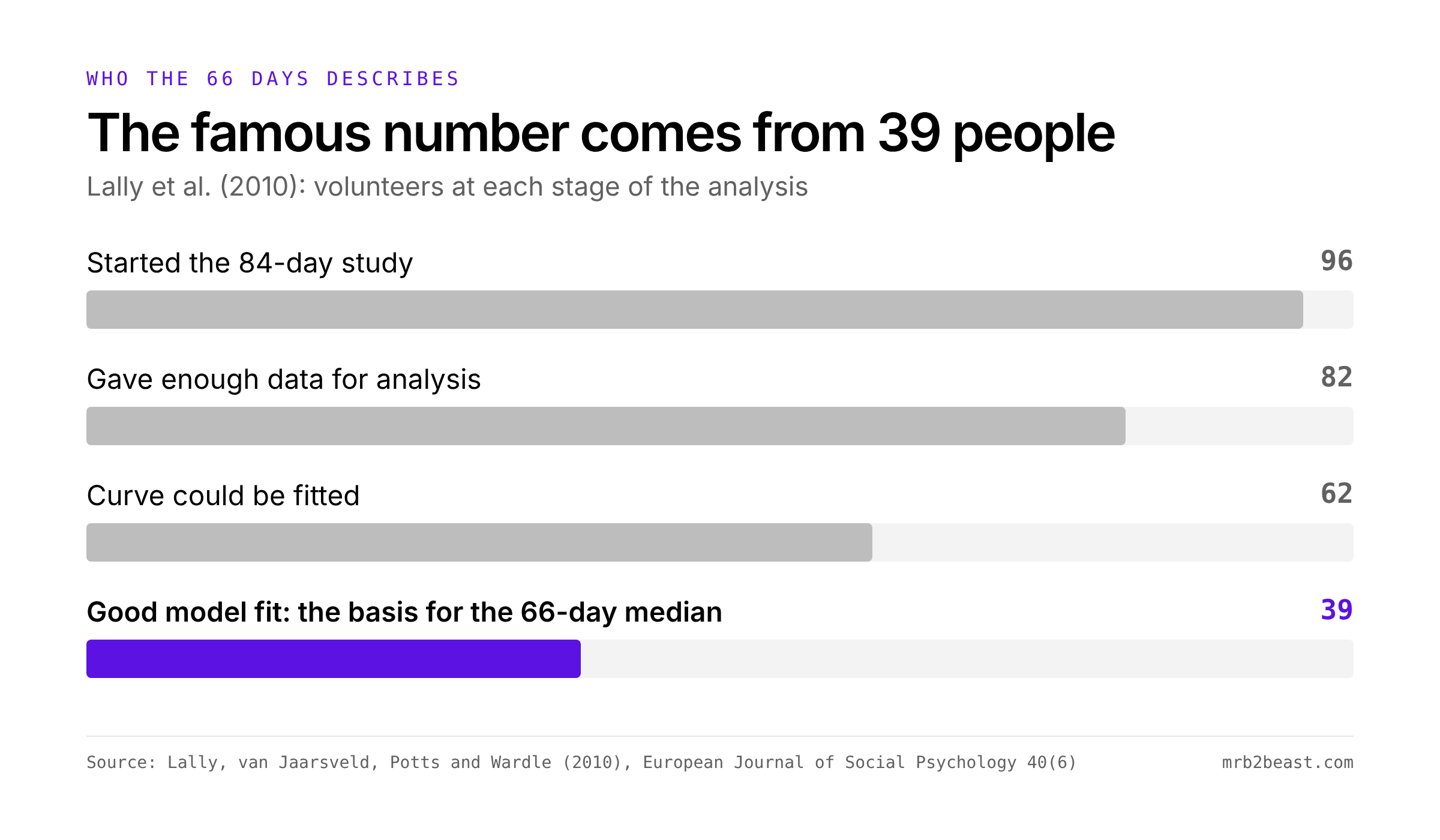
Here is where it gets interesting. According to the paper, 82 of the 96 volunteers gave enough data to analyse. The curve could be fitted for 62 of them. Only 39 showed a good fit.
The famous 66 days is the median of those 39 people. That is less than half of the people who gave enough data.
There is a second detail. The study ran for 84 days. Any estimate longer than that, including the 254 days, is a projection of the curve, not an observed finish line.
None of this makes the study bad. It was careful and honest about its limits. It just means "66 days" is a rough middle, not a promise.
What the 2024 review adds
In 2024, Singh and colleagues at the University of South Australia published a systematic review in the journal Healthcare. They found 20 studies with 2,601 participants on health habits like exercise, diet, flossing and drinking water.
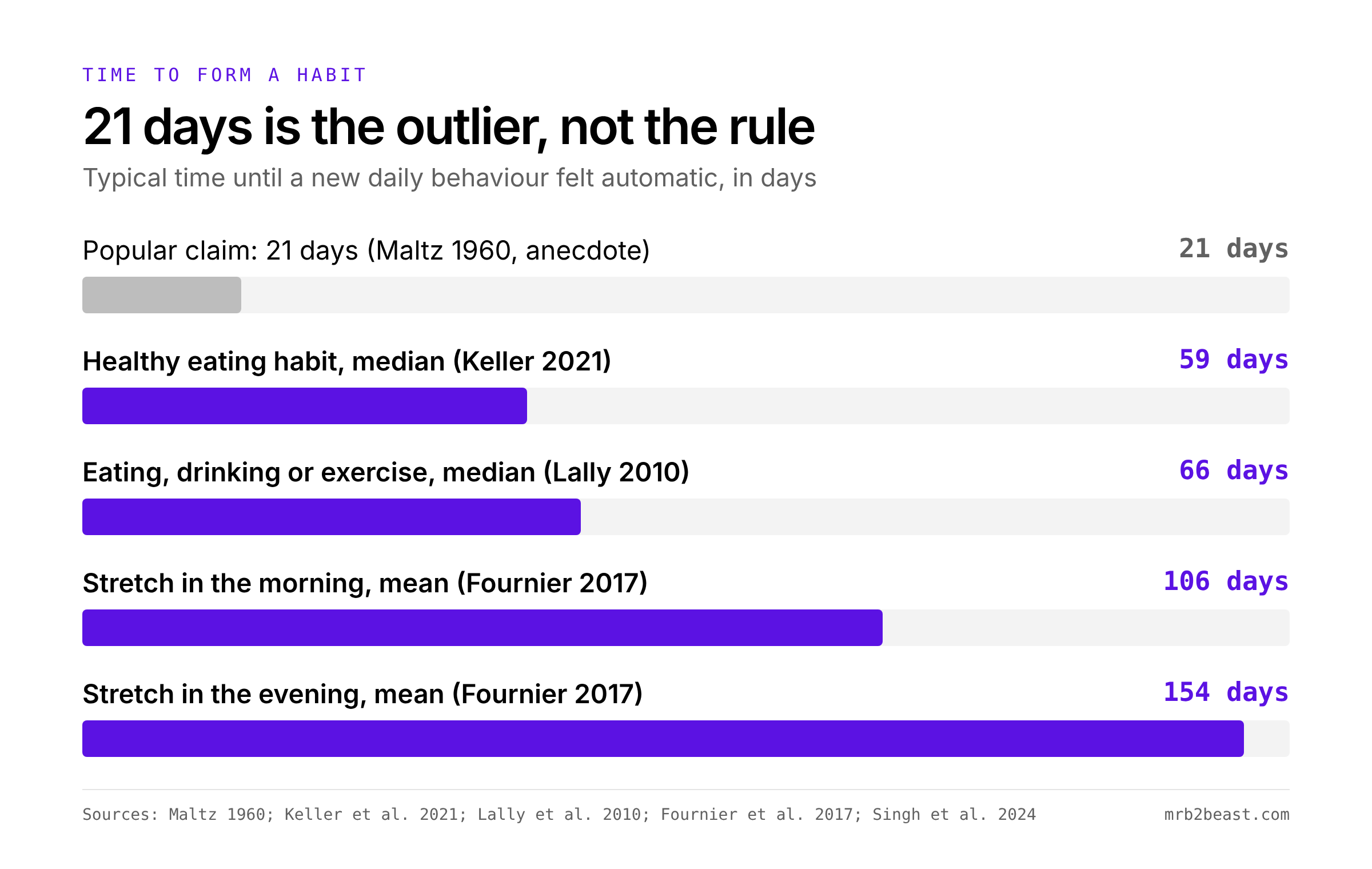
Only four of those studies reported how long habit formation took. Medians ranged from 59 to 66 days. Means ranged from 106 to 154 days. Individual times ranged from 4 to 335 days.
Two of those studies are worth a closer look.
In Keller and colleagues (2021), 192 adults tried to build a nutrition habit over 84 days. Those who formed one took a median of 59 days. But the review notes that only 23 percent of participants reached the threshold for habit formation at all.
In Fournier and colleagues (2017), 48 students practised a daily stretch for 90 days, either right after waking or before bed. Extrapolated curves put automaticity at about 106 days for the morning group and about 154 days for the evening group.
The review authors draw a plain conclusion. Most people should expect two to five months, not 21 days. Short "21-day challenges" are unlikely to be enough.
In short: 21 days is the outlier. Two months is a realistic middle. Many people need much longer, and that is normal, not failure.
The three mistakes almost everyone makes with habits
Once you know the real timeline, the usual mistakes become obvious.
Mistake 1: Treating day 21 as the finish line
Here is an example. A solo founder starts a 30-day writing challenge. She writes every morning, finishes the challenge and celebrates. By week six, she writes twice a week. By week ten, not at all.
Nothing went wrong in month one. The problem is that the challenge ended where the curve was still climbing. Lally found that early repetitions add the most automaticity. But for most people, the plateau was still weeks away.
Mistake 2: Judging the habit by the streak
Streak apps make one missed day feel like a reset to zero. That feeling is not supported by the data.
In the Lally study, missing one opportunity did not materially affect the habit formation process. Gardner, Lally and Wardle wrote in 2012 that automaticity gains soon resumed after one missed performance.
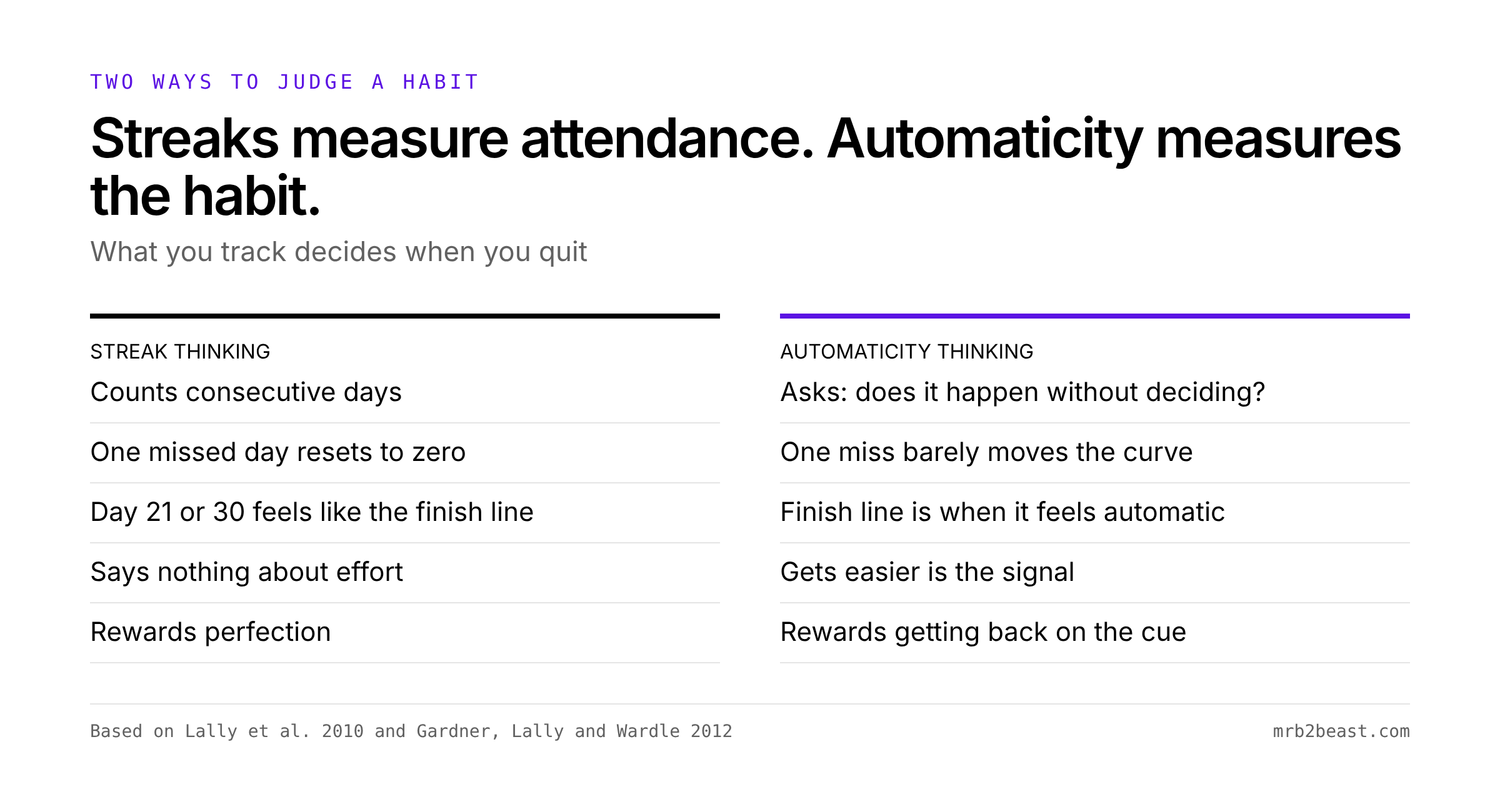
That means: the streak measures attendance. It does not measure the habit. People often quit not because they missed a day, but because the counter told them they had failed.
Mistake 3: Starting without a cue or a reason
A habit forms through context-dependent repetition: the same action in response to the same cue. "Exercise more" has no cue. "After I park the car, I walk 10 minutes" has one.
The behaviour also matters. Gardner and colleagues note that automaticity peaked faster for simple actions, like drinking water, than for more elaborate routines, like 50 sit-ups. The Singh review adds that self-chosen habits and morning practice tended to show greater habit strength.
A habit with no cue relies on memory. A habit with no reason relies on mood. Both run out long before day 66.
How to build habits: the Habit Runway
I am not saying a 21-day challenge is worthless. It is a fine start. I am saying it is a start, and you need a plan for the months after it.
Here is a system built on what the studies found.
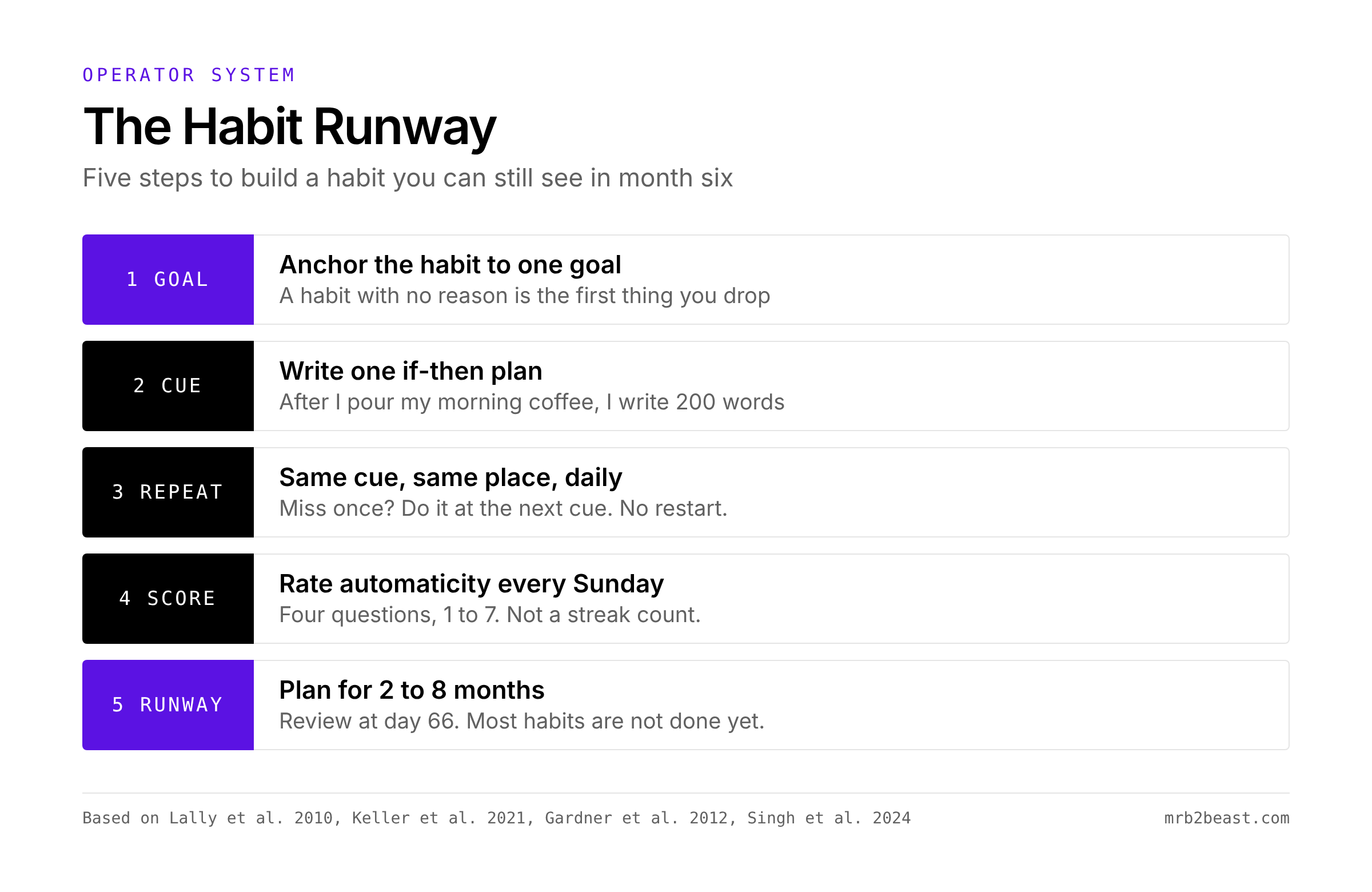
Step 1: Anchor the habit to one goal. Write down which goal the habit serves. "Write 200 words a day" serves "publish one article a week." A habit without a reason is the first thing you drop in a busy week. If you have not set the goal yet, start with how to achieve goals.
Step 2: Write one if-then plan. Pick a cue you hit every day. "If I pour my morning coffee, then I write 200 words at the kitchen table." Keller and colleagues found that routine cues and time cues worked about equally well. What mattered was repeating the plan.
Step 3: Repeat in the same context, and recover fast. Same cue, same place, every day. When you miss, do not restart a 21-day clock. Just do it at the next cue. One miss barely moves the curve. A pattern of misses does.
Step 4: Score automaticity, not the streak. Every Sunday, rate four statements from 1 to 7: I do it automatically. I do it without having to remember. I do it without thinking. I start before I realise it. When the scores stop rising and sit near the top, the habit is formed.
Step 5: Plan a runway of 2 to 8 months. Put a review on your calendar at day 66. Expect many habits to still be climbing. Budget up to eight months for anything complex, like daily exercise. The 254-day estimate in Lally is about eight months.
This is the idea behind Gaapp.io, a habit and goal tracker that links each daily habit to the bigger goal it serves and shows what is due today. Disclosure: I am building it. A paper notebook works too. The runway matters more than the tool.
Ask yourself this week:
- Which goal does my new habit serve, and can I name it in one sentence?
- What exactly is the cue, and do I hit it every single day?
- If I miss tomorrow, what do I do at the next cue?
Conclusion: plan for the curve, not the countdown
The 21-day rule was about a new face. Your new habit needs a longer runway.
Habits do form. They form through repetition in a stable context, and they get easier over time. They just do not follow a countdown.
Plan for two months as a middle and up to eight as normal. Measure how automatic it feels. Forgive the single miss. That is the whole system.
What you learned today
- The 21-day habit rule traces to Maxwell Maltz in 1960, who wrote "a minimum of about 21 days" about adjusting to changes like plastic surgery.
- The 66-day median from Lally et al. (2010) comes from 39 of 96 volunteers, with individual estimates from 18 to 254 days.
- A 2024 systematic review found medians of 59 to 66 days and means of 106 to 154 days. One missed day does not reset the process.
FAQ
How long does it take to form a habit? It depends on the person and the behaviour. In the best-known study, the median was 66 days, with a range of 18 to 254 days. A 2024 systematic review found medians of 59 to 66 days and means of 106 to 154 days. The review authors suggest expecting two to five months for most health habits.
Is the 21 day habit rule true? No. The number traces to the 1960 book Psycho-Cybernetics by plastic surgeon Maxwell Maltz. He observed that patients took about 21 days to get used to a new face and called it a minimum. It was about adjusting to change. Habit studies since then have found much longer times.
Where does the 66 days habit number come from? It comes from Lally and colleagues (2010) at University College London. 96 volunteers repeated one daily behaviour for 12 weeks. The median time to reach 95 percent of peak automaticity was 66 days. That median is based on the 39 participants whose data fitted the model well.
What happens if you miss a day when building a habit? Very little. In the Lally study, missing one opportunity did not materially affect the habit formation process, and automaticity gains soon resumed. What matters is the overall pattern. Do the behaviour at the next cue instead of restarting a countdown.
How do you know when a habit is formed? A habit is formed when the cue triggers the behaviour with little thought or effort. Rate statements like "I do it automatically" and "I do it without thinking" each week. When the scores stop rising and stay high, the behaviour has become a habit.
About the author
Tristan Eilenburg. One person. AI systems. Global reach. I write about building systems that work, with evidence instead of hype.
- X: @MrB2Beast
- LinkedIn: Tristan Eilenburg
- Instagram: @mrb2beast
- Building Gaapp.io (Instagram: @gaapp.io)
I write one of these every week. If this one taught you something, the newsletter is where the next one lands first.
Sources
- Maltz, M. (1960). Psycho-Cybernetics. Prentice-Hall. Preface, pp. xiii-xiv, as quoted in source 2.
- Gardner, B. (2012, June 29). Busting the 21 days habit formation myth. UCL Health Chatter, Research Department of Behavioural Science and Health. https://blogs.ucl.ac.uk/bsh/2012/06/29/busting-the-21-days-habit-formation-myth/
- Lally, P., van Jaarsveld, C. H. M., Potts, H. W. W., and Wardle, J. (2010). How are habits formed: Modelling habit formation in the real world. European Journal of Social Psychology, 40(6), 998-1009. https://doi.org/10.1002/ejsp.674
- Singh, B., Murphy, A., Maher, C., and Smith, A. E. (2024). Time to Form a Habit: A Systematic Review and Meta-Analysis of Health Behaviour Habit Formation and Its Determinants. Healthcare, 12(23), 2488. https://doi.org/10.3390/healthcare12232488
- Keller, J., Kwasnicka, D., Klaiber, P., Sichert, L., Lally, P., and Fleig, L. (2021). Habit formation following routine-based versus time-based cue planning: A randomized controlled trial. British Journal of Health Psychology, 26(3), 807-824. https://doi.org/10.1111/bjhp.12504
- Fournier, M., d'Arripe-Longueville, F., Rovere, C., Easthope, C. S., Schwabe, L., El Methni, J., and Radel, R. (2017). Effects of circadian cortisol on the development of a health habit. Health Psychology, 36(11), 1059-1064. https://doi.org/10.1037/hea0000510
- Gardner, B., Lally, P., and Wardle, J. (2012). Making health habitual: the psychology of "habit-formation" and general practice. British Journal of General Practice, 62(605), 664-666. https://pmc.ncbi.nlm.nih.gov/articles/PMC3505409/
- Gardner, B., Abraham, C., Lally, P., and de Bruijn, G.-J. (2012). Towards parsimony in habit measurement: Testing the convergent and predictive validity of an automaticity subscale of the Self-Report Habit Index. International Journal of Behavioral Nutrition and Physical Activity, 9, 102. https://doi.org/10.1186/1479-5868-9-102