Keeping Your Goals Secret Is Half Wrong. Should You Share Your Goals?
Why the famous "keep your goals to yourself" study is real, smaller than you think, and only half the story.

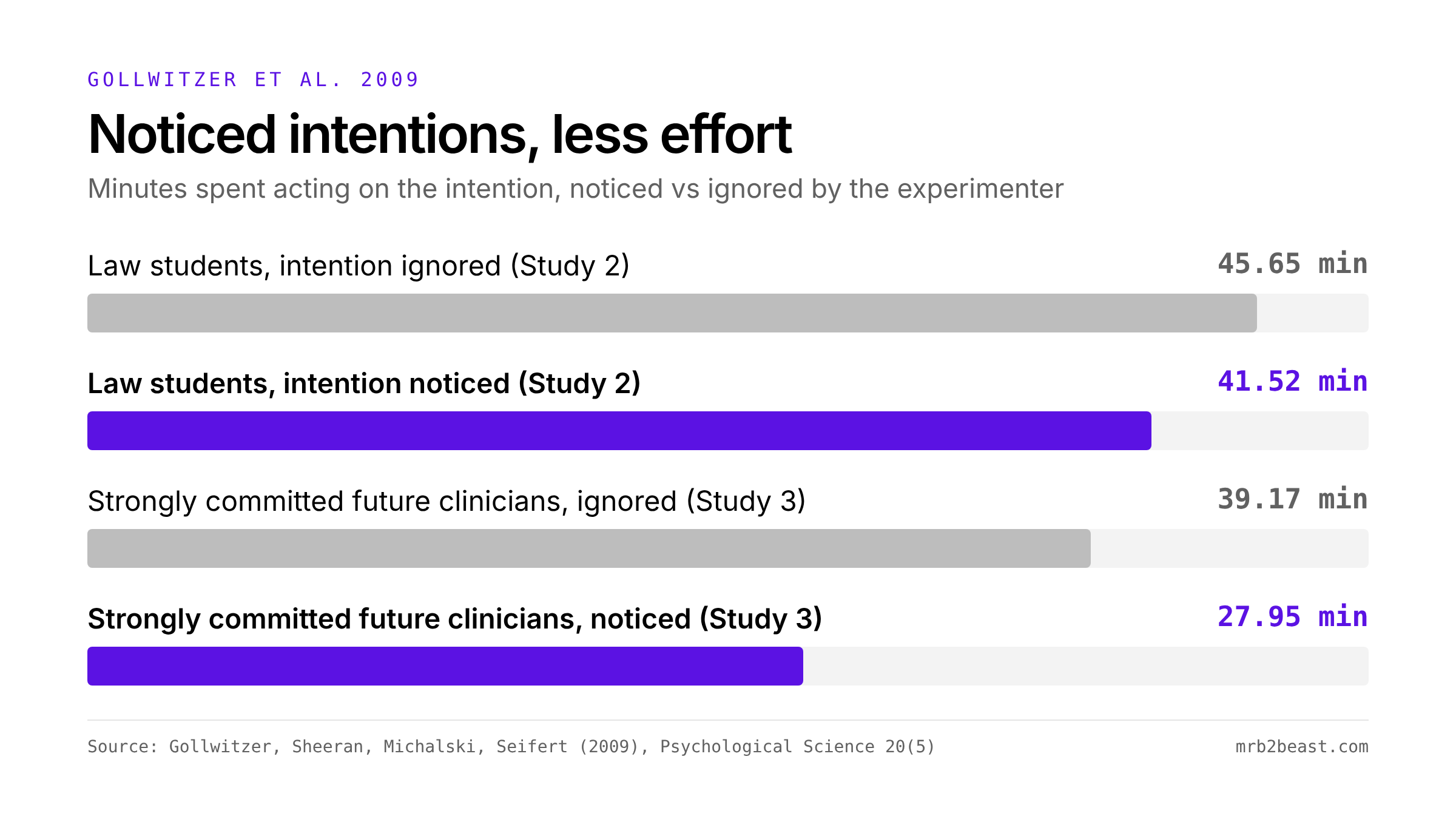
In 2009, Peter Gollwitzer and colleagues published a study in Psychological Science. Law students whose study intention was noticed by an experimenter worked on law cases for 41.52 minutes. Students whose intention stayed private worked 45.65 minutes.
That gap of about four minutes became one of the most shared pieces of goal advice online: keep your goals to yourself.
Eleven years later, a study in the Journal of Applied Psychology found the opposite. People who told their goal to someone of higher status were more committed and performed better.
So should you share your goals? Both studies are real. They just answer different questions.
The advice to stay quiet is not stupid. It is just aimed at the wrong thing. The problem is not telling people. The problem is what you tell, and who hears it.
I want to show you what the 2009 study actually measured, and what its own authors suggested as the fix. I want to show you the research that points the other way. And I want to give you a simple system for who to tell, what to tell and when.
Key takeaways
- The 2009 study is real, but small. The famous TED version of it overstated the gap by about three times.
- Sharing a goal with someone of higher status, whose opinion you value, raised commitment and performance in four studies.
- Reporting progress to someone roughly doubled the effect of tracking alone, across 95 studies in a meta-analysis.
What the research actually shows
The common belief comes from one place. In 2010, Derek Sivers gave a short TED talk called "Keep your goals to yourself." It has been watched millions of times.
His argument: when you tell people your goal, their recognition feels like progress. Your brain takes the talk as a substitute for the work. So you do less.
That idea has a real basis. But the details matter.
The 2009 study, read closely
Gollwitzer, Paschal Sheeran, Verena Michalski and Andrea Seifert ran four small experiments with German university students. In total, 168 students took part, and some were excluded before analysis.
The design was subtle. In the first three studies, nobody announced a goal to a room. In the "noticed" condition, the experimenter simply read the written intention and acknowledged it. In the "ignored" condition, the page was treated as anonymous or discarded.
In Study 2, 32 law students wrote that they intended to make the most of learning opportunities in law. Then they got 45 minutes to work on criminal law cases, with permission to stop early. Noticed intentions: 41.52 minutes. Ignored intentions: 45.65 minutes.
In Study 3, aspiring clinical psychologists could watch a 40-minute therapy video. Among the most committed students, those whose intention was noticed watched 27.95 minutes. Those whose intention was ignored watched 39.17 minutes.
Study 4 tested the mechanism. Law students who told the group their career intentions felt more like a jurist afterwards. Their commitment did not change. Only the feeling of already being there did.
What is self-completion theory? Self-completion theory, from Robert Wicklund and Peter Gollwitzer, says people pursue identities like "lawyer" or "writer" by collecting symbols of them. A degree is a symbol. So is a public statement. When others recognize a symbol, you feel more complete, and the urge to keep working drops. The 2009 paper calls this a "premature sense of completeness."
Now three details that rarely make it into the posts.
First, the effect appeared only in people strongly committed to the identity. In Study 3, students with weak commitment showed no difference at all: 30.68 versus 30.90 minutes.
Second, the numbers in the famous talk are not the numbers in the paper. Sivers described people who announced their goal quitting after 33 minutes, while the others used all 45. The paper reports 41.52 versus 45.65. Ian Ayres pointed out this gap on the Freakonomics blog in October 2010.
Third, the authors did not conclude that you should stay silent. In their discussion, they asked how committed people could escape the effect. Their ideas: consider the power of the audience, state the intention with specific standards so others can check it, and add an if-then plan.
In other words, the paper that launched "keep your goals to yourself" proposed a version of the opposite.
The study that points the other way
In 2020, Howard Klein, Robert Lount and two colleagues published four studies on exactly that open question: does it matter who hears your goal?
In one experiment, 171 undergraduates moved an on-screen slider to the number 50 as many times as they could. Then they set and wrote down a goal for a second round. A lab assistant saw it.
For some, the assistant wore a suit and was introduced as a doctoral student and business expert. For others, the same assistant wore casual clothes and was introduced as a community college student working part time.
People who shared their goal with the higher-status version were more committed and performed better. People who shared with the lower-status version performed no better than people who told no one.
A fourth study followed 292 college students over a full semester, with grade goals. The pattern held. The mechanism was evaluation apprehension.
What is evaluation apprehension? Evaluation apprehension is the concern about how someone will judge you. It rises when the audience matters to you. In the Klein study, it explained why higher-status audiences increased goal commitment. As Klein put it in the Ohio State press release, "you need to care about the opinion of who you are telling."
Progress is a different thing to share
There is a third piece of evidence, and it is the largest. In 2016, Benjamin Harkin and colleagues combined 138 studies with 19,951 participants in Psychological Bulletin. Monitoring your progress improved goal attainment with an average effect of d = 0.40.
The table nobody quotes splits that by who saw the progress. When people monitored privately and told no one, the effect was d = 0.19. When they reported their progress to at least one other person, it was d = 0.47.
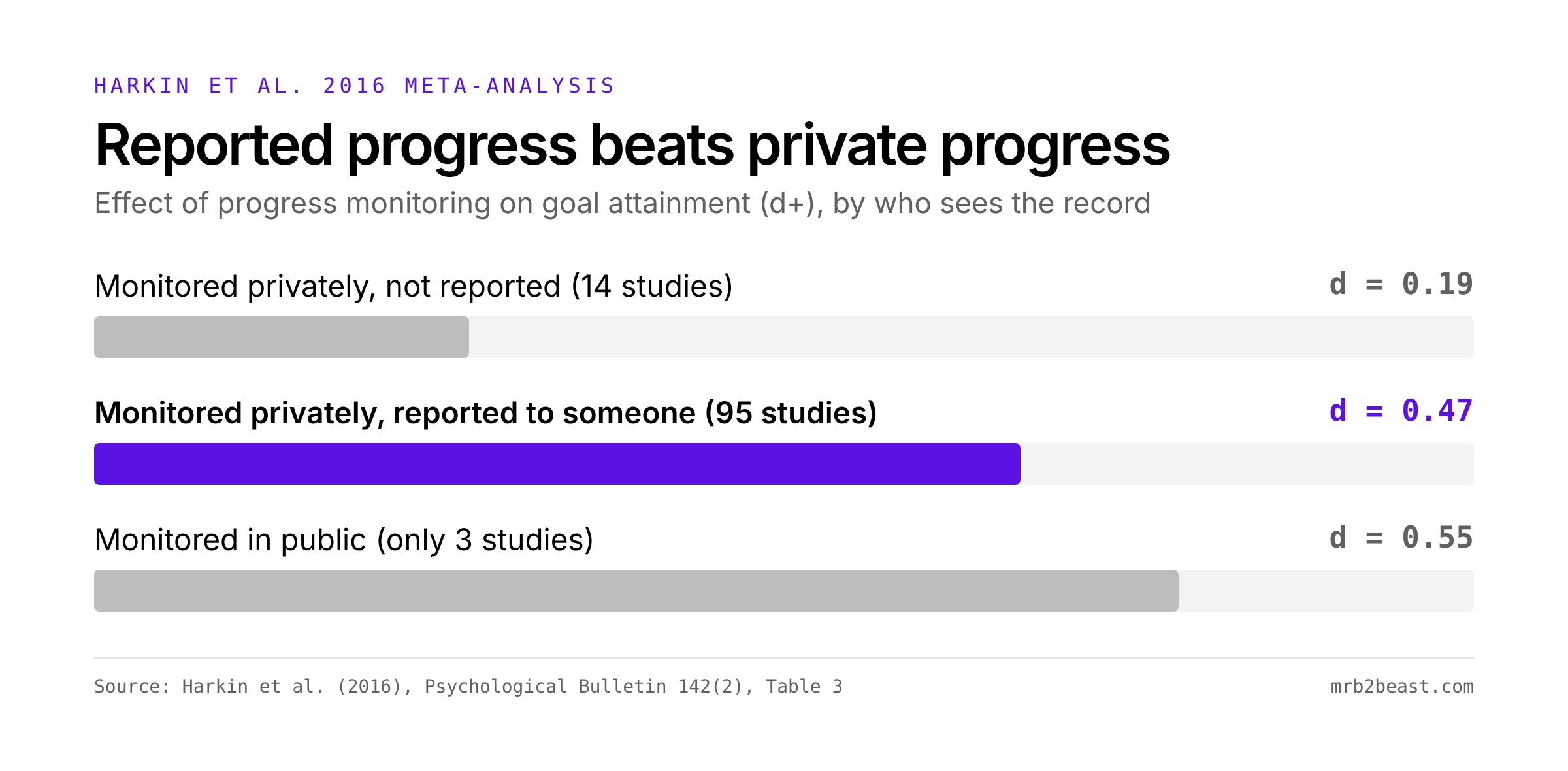
Monitoring in public scored d = 0.55, but that rests on only 3 studies. The reliable comparison is 14 private studies against 95 reported ones.
In short: telling people your goals can reduce effort when you share an identity claim with an audience that does not hold you to anything. Sharing progress with someone whose judgment you care about does the opposite.
The three mistakes people make with sharing goals
Here is an example. A solo founder decides to build a newsletter business. On Monday, she posts "Starting my journey to become a full-time creator." Two hundred likes, forty comments, a lot of "you have got this."
By Friday, she has not written a single issue. Nothing is wrong with her discipline. Every part of that post matched the conditions in the 2009 study.
Mistake 1: Sharing the identity instead of the plan
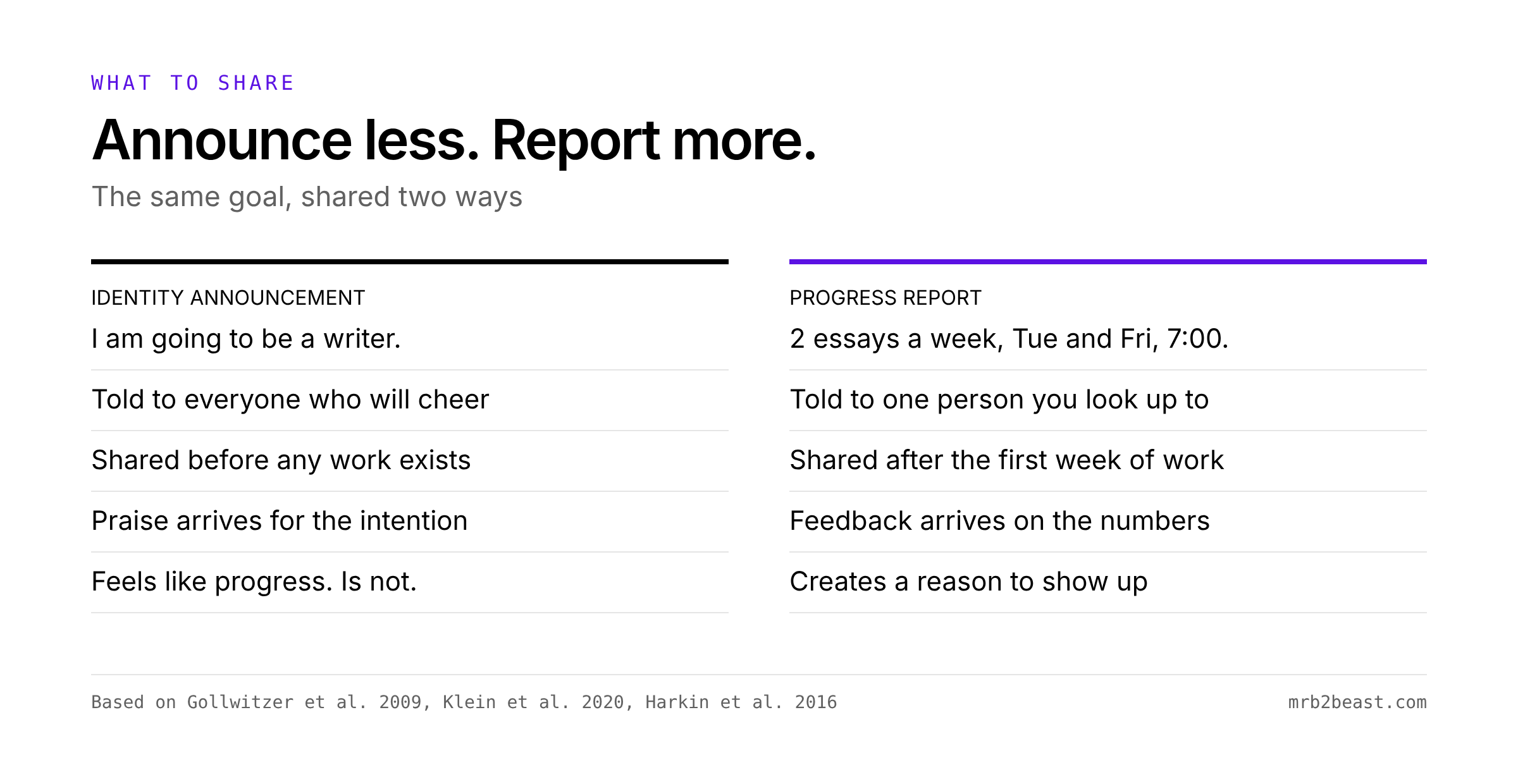
"I am becoming a creator" is an identity claim. It is exactly the kind of statement that, once acknowledged, gives the feeling of having arrived.
"Two issues a week, Tuesday and Friday at 7:00, first one out next Tuesday" is a plan. Nobody can congratulate you on becoming something from that. They can only check if it happened.
Mistake 2: Telling the wrong audience
The likes came from peers and strangers. Applause from people whose judgment you do not weigh is cheap. In the Klein study, a lower-status audience produced no benefit over telling nobody.
The person who would have helped is someone she looks up to. A mentor, an investor, a respected operator in her niche. Someone whose next question she would not want to answer badly.
Mistake 3: Going silent instead of reporting
The overcorrection is just as costly. Many people hear "keep your goals to yourself" and stop sharing anything. That throws away the strongest effect in the research: progress reported to someone.
It also explains why the generic accountability partner often fails. Two peers check in, encourage each other, and nobody risks being judged. You may also have seen a claim that a scheduled accountability meeting raises your odds to 95 percent. It is usually credited to the American Society for Training and Development, but the posts repeating it do not cite an original study.
How to share your goals: the Progress Briefing
Here is a system that avoids the setup the 2009 study warned about. It keeps what the other two lines of research found useful.
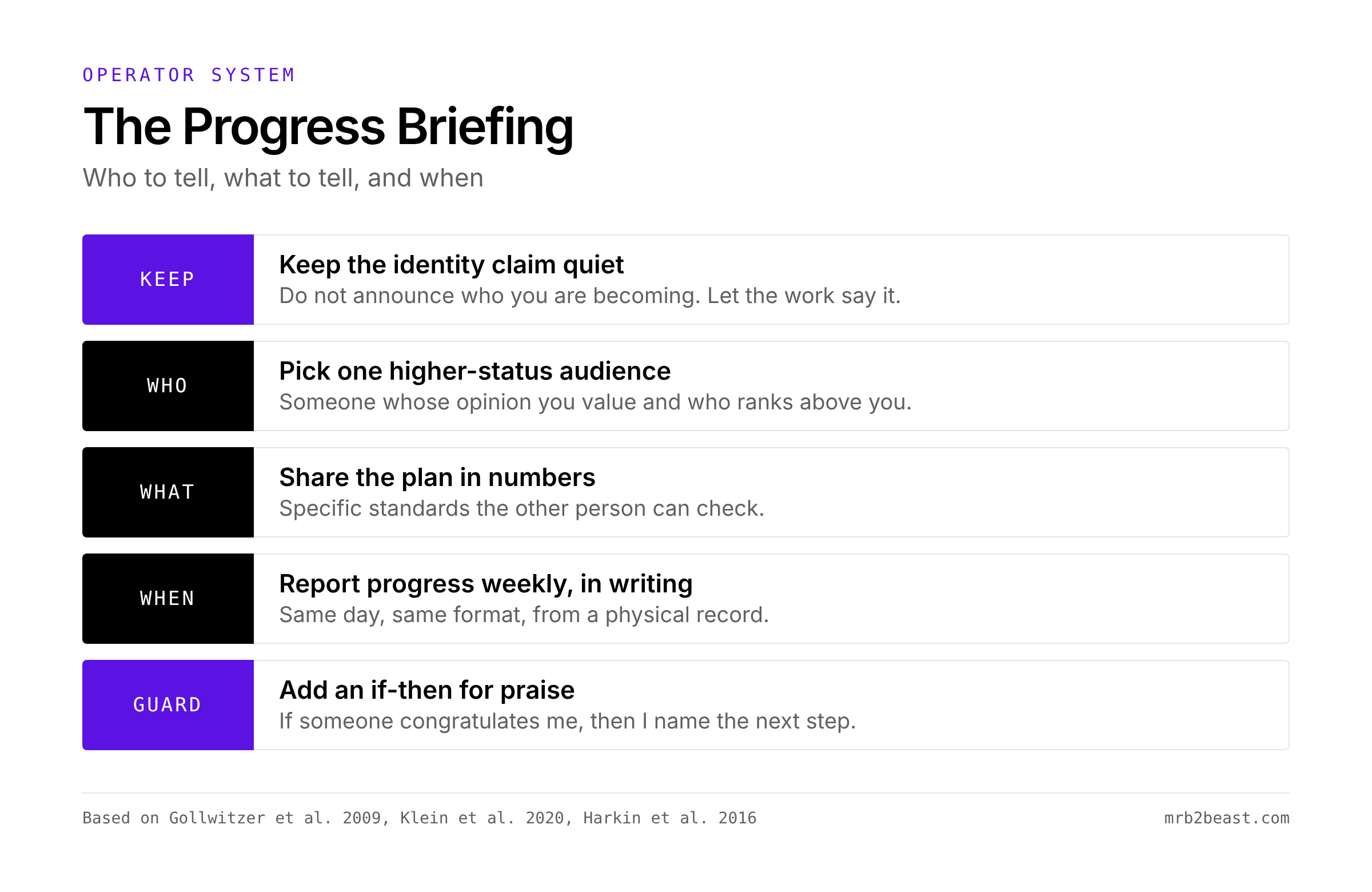
Step 1: Keep the identity claim quiet. Do not announce who you are becoming. Not on LinkedIn, not at dinner. The 2009 effect was strongest in people who cared most, which is likely you.
Step 2: Pick one higher-status audience. Choose one person whose opinion you value and who ranks above you in the area of the goal. One is enough. A boss, a mentor, a founder two stages ahead. If their judgment does not matter to you, the Klein results suggest it will not help.
Step 3: Share the plan in numbers. Tell them what you will do, how often and by when. "Ten sales calls a week, reviewed every Friday" is checkable. This is the fix the 2009 authors proposed themselves: specific standards an audience can verify.
Step 4: Report progress weekly, in writing. Same day, same format, three lines: what I planned, what I did, what is next. Pull the numbers from a physical record, because Harkin found recorded progress beat unrecorded progress too (d = 0.43 versus 0.29).
Step 5: Add an if-then for praise. Recognition is the trigger for the completeness effect. So plan for it: "If someone congratulates me, then I name the next step out loud." It turns applause back into a task.
When to start? After the first week of real work. That way your first message is a report, not an intention.
This loop is the idea behind Gaapp.io, a goal accountability app that connects yearly goals to daily steps and shows what is due today. Disclosure: I am building it. A paper notebook works too. What matters is that the record exists before the report.
If you want the full chain from yearly goal to daily step first, the article on how to achieve goals covers it.
Ask yourself this week:
- Have I recently told people who I am becoming, instead of what I am doing?
- Whose opinion on this goal would I actually be nervous about?
- What three lines could I send that person every Friday?
Conclusion: tell less, report more
Announcing the goal can feel like progress. Reporting it to the right person makes it progress.
The advice to keep your goals to yourself came from a real study. It was small, it applied to identity claims, and the numbers grew in the retelling. Its own authors pointed toward audiences, standards and plans as the way out.

The better question is not whether to share. It is what you share, and with whom.
What you learned today
- In the 2009 study, noticed intentions cut effort, but only for strongly committed people. The famous talk tripled the gap: about 4 minutes in the paper, 12 on stage.
- Sharing a goal with a higher-status person raised commitment and performance. A lower-status audience was no better than telling nobody.
- Progress reported to someone had more than twice the effect of progress kept private (d = 0.47 versus 0.19).
FAQ
Should you share your goals with others? Yes, but selectively. Sharing an identity claim, like "I am becoming a writer," with an audience that just applauds can reduce effort. Sharing a specific plan and weekly progress with someone of higher status, whose opinion you value, increased commitment and performance in research by Klein and colleagues in 2020.
Is it better to keep your goals to yourself? Not as a general rule. The study behind that advice found that noticed identity intentions reduced effort among strongly committed students, by about four minutes in one lab task. Other research shows that reporting progress to someone and sharing goals with a respected person both improve results.
Why does telling people your goals make you less likely to achieve them? When others acknowledge an identity-related intention, it can create a premature sense of already having that identity. Gollwitzer and colleagues call this self-completion. The effect is strongest when the statement is about who you are becoming, and when nobody checks specific numbers afterwards.
Does having an accountability partner work? It depends on the partner. Research by Klein and colleagues found that a lower-status audience gave no benefit over telling no one. A meta-analysis by Harkin and colleagues found that reporting progress to someone strengthened the effect of tracking. Choose someone whose judgment you care about, and report numbers, not intentions.
Who should you share your goals with? Pick one person who ranks above you in the area of the goal and whose opinion you value: a mentor, a manager or an experienced peer. Tell them your plan in numbers and send a short written progress report on a fixed day every week.
About the author
Tristan Eilenburg. One person. AI systems. Global reach. I write about building systems that work, with evidence instead of hype.
- X: @MrB2Beast
- LinkedIn: Tristan Eilenburg
- Instagram: @mrb2beast
- Building Gaapp.io (Instagram: @gaapp.io)
I write one of these every week. If this one taught you something, the newsletter is where the next one lands first.
Sources
- Gollwitzer, P. M., Sheeran, P., Michalski, V., and Seifert, A. E. (2009). When intentions go public: Does social reality widen the intention-behavior gap? Psychological Science, 20(5), 612-618. https://doi.org/10.1111/j.1467-9280.2009.02336.x (PDF: https://www.socmot.uni-konstanz.de/sites/default/files/09_Gollwitzer_Sheeran_Seifert_Michalski_When_Intentions_.pdf)
- Klein, H. J., Lount, R. B., Park, H. M., and Linford, B. J. (2020). When goals are known: The effects of audience relative status on goal commitment and performance. Journal of Applied Psychology, 105(4), 372-389. https://doi.org/10.1037/apl0000441
- Grabmeier, J. (2019, September 3). Share your goals, but be careful whom you tell. Ohio State News. https://news.osu.edu/share-your-goals--but-be-careful-whom-you-tell/
- Harkin, B., Webb, T. L., Chang, B. P. I., Prestwich, A., Conner, M., Kellar, I., Benn, Y., and Sheeran, P. (2016). Does monitoring goal progress promote goal attainment? A meta-analysis of the experimental evidence. Psychological Bulletin, 142(2), 198-229. https://eprints.whiterose.ac.uk/91437/
- Sivers, D. (2010). Keep your goals to yourself. TEDGlobal 2010. https://www.ted.com/talks/derek_sivers_keep_your_goals_to_yourself
- Ayres, I. (2010, October 28). Are public commitments counterproductive? Freakonomics. https://freakonomics.com/2010/10/are-public-commitments-counterproductive/
- Wicklund, R. A., and Gollwitzer, P. M. (1982). Symbolic self-completion. Hillsdale, NJ: Erlbaum.